30-second read
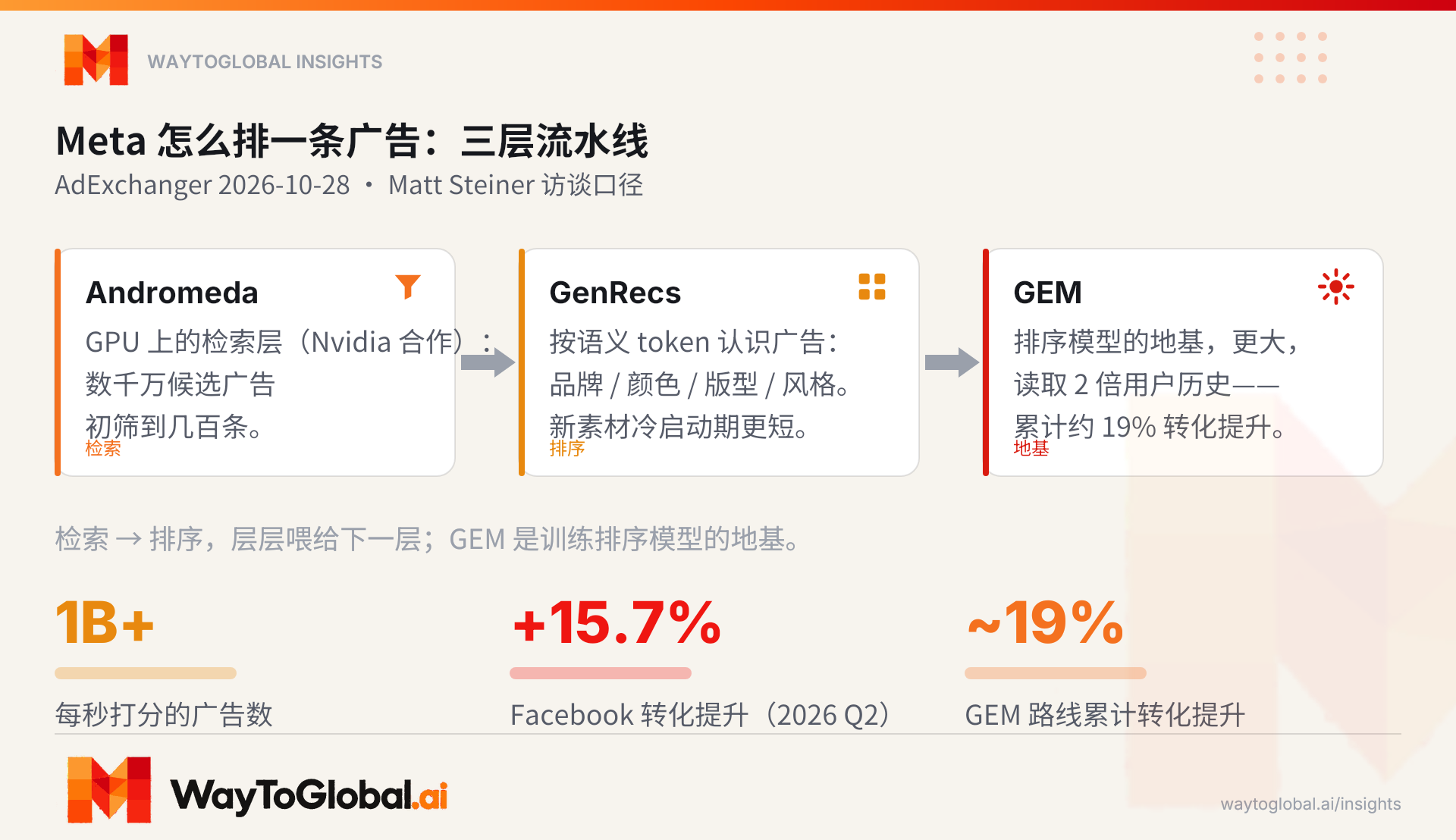
- Meta now scores 1B+ ads per second through three layers: GenRecs reads new ads as semantic tokens (shorter cold start), Andromeda retrieves on-GPU, GEM reads twice the user history (~19% conversion lift since last year).
- Targeting is depreciating: Meta's own VP says ranking models increasingly pick the audience. Value moves to creative supply, event plumbing and strategy.
- Three moves now: replace audience-pack time with a creative matrix, audit event return completeness, and track learning-phase length as your acceptance metric.
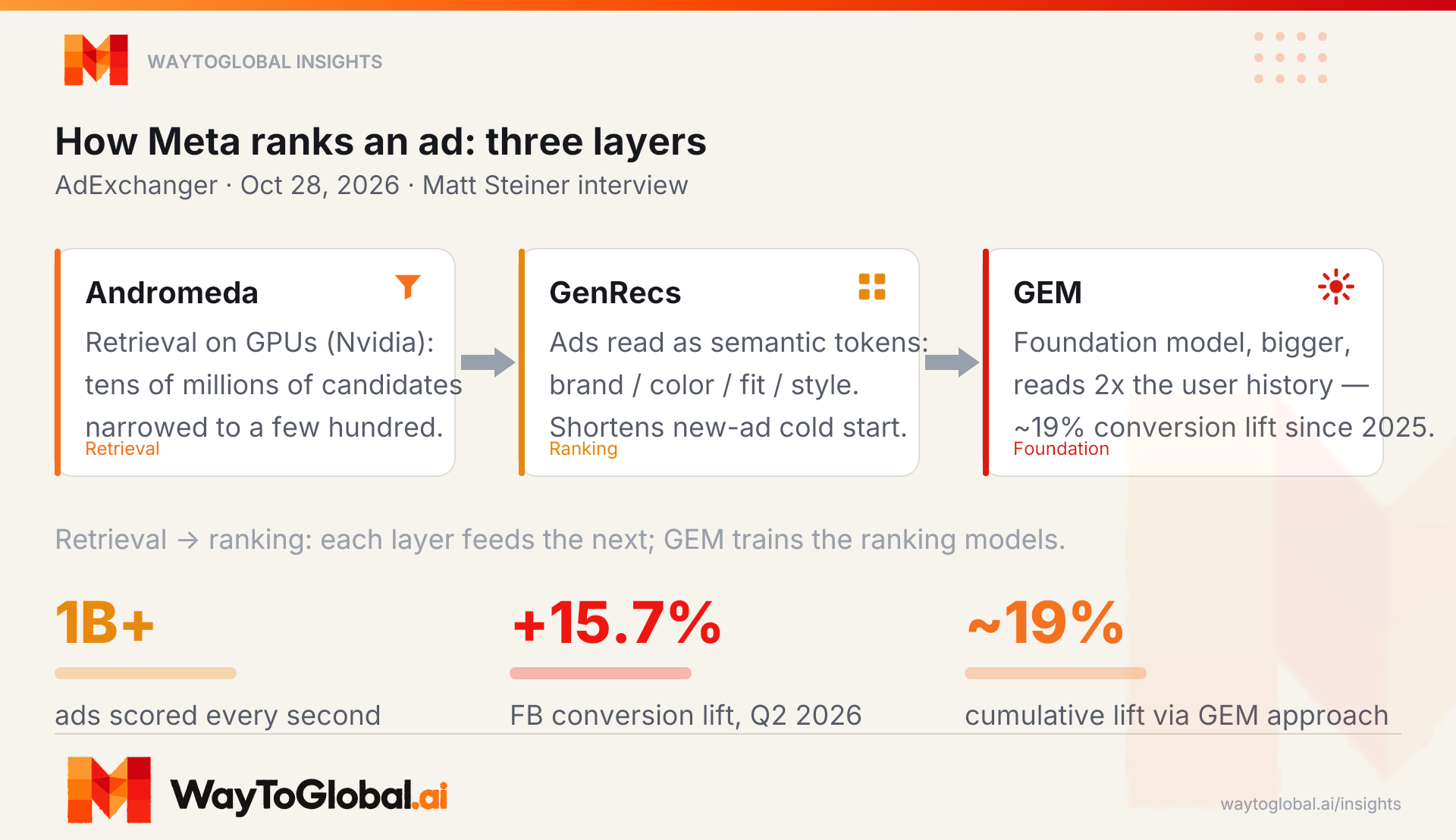
Meta swapped out the engine under its ads system. AdExchanger's October 28 report lays out the three layers: GenRecs, a new LLM-based ranking system; a hardware-and-software overhaul of the retrieval layer called Andromeda; and a bigger, longer-memory upgrade to GEM, the foundation model behind ranking. Advertisers need to change nothing to benefit — but the flip side of "nothing" is that the manual targeting craft you built in Ads Manager is being taken over by the system.
What each layer got
GenRecs: understanding ads by semantics. The old ranking tracked performance history tied to IDs — campaigns, creatives, products. New ads have no history, so cold start was slow. GenRecs instead uses an LLM to describe ads through shared semantic tokens — attributes like brand, color, fit and style — so the model understands a new ad by its concepts. It doesn't eliminate cold start, but it shortens the learning phase.
Andromeda: a hardware-level refresh of retrieval. Retrieval narrows tens of millions of candidate ads down to the few hundred worth bidding. Through Meta's Nvidia partnership, ad data now lives more on the GPUs themselves, cutting idle compute, and ads route to specialized "expert" models for smarter first-pass filtering.
GEM: bigger base model, twice the user history. GEM doesn't pick ads itself; it trains the surface-level ranking models. The new version is larger and reads twice as long a user history, improving interest predictions. Meta credits the GEM approach with roughly 19% conversion improvement accumulated since last year.
The scale: per impression, Meta filters tens of millions of candidates down to one, scoring over 1 billion ads every second. Q2 results on Facebook: 8.3% more clicks and a 15.7% conversion lift.
Targeting depreciates; the operator's value moves
Matt Steiner, Meta's VP of ads infrastructure, ranking and AI foundations, put it plainly: "The importance of targeting is diminishing over time as ranking models get better at selecting who an ad would be relevant for." The core agency craft — audience packs, interest stacks, lookalike tuning — is becoming an internal function of the system.
This is not Meta-specific; it is the shared direction of every large-model ranking platform. For DTC operators, value moves to three places. Creative supply: the system reads ads by semantics, so creative variety and concept coverage matter more than ever — the more concepts you feed it, the wider it can explore. Data plumbing: the ranking model eats what you send it, and the completeness of purchase/ROAS events now decides learning-phase speed and survival. Strategy: budget allocation, channel mix, margin constraints — the model doesn't manage your P&L.
Three changes to make now
First, stop stacking audience packs. Move that time into a creative matrix: multiple expressions of each selling point, multiple formats, multiple scenarios — give the semantic tokens material. Second, audit event return completeness; the new system's demand for clean inputs is only higher, and gaps cost more. Third, change your acceptance metric to learning-phase length: whether new creatives cold-start faster than last quarter is the most direct read on whether you're capturing this upgrade. For what a second engine looks like under the same logic, see our AppLovin AXON guide — a fully automated ranking system built on the same premise.
Sources: AdExchanger, "Meta Has A New Ad Ranking System Built On LLMs, Plus Upgrades To Andromeda And GEM" (Oct 28, 2026; Matt Steiner interview and Q2 figures); Meta Q2 earnings figures (click and conversion lifts). Platform-mechanics explainer — no proprietary campaign data.
Series — buying in the AI era: Google AI Mode ads entry · the pre-BFCM incrementality test.
Want your Meta account tuned for the new ranking stack?
Leave your category and current Meta performance — we'll come back with a concrete read on your creative matrix and event plumbing for the new ranking stack. Managed Meta buying is our main line.