30-second read
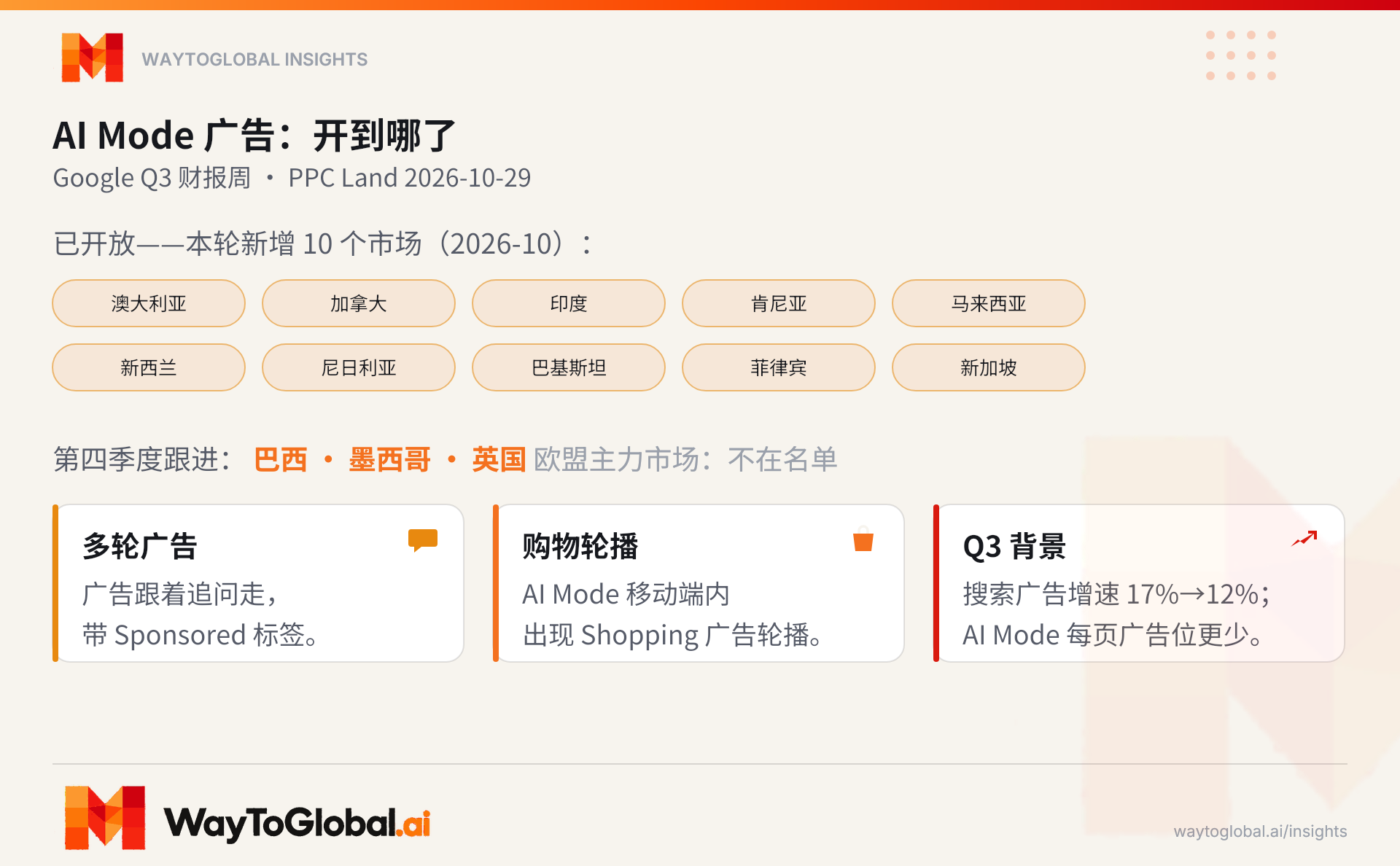
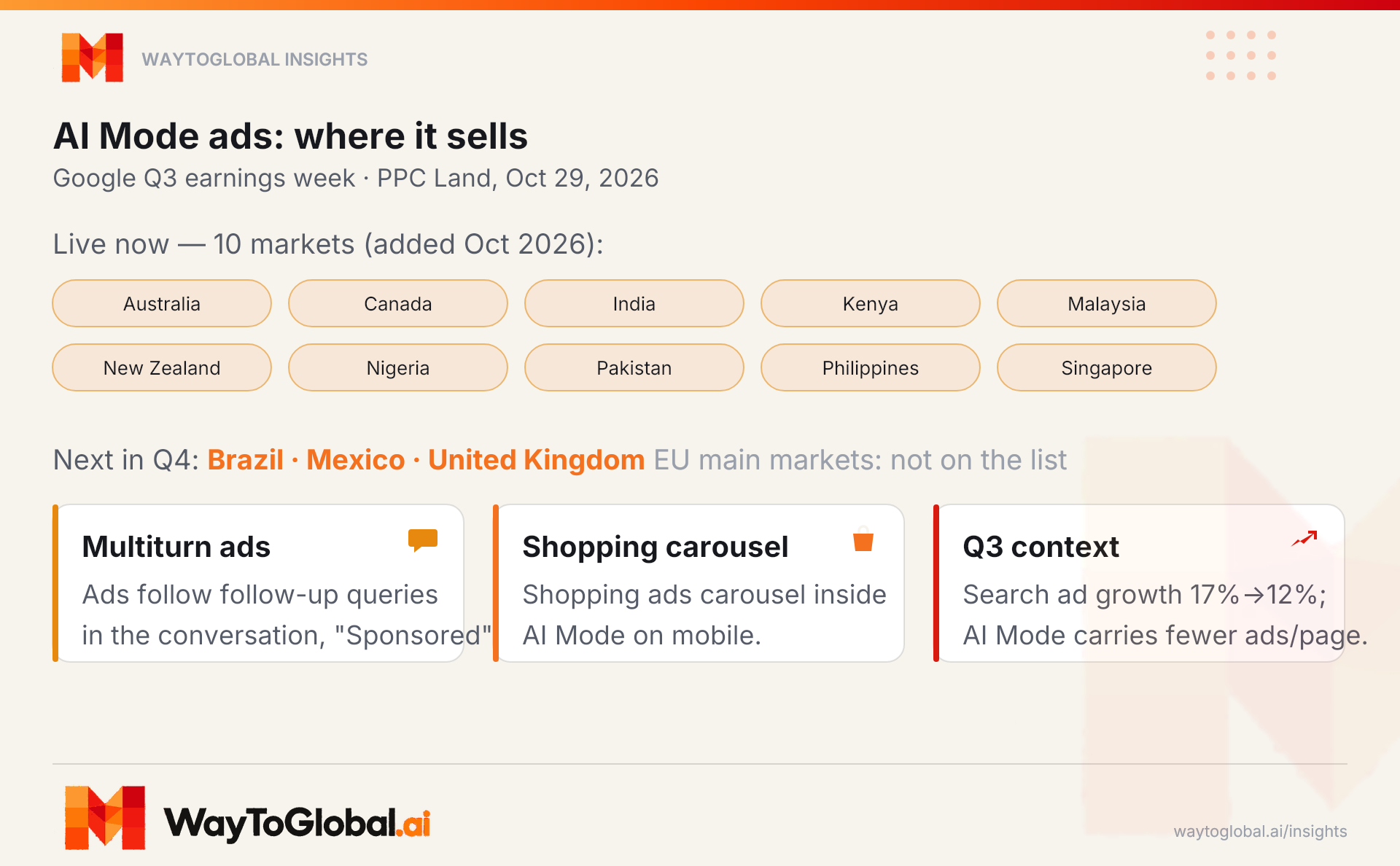
- AI Mode ads add ten markets (Australia, Canada, India, Kenya, Malaysia, New Zealand, Nigeria, Pakistan, Philippines, Singapore); Brazil, Mexico and the UK follow in Q4. EU main markets remain absent.
- Google monetization is expanding because AI Mode carries fewer ads per page — Q3 Search ad growth slowed to 12%, and AI Mode queries run 3x longer than standard searches.
- Your Shopping feed is the entry ticket: clean the Merchant Center feed, cover core markets with Shopping/PMax (no separate campaign type), and don't read "invisible in GA4" as "not working."
In its Q3 earnings week, Google pushed AI Mode's commercialization a big step forward: ads expand to ten more markets, "multiturn ads" launch in the US, and a shopping ads carousel is appearing inside AI Mode. The same earnings call also put an awkward fact on the table — AI Mode is growing fast, but each page carries fewer ads than a conventional results page, and that is slowing Search ad growth. Read together, these two facts are the full context for how DTC brands should enter AI Mode.
Where it expanded
AI Mode ads launched in the US in May 2025. The ten new markets: Australia, Canada, India, Kenya, Malaysia, New Zealand, Nigeria, Pakistan, the Philippines and Singapore. Three more follow in Q4: Brazil, Mexico and the United Kingdom. Most relevant for Chinese sellers: the EU's main markets are not on the list (the same gap as Merchant Center's AI share-of-voice report — EU is absent; the UK is on the Q4 follow-up list), so stores selling mainly into Europe can't take this position yet, while US-focused stores already can.
Two new formats matter. Multiturn ads: ads that appear on follow-up queries inside an ongoing AI Mode conversation, labeled "Sponsored" — the ad follows the dialogue. Shopping ads carousel: already showing inside AI Mode on mobile. Google also offered a notable claim: within AI Mode, click-through rates on sponsored and organic product items are "already similar."
The other side of the earnings call
Q3 numbers: Alphabet revenue $127.6B (+25%); ad revenue about $82B (+10.5%, below expectations); Search ads $63.4B, with growth slowing to 12% from 17% in Q2. Chief business officer Philipp Schindler blamed part of the slowdown on AI Mode — "growing fast and carries fewer ads than a conventional results page." CEO Sundar Pichai added that AI Mode queries are on average three times longer than standard searches.
Read together with the expansion, Google's path is clear: if AI Mode is absorbing queries with fewer ad slots per page, then open more markets, push ads into the conversation's follow-up turns, and bring the shopping carousel into AI Mode — compensating "fewer per page" with "more surfaces." For advertisers, AI Mode ad supply is expanding quickly; early accounts accumulate data in a thin auction.
How DTC enters
Shopping ads in AI Mode draw from your product supply — your Shopping feed is the ticket in. Three steps. First, audit the Merchant Center feed: titles, attributes, categories, price and inventory accuracy are the precondition for being selected into the carousel. Second, make sure standard Shopping and Performance Max cover your core markets — AI Mode shopping slots pull from these campaigns; there is no separate "AI Mode campaign type" to create. Third, watch the measurement gap — AI Mode attribution in GA4 is still maturing; don't read "can't see it" as "not working." As for whether the position is worth taking, Adobe's measurement is the scale: in September 2026, AI-referred traffic generated 83% higher revenue per visit and converted 90% better than non-AI traffic — the largest gap Adobe has recorded this year, across a methodology covering 1 trillion+ US retail visits and 100M SKUs. For a systematic way to measure your own share, see our AI search visibility guide.
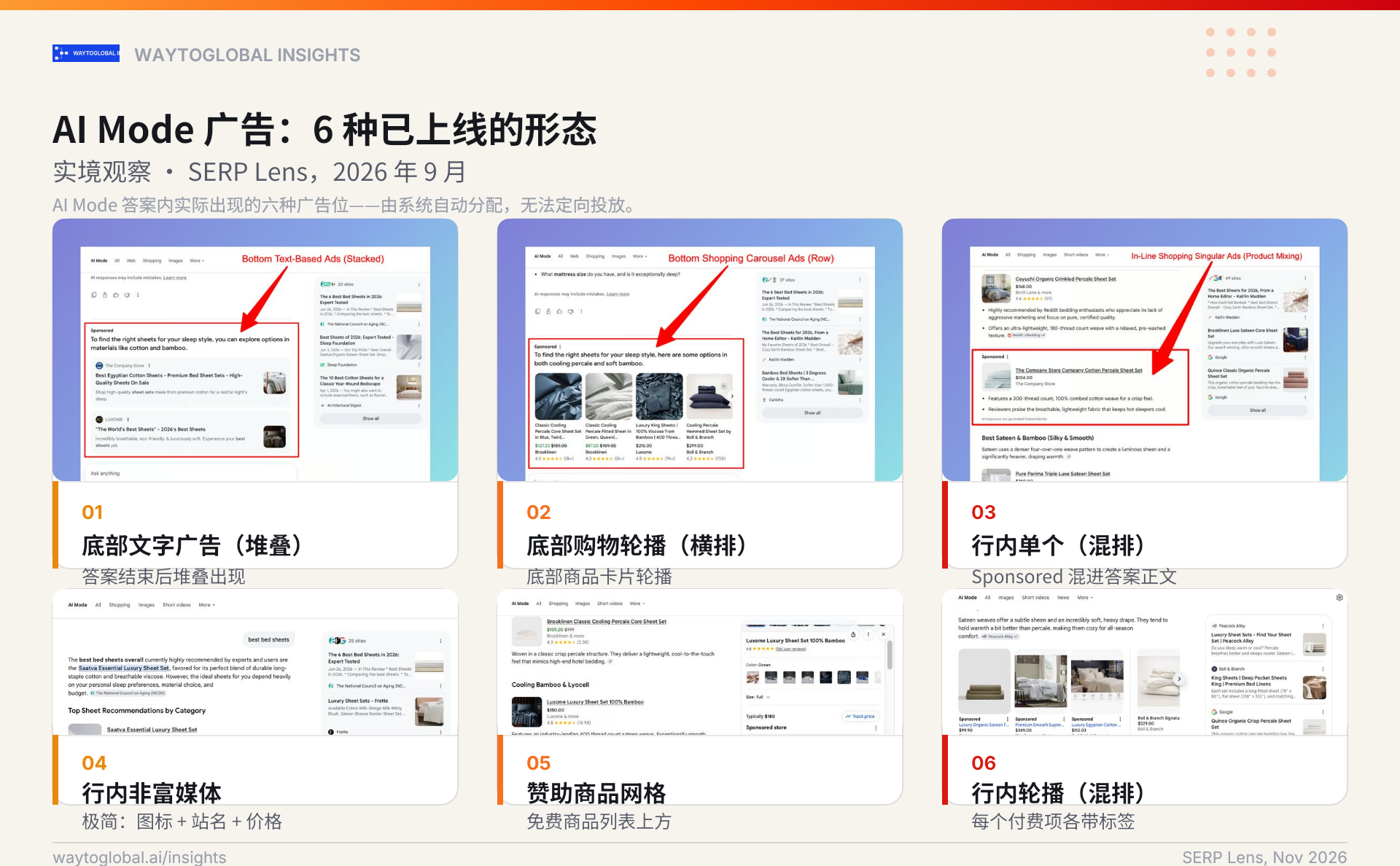
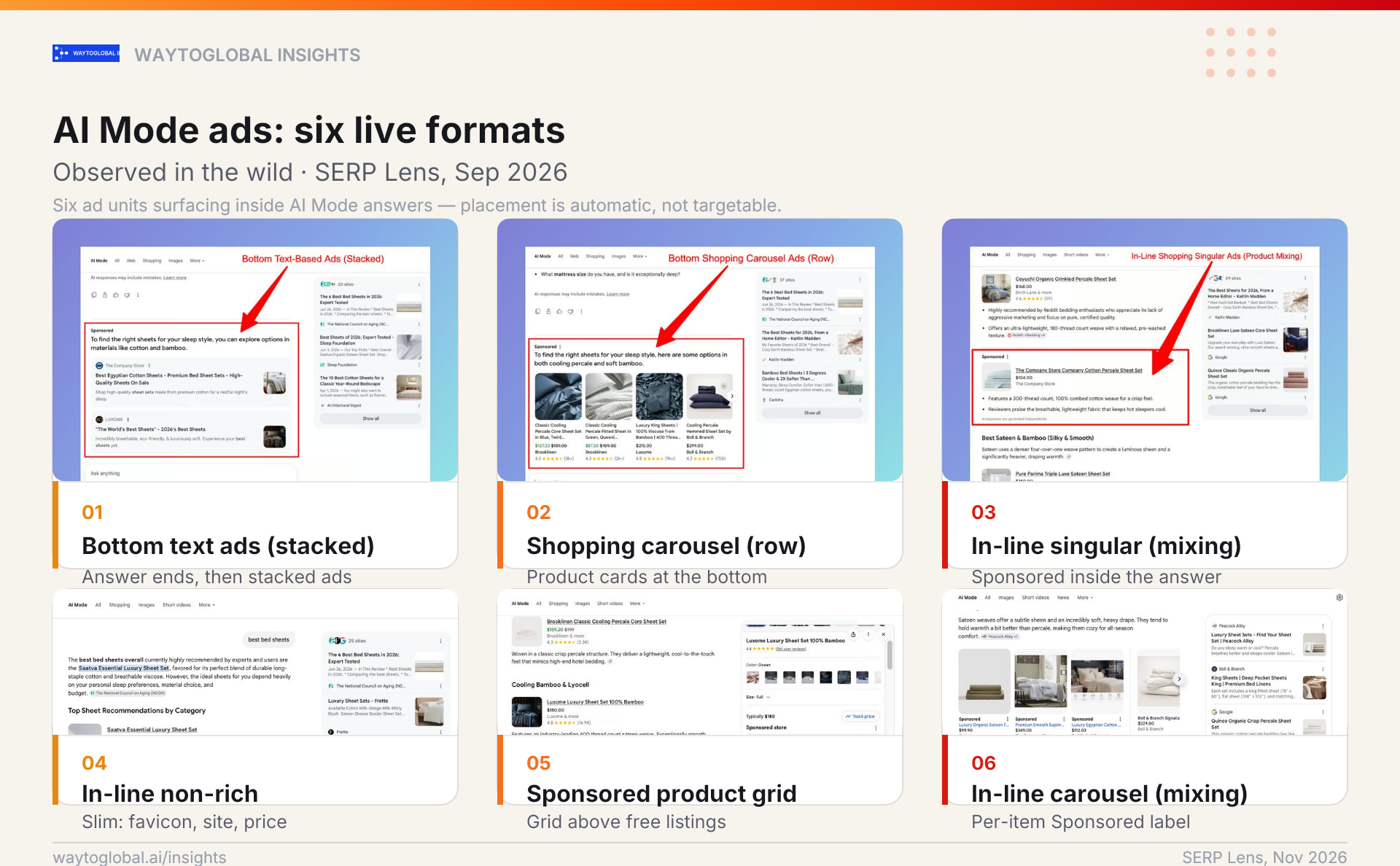
Six ad units are now surfacing inside AI Mode answers. The two "bottom" units sit below the answer: stacked text ads for non-product URLs, and a shopping carousel for product URLs. The four in-line units sit inside the generated answer — a single sponsored product mixed among organic listings, a slim non-rich line near the top, a sponsored product grid above free listings, and an in-line carousel where each paid item carries its own "Sponsored" label. That last group is the one to watch: the ad borrows the exact typography of the organic result it sits beside, so it reads like a recommendation until you look for the label. Placement is automatic — there is no AI Mode targeting, and no way to block your ads from it. Reporting is still folded into AI Max for Search rather than split out by surface.
Sources: PPC Land, "Google's ad growth slows to 10.5% as AI Mode ads go to 10 more markets" (Oct 29, 2026; Alphabet Q3 figures and Schindler/Pichai comments; expansion reporting by Barry Schwartz / Search Engine Roundtable); Adobe AI shopping data (Oct 29, 2026, via Retail TouchPoints: 1T+ visits, 100M SKUs, 18 categories). No proprietary campaign data.
Series — buying in the AI era: Meta's LLM ranking rewrite · the pre-BFCM incrementality test.
Is your feed ready for the AI Mode shelf?
Leave your category and target markets — we'll audit your Shopping feed for AI Mode readiness and tell you what's missing. Google Shopping and PMax managed buying is our main line.