30-second read
- Last-click mis-ranks channels: coupon partners at 21x ROAS lost to content partners (8x) on new-customer acquisition — position in the buying path decides who gets credit.
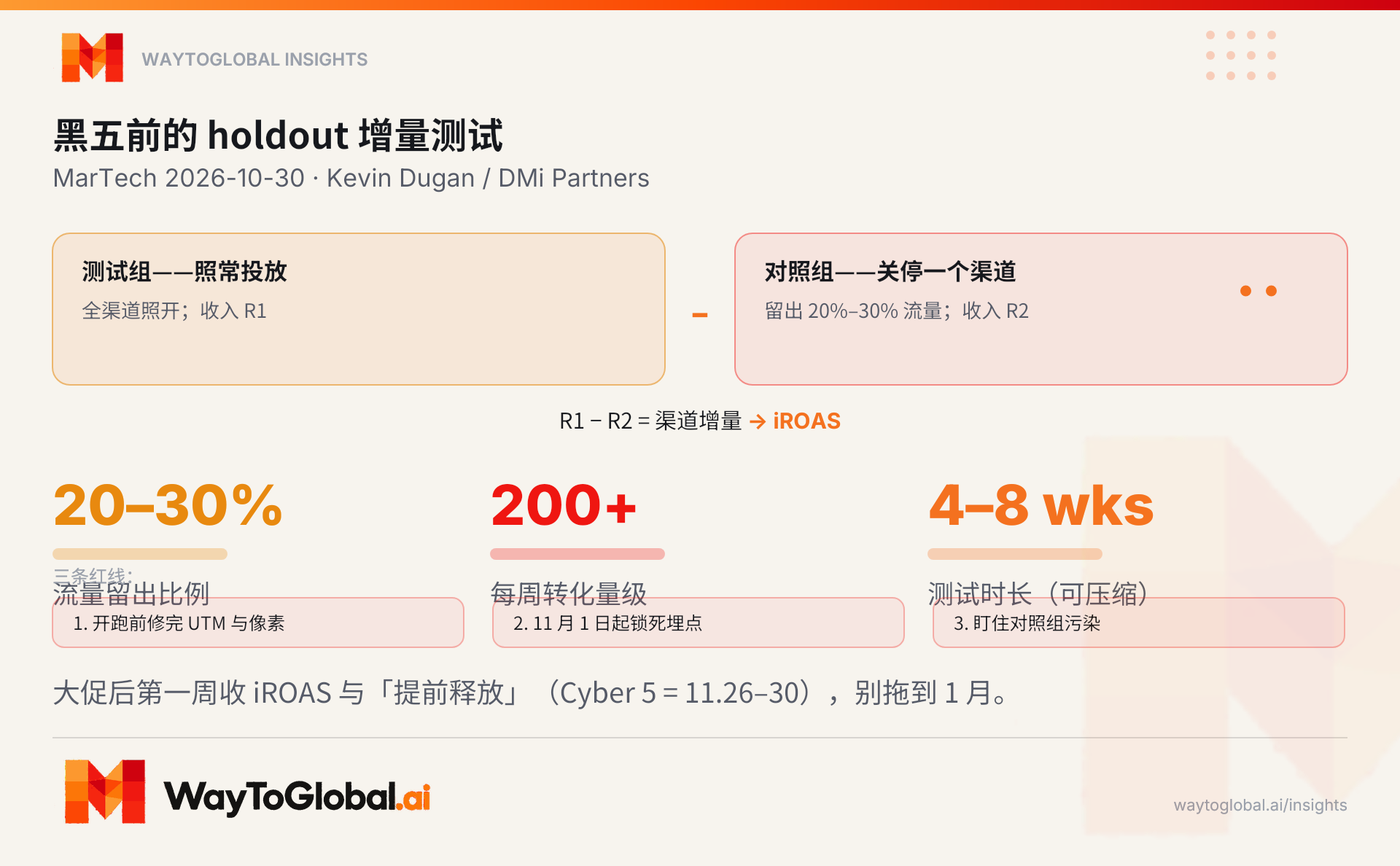
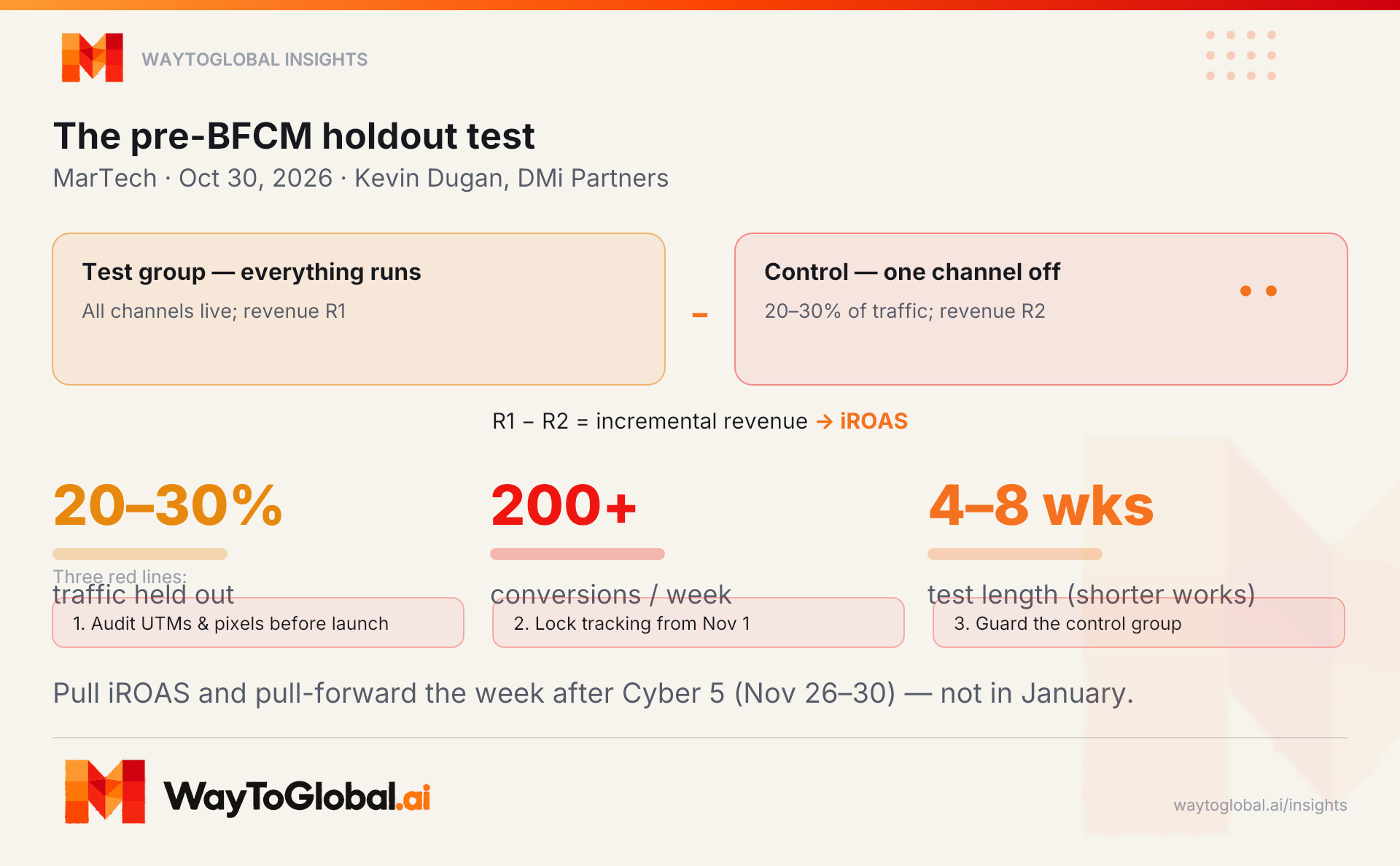
- Holdout parameters: turn one channel off for 20-30% of traffic, 200+ conversions per week, 4-8 weeks; geo holdouts for affiliate, audience/code for closed-loop, code/geo for creator.
- Three red lines: audit UTMs/pixels before launch, lock tracking Nov 1, watch the control group (rising direct traffic with flat brand search = contamination). Read iROAS and pull-forward the week after Cyber 5.
Cyber 5 — Thanksgiving through Cyber Monday, November 26–30 this year — typically drives more than a fifth of November–December revenue: 21.5% in DMi Partners' client benchmark, on a Cyber Week 2025 that hit a record $44.2B in US online spending (Adobe). The weeks before the peak are the last window of the year to run an incrementality test on your channels. Once the peak starts, every channel fires at once and you can no longer tell which dollars were earned. The practical playbook MarTech published on October 30 is worth translating for DTC brands.
Why last-click lies to you
The sharpest example in the piece: a brand's coupon-affiliate partners showed a 21x ROAS while content partners showed 8x — yet when ranked by new-customer acquisition, the content partners won. The reason is position in the buying path: content and PR show up early in the journey, so last-click under-credits them; coupons show up at the door, so they over-credit themselves. Budget by ROAS alone and money keeps flowing to whichever channel is best at grabbing credit.
How a holdout test works
One sentence: turn a channel off for part of your audience while the rest stays exposed; the revenue gap between the two groups is that channel's incremental revenue. If sales barely move when a channel is off, its reported revenue would have happened anyway.
The parameters: hold out 20–30% of traffic, aim for 200+ conversions per week, run 4–8 weeks — a shorter test still yields usable signal. Pick the design by channel: geo holdouts for affiliate; audience or code holdouts for closed-loop programs; code or geo tests for creator marketing that settles off-pixel (TikTok Shop, Amazon).
Timing and the red lines
The ideal schedule started the last week of October and reads out around November 23, in time to act before the peak. Starting now means a compressed version: pick the single most suspect channel (usually coupons/rebates), run a 2–3 week geo holdout, and take a directional answer — better than nothing.
Three red lines, verbatim. Audit before you launch — fix links, UTMs and pixels first; "you can't fix broken UTMs once a test is running." Lock tracking on November 1 — tag changes mid-test void the data. Guard the control group — if direct traffic rises in paused markets while brand search stays flat, the control is contaminated (a coupon leaking through group chats, for example); deal with it on the spot.
Readout and usage
Pull the data the week after Cyber 5, not in January. Two things to read: incremental ROAS (iROAS — test-group revenue minus control revenue, divided by spend, with groups scaled to equal size) and pull-forward — existing customers moving December purchases into the peak, revenue that shifted in time rather than grew. The closing principle deserves to be a standing rule: every test finding lands as a budget line, an owner, or a follow-up test; and commissions should reward new-customer acquisition, not last-click numbers. To clean up your attribution picture first, see our chatgpt.com referrer guide; for what to measure on AI channels, the visibility guide has the framework.
Sources: MarTech, "How to test incrementality before peak spending starts" (Oct 30, 2026; Kevin Dugan, DMi Partners: holdout parameters, channel designs, audit red lines, iROAS definitions); Adobe Cyber Week 2025 spending figure ($44.2B, as cited therein). Methodology breakdown — no proprietary client data.
Series — buying in the AI era: Meta's LLM ranking rewrite · Google AI Mode ads entry.
Want a holdout test that reads out before Cyber 5?
Want a holdout test designed and run before the peak? Leave your category and channel list — we'll come back with a test plan that reads out before Cyber 5.