30-second read
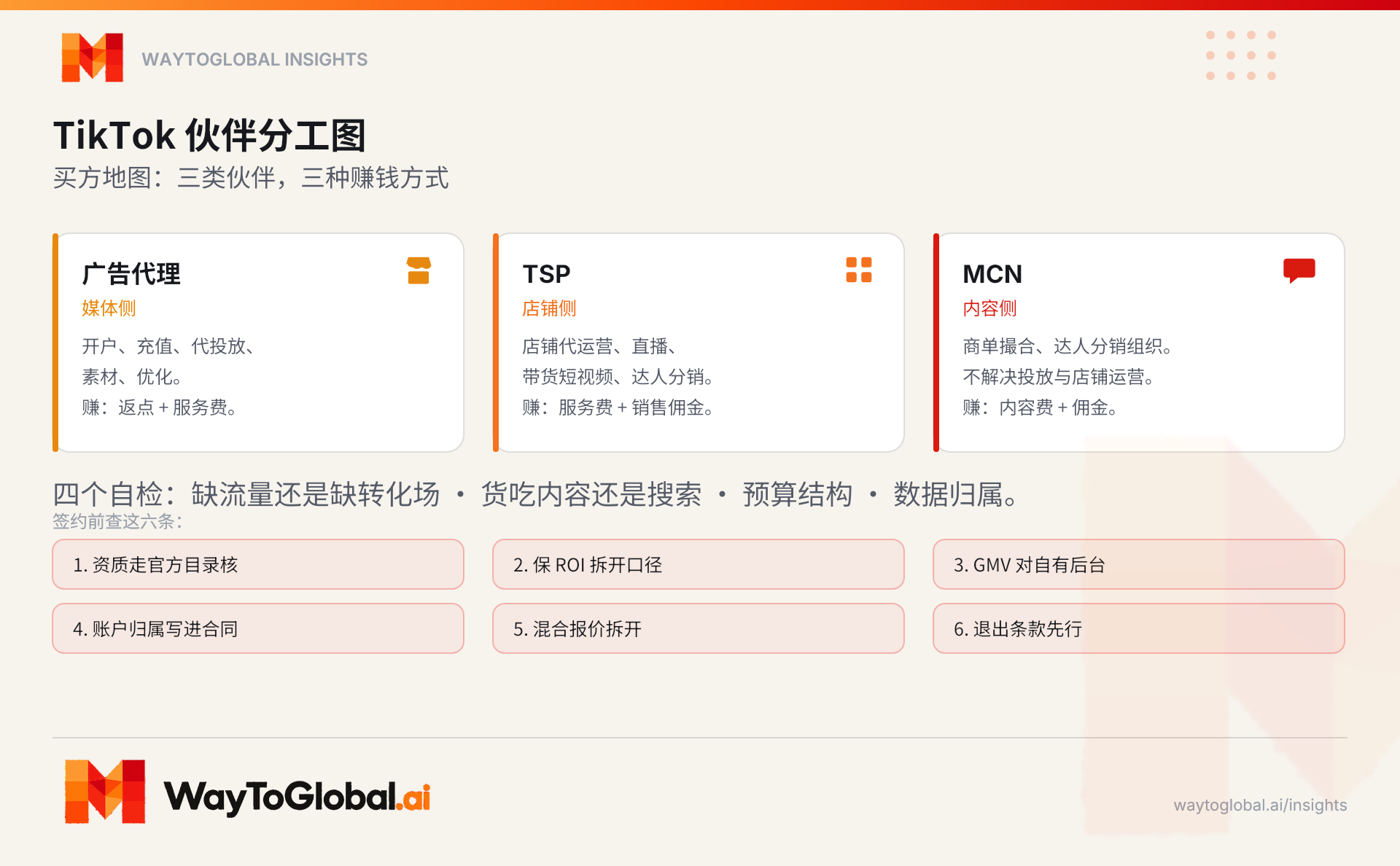
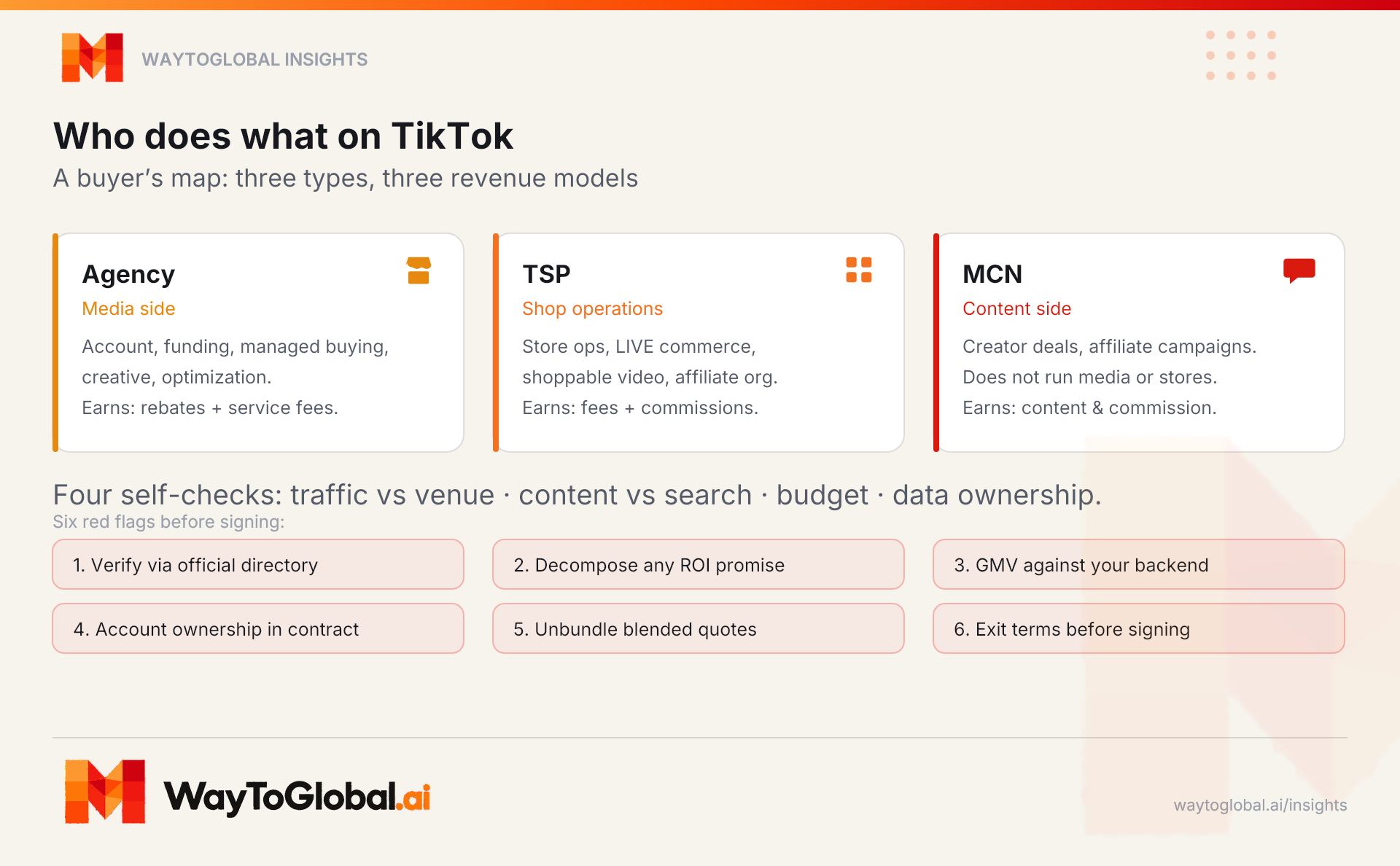
- The three partner types earn differently: agencies on media (rebates + fees), TSPs on shop operations (fees + commissions), MCNs on content — pick by the problem you actually have.
- Four self-checks: traffic or conversion venue, content-fit vs search-fit product, budget structure, and data/asset ownership.
- Six red flags: unverifiable credentials, ROI guarantees that cannot be decomposed, self-reported GMV, murky account ownership, blended quotes, missing exit terms.
TikTok Agency or TSP: Where the Difference Actually Sits
TikTok Agency or TSP: Where the Difference Actually Sits
Start with the thing that trips people up. TikTok splits its partner ecosystem into several categories; in English-language circles they collapse into one pile — agencies, TSPs, service providers, resellers, MCNs. Most buyer confusion starts there, because the names sound similar while the money comes from completely different places.
Agencies earn on the media side. TSPs earn on running the shop. Creator agencies earn on the content side. Picking the wrong type doesn't just cost you more money — it means nobody ever picks up the problem you actually brought them.
Three partner types, three revenue lines
Ad agencies (Agency)
Get the vendor comparison checklist
The six red flags and four self-checks as a tick-box sheet — run every candidate through it before you sign.
Only used to send the checklist. One touch, no spam.
Got it — download the checklist.
work the TikTok for Business media side: account opening, funding, managed buying, creative, optimization. Their revenue is platform rebates plus service fees. The question they answer is "where should my ad budget go, and how do I make it stretch further."
Three things separate a good one from a bad one. Whether credentials check out in TikTok's official partner directory — skip anyone whose pitch is "we have connections inside." Whether the strategist understands your business: with your margin structure on the table, can they explain how they'd bid under that constraint. And data discipline: when the platform backend and your own backend disagree, how do they explain it.
TSPs (TikTok Shop Partners)
work the store side: store operations, LIVE commerce, shoppable video, organizing creator affiliate distribution. Revenue is service fees plus sales commission. The question they answer is "how do I actually sell on TikTok Shop."
Three things to check. Cases they've actually run in your category (not "we've done many categories"). Whether the creator network is real — can they name people, can they produce collaboration records (not one line about "massive creator resources"). And whether the LIVE team is in-house or subcontracted.
Creator agencies / MCNs
work the content side: brand deal brokering, organizing affiliate programs. They answer "who says nice things about my product."
One company often promises all three. Few genuinely do all three. Which ones they're genuinely strong at matters more than whether they claim they can do everything.
Four questions to ask yourself first
Do you lack traffic, or lack a place to convert it? Own a site and need new customers — agency first. Attacking on-platform TikTok Shop sales — TSP first.
Which path fits your product? Visually striking, impulse-buy categories ride content distribution first. High-AOV, comparison-heavy categories need search and storefront support, or the spend goes nowhere.
Which budget structure can you live with? Ad spend is controllable and stoppable. Commission ties to sales but eats margin. When you see a "low service fee" rebate agency, work out the hidden cost inside the rebate structure first.
Who owns the data and the assets? The business account, the follower base, the creator relationships, the creative library — write down who owns all four in the contract. Don't rely on "we'll sort it out later."
Six checks before signing
Verify credentials in the official directory, not from screenshots — for both agencies and TSPs. When someone promises to guarantee ROI or GMV, break it into three questions: which metric, which attribution window, what happens if they miss it. A promise that can't be written into the contract doesn't exist.
Reconcile every self-reported GMV number against the backend: have them run the numbers from an account you've authorized, and when platform data and third-party screenshots conflict, platform data wins. Get clarity on account ownership — whose business license opened the entity, whose Business Center holds the ad account. It determines what you walk away with.
Get quotes unpacked: service fee, commission, rebate, creative production, itemized separately. Bundled pricing usually hides an area nobody wants to explain. Write the exit terms early: how the engagement ends, how data gets handed over. For the "see the numbers before committing" version of this, the "demand a baseline first" approach in our GEO agency guide applies just as well.
Sources: TikTok for Business official partner taxonomy (Agency/TSP/marketing-partner categories, per ads.tiktok.com); the selection framework is WayToGlobal's working framework. Disclosure: WayToGlobal runs managed overseas media buying; the bar applies to the whole market, including us.
Related: the GEO agency buyer’s guide · the BFCM calendar.
Want a straight answer on which partner type you need?
Not sure whether you need an agency, a TSP, or both? Leave your category and current setup — we'll give you a straight answer, even if it's not us.