30-second read
- A working definition: a DTC global expansion agency owns the whole "enter new markets" job — not ads, not localization, not operations alone.
- It separates from four neighbors: US growth agencies, China-inbound agencies, TP operators, translation vendors — each optimized for something else.
- Choose with the eight questions (assets, compliance, pricing incentives, data ownership); the 2026 US and EU rule changes are why the category now exists.
Your DTC brand works at home, and the next move is a second country market. So you search for the thing that should exist: a "DTC global expansion agency." On October 27, 2026, we ran that exact search. The front page was a different world — listicles and directories of US domestic DTC marketing agencies, plus a Tampa IT and management consulting firm that happens to be called DTC Global Services. Even the closest-looking hit — New Engen's Best Agencies for DTC Brands Expanding Into Retail (2026-10-14) — is about moving online brands into offline retail channels, not new country markets. An evening re-run on a different search engine put one definition-grade long article on DTC international expansion in the front rows (attnagency's 2026 guide, 2026-03-21) — the route already has early walkers. Search the neighboring phrase "China cross-border ecommerce agency" and the front rows are dominated by China-entry guides and service pages helping foreign brands sell into China; we opened one of them, ecommercechina.agency, whose lead offer is "Sell in China through cross-border e-commerce, without a local entity."
Plenty of companies do this work — the Chinese-language market calls them overseas-expansion service providers, and the English-language world scatters them across service pages. Many of them put "entering new country markets" right in the title, but read the service lists and the deliverables concentrate on media buying, storefront builds, and content; the market-entry milestones — compliance going live, first orders, the fulfillment switch — rarely appear in anything anyone signs. The seat accountable for market entry itself is mostly unclaimed. On the Chinese-language side, the same day's two searches tell the same story: the morning run surfaced storefront builders, store operators, and independent-store SaaS tools, with methodology content mostly from 2021–2023 and no AI-native end-to-end provider in that front row; by evening the front rows had turned over to EastDigi's long-form guide, ai-chuhai, and other content sites and going-global service pages. This article proposes a working definition, separates it from four neighbors it gets mistaken for, and offers a selection framework you can put to any provider — the definition is ours, not an industry standard.
What Is a DTC Global Expansion Agency?
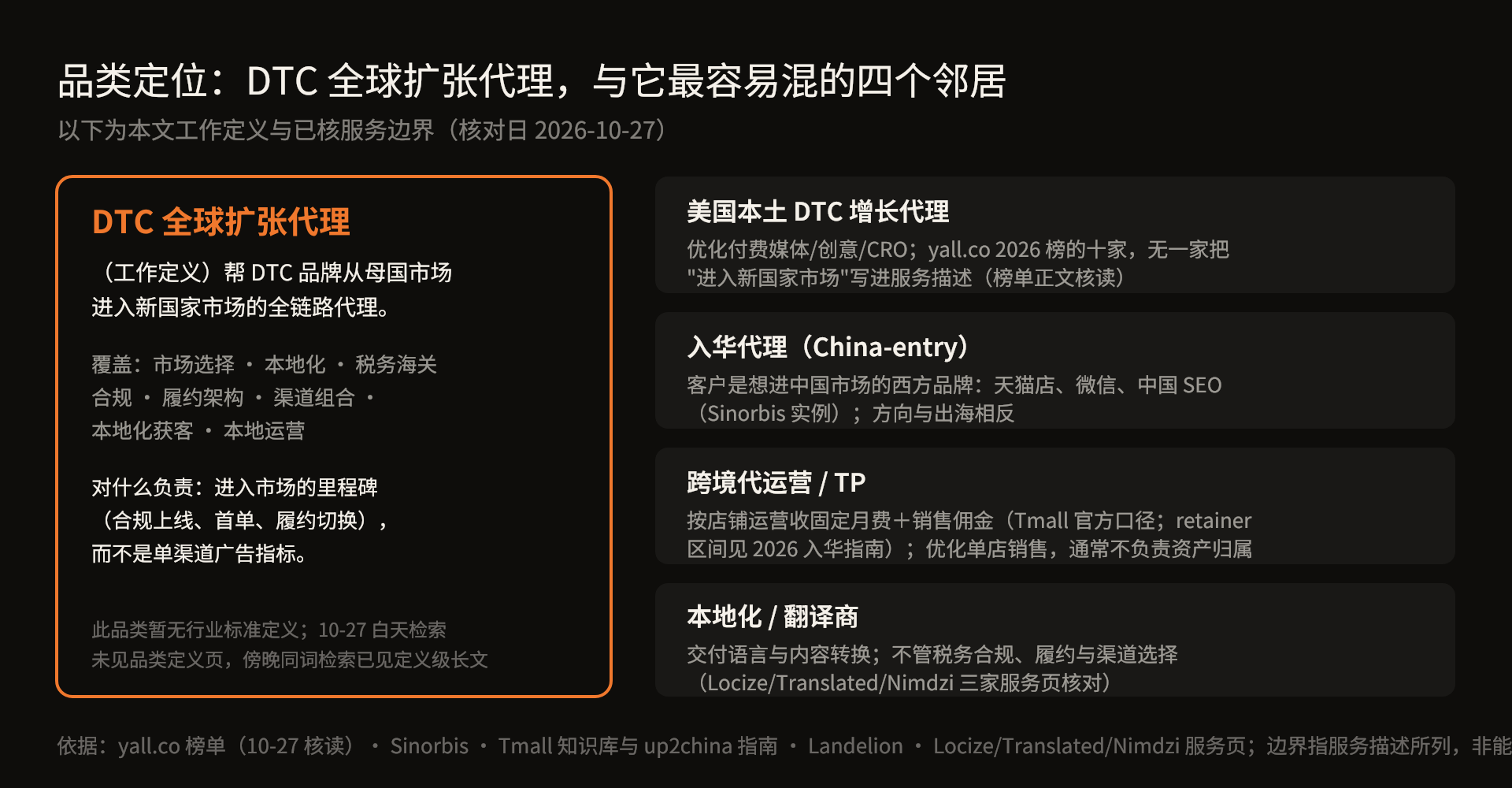
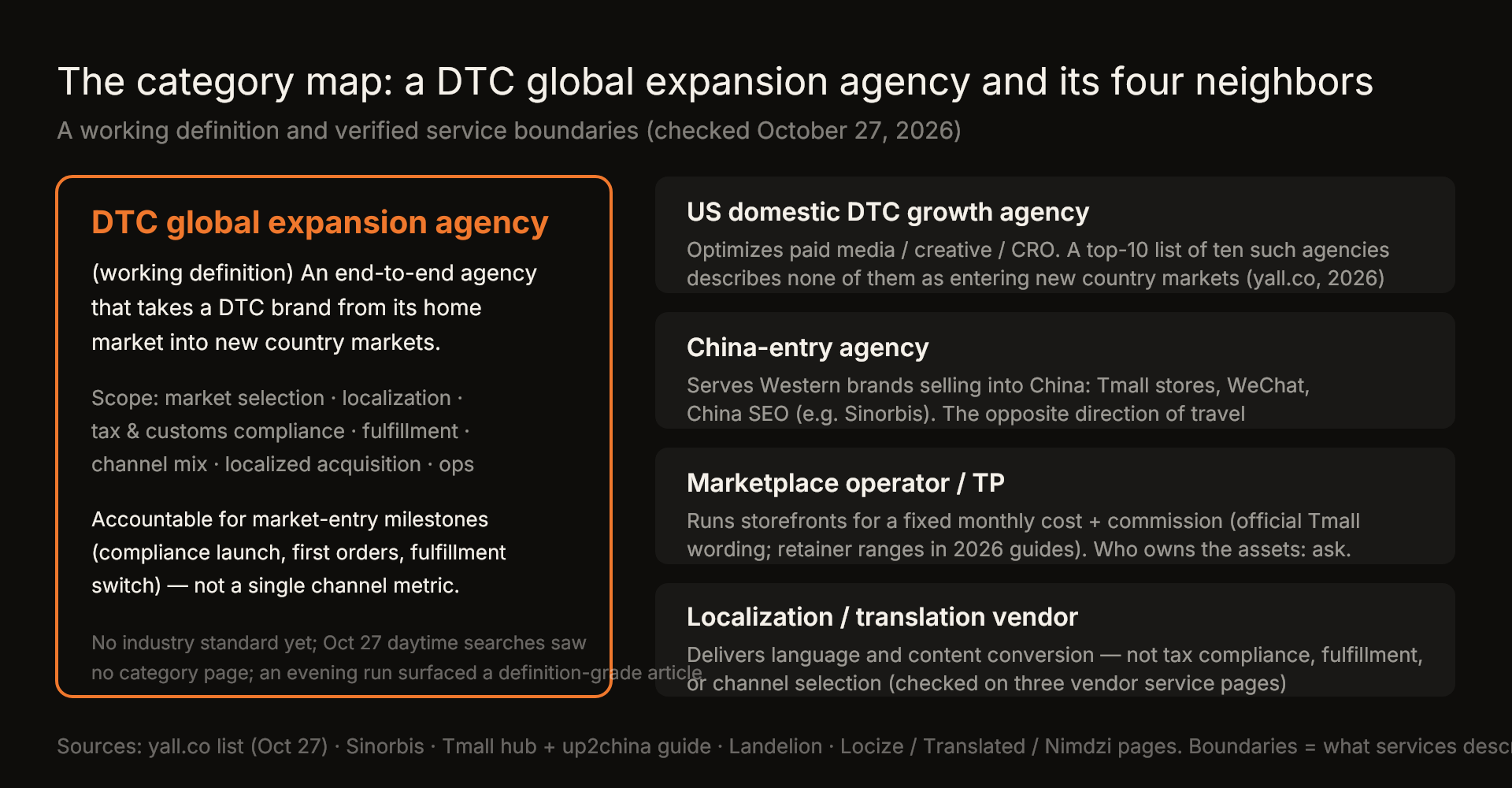
A DTC global expansion agency is an end-to-end agency that takes a DTC brand from its home market into new country markets. Its scope covers market selection, localization, tax and customs compliance, fulfillment architecture, channel mix (owned store plus marketplaces), localized customer acquisition, and local operations. And it is accountable for market-entry milestones — compliance going live, first orders, the fulfillment switch — rather than a single channel's ad metrics.
Two phrases in that definition do real work. "End-to-end" rules out providers that only cover one layer — media buying, storefront setup, translation. "Milestones" means the contract can name an owner for each stage: who is responsible for compliance going live, and who backstops a stalled fulfillment switch. A media agency never has to answer those questions. An expansion agency does.
The DTC scope is deliberate, too. When a brand owns its storefront, pricing, and customer data, entering a market pulls in a whole chain of decisions — tax, fulfillment, channels, acquisition. A marketplace seller gets part of that chain absorbed by platform mechanics (EU platforms typically collect VAT as deemed suppliers — a mechanism we've verified only at search-summary level, not in the source texts — though product-ID data still falls to the seller); a DTC brand owns the whole chain. That's a different category.
How It Differs From Four Neighbors
Each of these neighbors is a real, mature business. The cost is in mistaking one for the thing you need.
| Neighbor | Typical client | What it optimizes | What it doesn't own |
|---|---|---|---|
| US domestic DTC growth agency | DTC brands in their home market | Paid media, creative, CRO, retention, SEO, influencers | Entering new country markets |
| China-entry agency | Western brands selling into China | Tmall stores, WeChat, China SEO | Chinese brands going out |
| Marketplace operator (TP) | Brands and factories | Single-storefront sales | Asset ownership, multi-market architecture |
| Localization / translation vendor | Brands with multilingual content needs | Language and content conversion | Tax compliance, fulfillment, channel selection |
We read the yall.co Top 10 DTC Growth Agencies in 2026 list agency by agency. The ten — Y'all, Common Thread Collective, Darkroom, Structured, NoGood, Power Digital, Pilot House, Wpromote, Tinuiti, Forge — describe paid media, creative, retention, CRO, SEO, influencers, and marketplace management. Not one describes entering a new country market. That doesn't mean they can't run international campaigns. It means the capability a listicle showcases and the capability you need are different things: hire a growth agency for an expansion job and the media layer has an owner while compliance, fulfillment, and asset ownership don't.
Sinorbis, which surfaces for China-related agency searches, serves universities and B2B firms marketing into China — the opposite direction of travel. Per the Tmall Global knowledge hub, a TP (Tmall Partner) is a professional services firm in China that operates stores for merchants; the official fee wording is "a fixed monthly cost and a sales-based commission," and a 2026 China-entry guide is more specific — $3,000–$8,000/month in retainer plus a 5–15% revenue share. That structure rewards storefront sales; who owns the domain, the store, and the data is a question nobody answers unless you ask. On the translation side, we checked the service pages of three vendors — Locize, Translated, and Nimdzi: all three deliver language and content conversion; tax compliance, fulfillment, and channel selection appear on none of their service lists (Nimdzi also runs international market research).
Why the Category Is Separating Out in 2026
Before 2026, you could enter a market in stages: ship direct, learn, then add compliance and local fulfillment. This year, tax rules on both sides of the Atlantic closed that sequence.
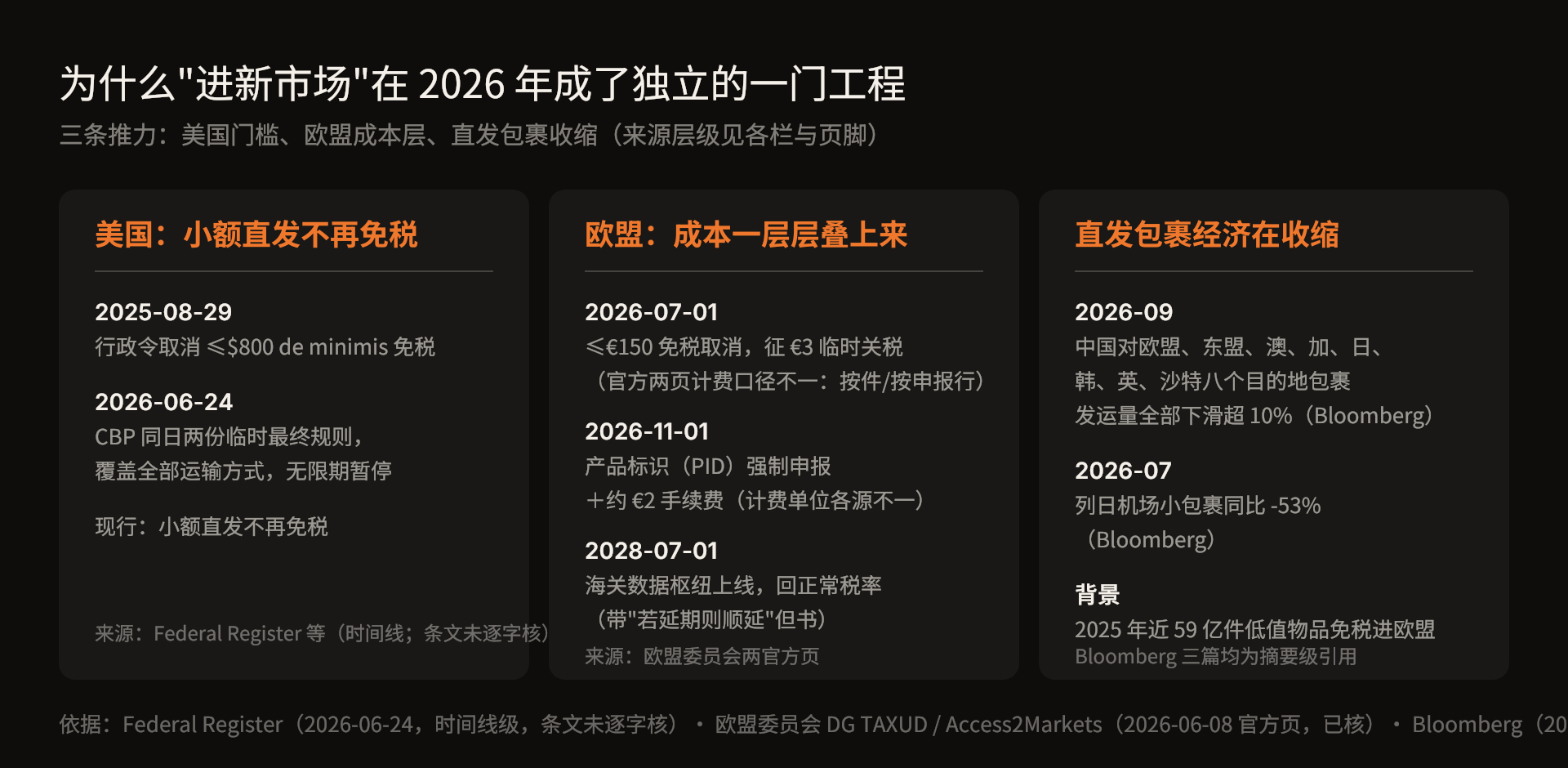
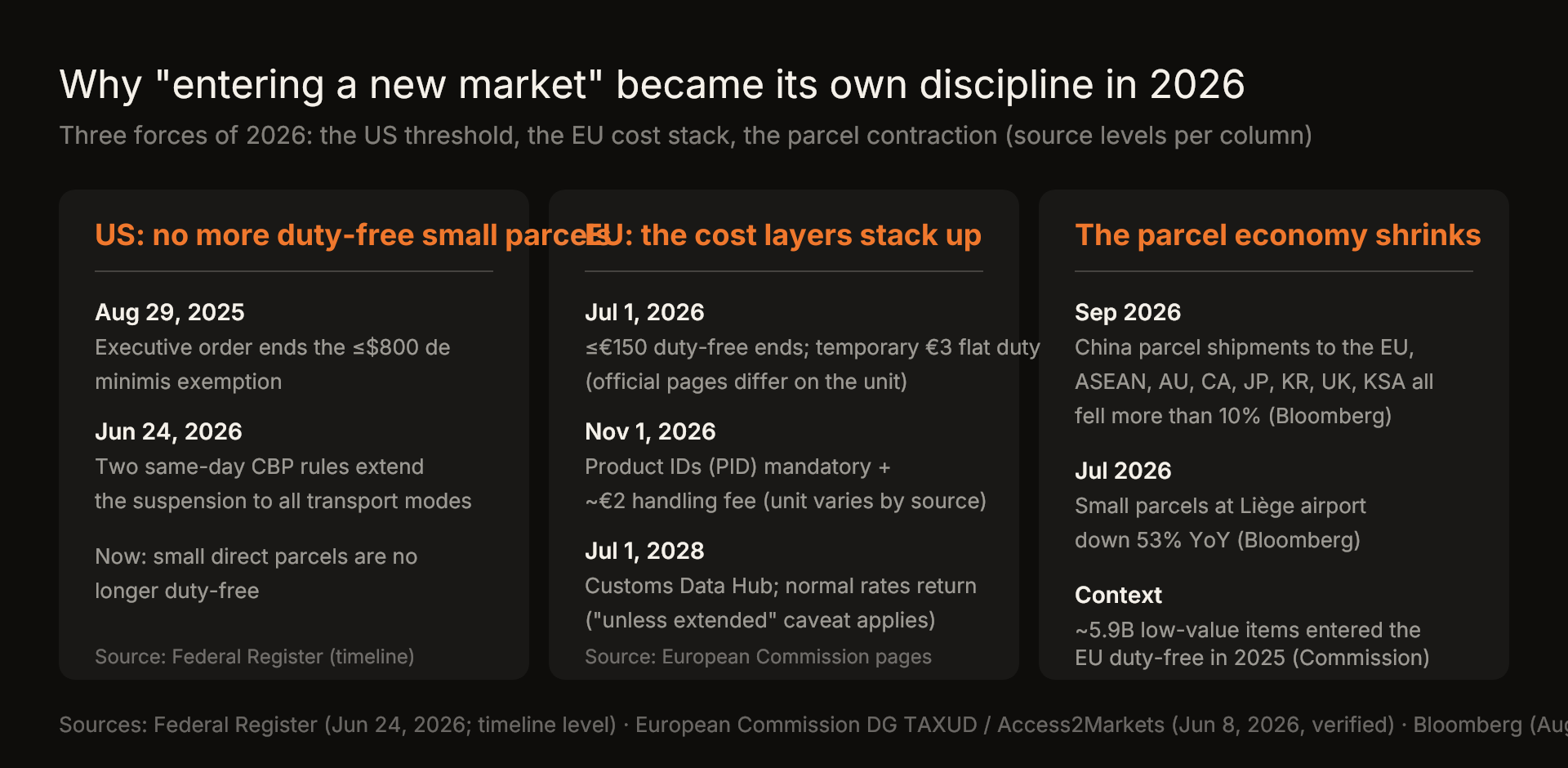
The US removed the small-parcel loophole. The $800 de minimis exemption ended by executive order in August 2025, and on June 24, 2026, two same-day CBP interim final rules extended the suspension indefinitely across all transport modes. The duty-free lane for small direct parcels is closed.
The EU stacked costs on direct shipping. Since July 1, 2026, the ≤€150 duty-free threshold is gone and low-value consignments carry a temporary €3 flat customs duty (the Commission's own two pages differ on whether it applies per item or per declaration line; normal rates return when the customs data hub goes live on July 1, 2028, unless extended); from November 1, product identifiers become mandatory and a roughly €2 handling fee arrives. We documented the full stack — including where official and carrier sources disagree — in our EU customs checklist.
The parcel economy is contracting. Bloomberg's October 23 newsletter — paywalled; the figures below come from search-result summaries, not the opened text — reports that China's September parcel shipments to the EU, ASEAN, Australia, Canada, Japan, South Korea, the UK, and Saudi Arabia all fell more than 10%. Small parcels at Liège airport dropped 53% year-over-year in July (also summary-level). For scale: per Reuters, more than 90% of sub-€150 shipments entering the EU in 2024 came from China, and per the European Commission, nearly 5.9 billion low-value items entered the EU duty-free in 2025. Goldman Sachs estimates — via Bloomberg — that the EU's measures threaten about 27% of China's annual exports to the bloc (also summary-level; we could not open the article).
The demand side is not small. China's cross-border e-commerce totaled ¥2.63 trillion (about $362 billion) in 2024, up 10.8% per customs data, with more than 120,000 cross-border e-commerce business entities per Ministry of Commerce data (both reported via China Daily).
There's a precedent for how a category like this forms: generative engine optimization (GEO) has traveled from coined concept to scaled agency shortlists (First Page Sage's 2026 list, among others) — though we found no verifiable date for when the term was coined, so we make no claim about how long that took. But it is an analogy about mechanism, not evidence for this definition — in the same day's searches, "GEO × DTC" was already a contested lane, with ten-plus Western listicles competing for "best GEO agency for DTC," far more crowded than "entering a new country market." What is verifiable is something else: the 2026 US and EU rules turned entering a new market into something that requires local fulfillment, tax structure, and compliance data to arrive together.
How to Choose One: Eight Questions That Get Checkable Answers
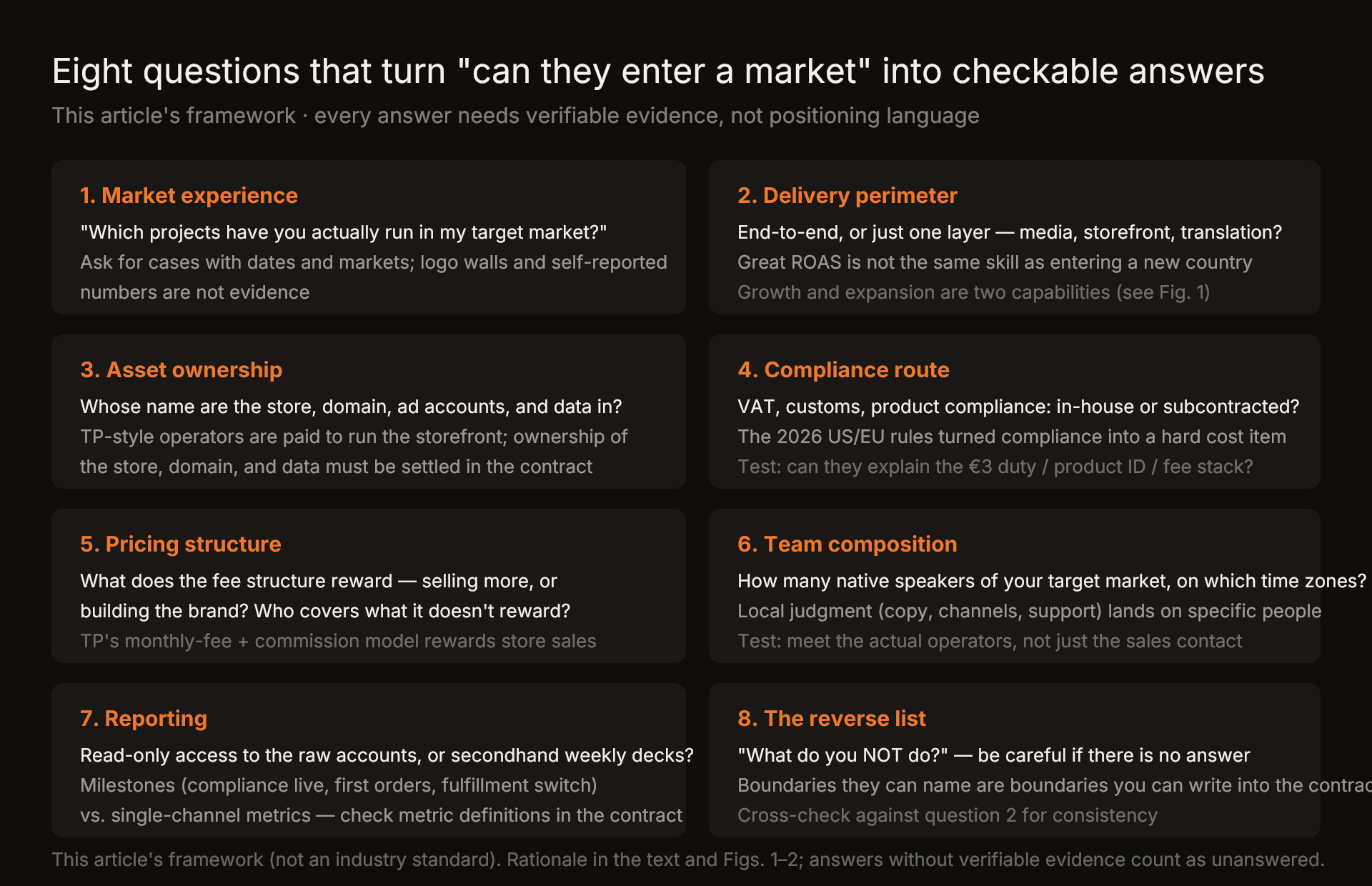
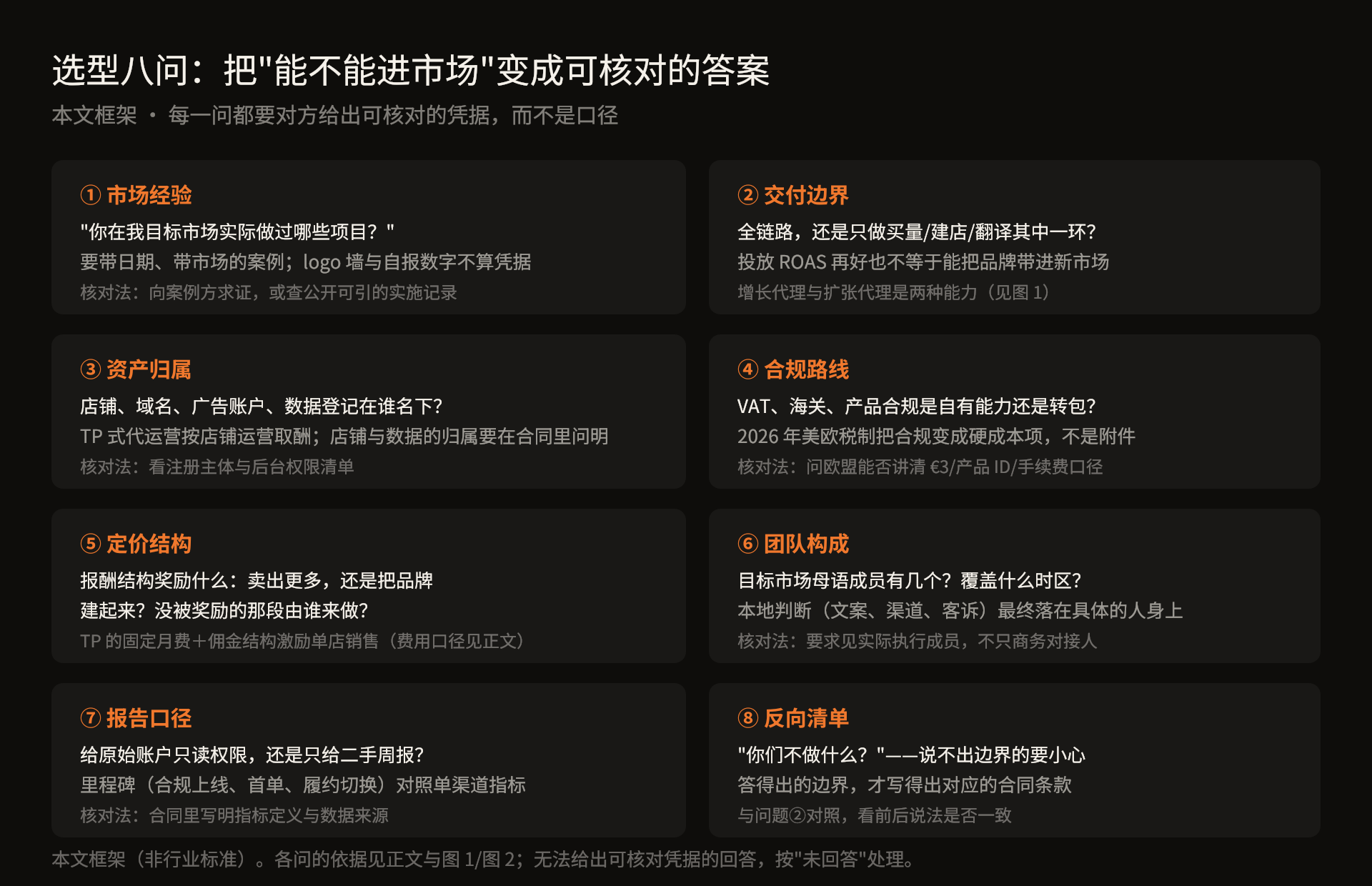
This framework is ours, not an industry standard; other agencies have published similar checklists — use them side by side. Every question should produce verifiable evidence, not positioning language.
- Market experience. "Which projects have you actually run in my target market?" Ask for cases with dates and named markets. Logo walls and self-reported numbers are claims, not credentials — on the Chinese-language supply side, figures like "$20M+ annual budget managed" are vendor-reported.
- Delivery perimeter. End-to-end, or one layer? Great ROAS is not the same skill as entering a country.
- Asset ownership. Whose name are the store, domain, ad accounts, and data in? This decides what you can take back as you build the brand. Another agency's public selection checklist calls this the single most important item: ad accounts, website, domain, analytics, social handles, and customer data registered under your company, with exit terms that spell out how assets transfer intact (Ignite's checklist).
- Compliance route. VAT, customs, product compliance — in-house or subcontracted? An agency that can't explain the €3 duty, product IDs, and the fee stack gives you no evidence that this layer is in-house or practiced.
- Pricing structure. What does the fee structure reward — and what does it quietly leave out? Whatever it rewards is where the effort goes, and a reward structure can misalign with building the brand without anyone noticing.
- Team composition. How many native speakers of your target market, covering which time zones? Ask to meet the operators, not just the sales contact.
- Reporting. Read-only access to raw accounts, or secondhand weekly decks? Whoever selects the data controls the story — get metric definitions and data sources into the contract.
- The reverse list. "What do you not do?" Boundaries they can name are boundaries you can write into the contract. Cross-check against question 2.
The 2026 Supply Landscape and the Search Mismatch
Sort the supply by direction and layer (positions confirmed by opening sites or reading search results, October 27, 2026). Chinese media-buying and marketing agencies (Tecdo, YinoLink, MeetSocial) solve acquisition; their service descriptions don't include the compliance and fulfillment stretch of market entry. Marketplace operators and TPs solve storefront operations. A thin scatter of westward independents exists — Landelion builds content systems and multilingual communications for Chinese companies (site opened and verified); the searches also surfaced independent-site and SEO supply (EastDigi — first just a directory listing in an English search; in the evening's Chinese-language run we read its 2026 independent-store guide) and bidirectional operators like BrandEntre.
The gap is moving, too. Earlier on October 27, our searches for "agency for Chinese DTC brands going global" had turned up no front-row occupant; an evening full re-run found four or five names already in the front rows. Himax still carries "Performance Marketing for DTC Brands Going Global" in its page title tag — that phrase was the homepage headline when we checked on October 27; by October 30 the headline had changed to "Become the NextBreakout Brand" (storefront builds, paid media, and CRM remain the deliverables); eddone leads with "DTC Brand Globalization" — independent stores, paid ads, and GEO/SEO; Ignite's 2026 guide for taking a China brand global runs from market selection and channels to warehousing and EU VAT. These services are real, but read as service lists, the deliverables still sit on the media, storefront, and content side.
The search mismatch is real and repeatable: in one run of our own and two same-day searches, the front rows for "China cross-border ecommerce agency" were dominated by China-entry guides and service pages, and neither scouting run surfaced an outbound-facing English contender (we also ran a retest in between; its itemized results weren't retained, so we don't lean on it). Directionally correct supply doesn't hold the front rows for this phrase — several of those providers surfaced through other search terms. And directory listings on Clutch or DesignRush are leads, not evidence of a category.
What This Article Doesn't Have
No pricing benchmarks — there is no public, comparable pricing data for expansion agencies, so the framework stops at "what does the structure reward." The nearest public artifact is a fee-structure teardown (What overseas growth consulting actually costs, 2026-06-24): it explains four pricing models and what drives the numbers, but gives directional ranges, not quotes. No verified performance ranking — agencies' case numbers are self-reported. And the definition is a working definition, offered for use and revision, not a standard.
Where We Fit
WayToGlobal is an agency for DTC e-commerce brands and AI-application companies heading overseas — as our site puts it: brand positioning and narrative, content and discovery (including visibility on ChatGPT, Perplexity, and Gemini), market entry and growth, and brand assets. Our case results are qualitative; we don't publish unverified metrics. If you're evaluating expansion agencies, run the eight questions past us, too. For the details behind one of the forces above, see the EU customs checklist.
Choosing an expansion agency?
Run the eight questions past us, too — we answer with cases, dates and evidence, including what we don't do.
Sources
- New Engen — Best Agencies for DTC Brands Expanding Into Retail (2026-10-14) — newengen.com
- attnagency — DTC brand international expansion, 2026 guide (2026-03-21) — attnagency.com
- ecommercechina.agency — cross-border e-commerce (into China) service page — ecommercechina.agency
- yall.co — Top 10 DTC Growth Agencies in 2026 — yall.co
- Sinorbis — services page (marketing into China) — sinorbis.com
- Tmall Global knowledge hub — TP definition and fee wording — tmall.hk
- up2china — complete guide to selling on Tmall Global 2026 — up2china.com
- Locize · Translated · Nimdzi — localization vendor service pages — locize.com / translated.com / nimdzi.com
- Federal Register — indefinite suspension of the de minimis exemption, CBP interim final rules (2026-06-24) — federalregister.gov
- Bloomberg — China's parcel sales are shrinking (2026-10-23; summary-level) — bloomberg.com
- Bloomberg — Liège airport small-parcel drop, July 2026 (summary-level) — bloomberg.com
- Bloomberg — Goldman Sachs estimate of EU curbs on China exports (summary-level) — bloomberg.com
- Reuters — how the EU plans to crack down on low-value e-commerce goods — reuters.com
- China Daily — China cross-border e-commerce 2024 figures — chinadaily.com.cn
- Ignite Consulting — agency selection traps · cost teardown · 2026 go-global guide — igniteconsulting.io
- Landelion · Himax · eddone — outbound provider pages opened and verified, October 27–30, 2026 — landelion.com / himaxtec.com / eddone.com