30-second read
- From 1 November 2026 every EU-bound B2C item needs declared product identifiers — merchant ID and manufacturer ID, plus a barcode where one exists.
- The cost stack per order: a €3 flat customs duty on low-value consignments plus roughly €2 handling — price it in before BFCM.
- No official source says parcels are rejected outright for missing data — but capture, validation and declaration must now be provable.
If you sell into Europe, you've probably seen the posts going around seller forums this week: from November 1st, every product shipped into the EU must carry three product IDs — "or else they will be rejected." DTC seller groups are treating it like a customs doomsday.
Here's the thing: the date is real, and the requirement is real. The European Commission confirmed that Product Identifiers (PIDs) become mandatory for imported distance sales on 1 November 2026. But "rejected" is scarier than anything we found in the documents we checked — the Commission's guidance pages and eBay's announcement. We went through those line by line, plus carrier notices. What's left is a checklist you can actually run this week: which IDs are mandatory, what low-value orders have paid since July, and when the math tips toward EU local fulfillment.
What becomes mandatory on November 1
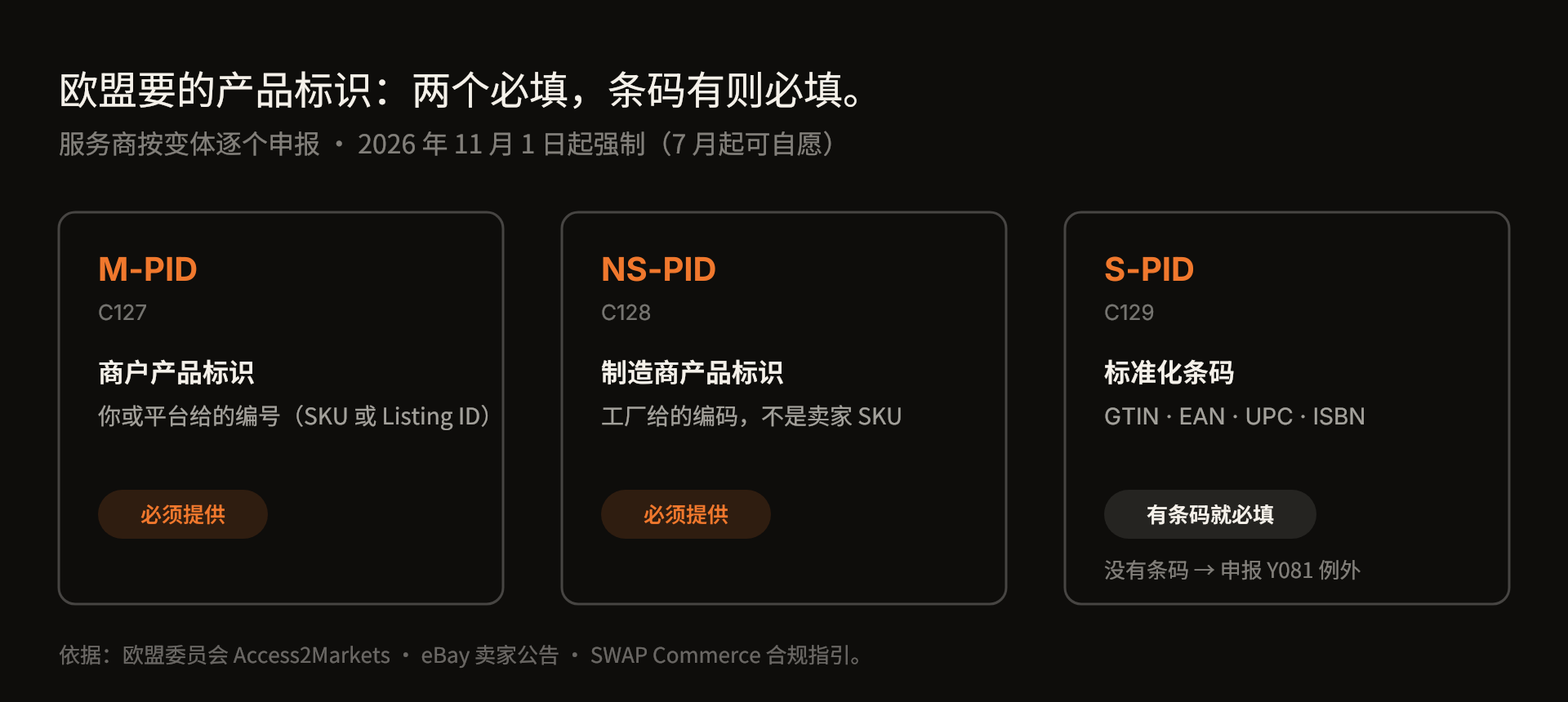
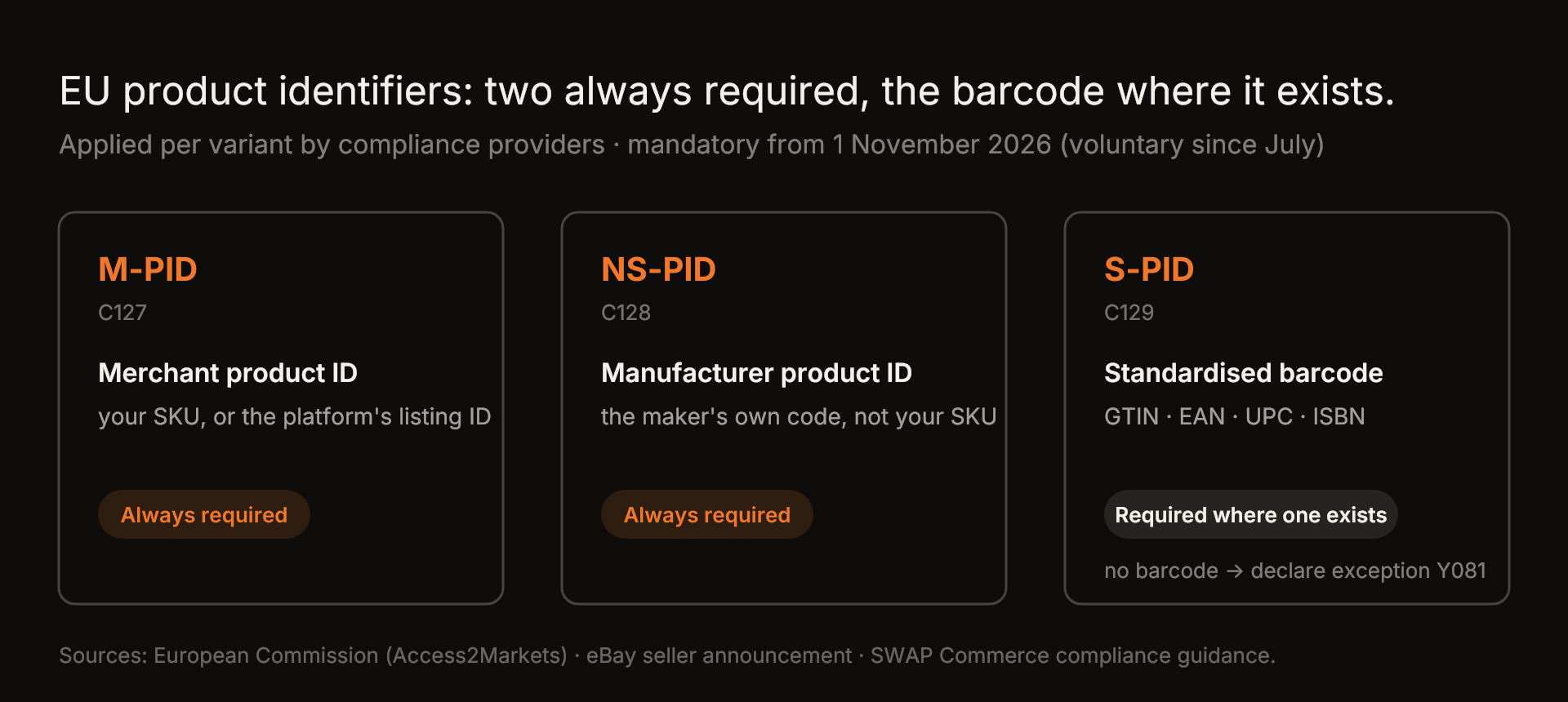
Every item in an EU-bound B2C shipment must now carry declared product identifiers, per the Commission's Access2Markets notice — a merchant ID and a manufacturer ID in all cases, plus a barcode where one exists:
| Code | What it is | Requirement |
|---|---|---|
| M-PID (C127) | Merchant product ID — the number you or the platform assign (your SKU, or a listing ID) | Mandatory in all cases |
| NS-PID (C128) | The manufacturer's own product code, not your SKU | Mandatory in all cases |
| S-PID (C129) | A standardised barcode: GTIN, EAN, UPC, ISBN | Required where one exists; declare exception Y081 if not |
Three details the forum version skips:
Only two of the three are unconditional. The S-PID is "required where it exists," with a Y081 exception declaration when there's no barcode. So "three IDs on every product" is a simplification — and on eBay, your Listing ID can even serve as the M-PID (eBay announcement).
They apply per variant, not per product. That's how compliance providers like SWAP Commerce are implementing it: one hoodie in three colors is three sets of IDs. If your SKU table only goes to product level, that's the gap to close.
The value threshold is genuinely unclear. eBay says the rule applies to all items shipped to EU buyers "regardless of item value." Some providers frame it around shipments of €150 or less. The Commission's notice doesn't state a cap. Preparing every order — not just small ones — is the version of conservative that can't hurt you.
What actually happens if the data is missing
None of the documents we checked — the Commission's two guidance pages and eBay's announcement — says parcels will be rejected outright, let alone seized. The official requirement is that identifiers are "correctly captured, validated, transmitted and declared."
The consequences, as stated by the parties enforcing them: eBay warns self-shipping sellers that failing to pass PID data to their carrier "may result in potential delivery disruption, increased processing time, or other customs clearance delays." A merchant notice we could only see in summary form lists "additional checks, delays, or rejected declarations." And SWAP's read is blunt: the voluntary window ends October 31, no grace period has been published, and carriers are preparing for strict enforcement from day one.
Put those together and the risk chain to plan for is: bad data → a rejected declaration, a parcel held for checks, days of clearance delay — and each day eats a Q4 delivery promise. That lands nearly as hard as outright rejection, and the fix is the same: get the data right before November 1. Which is why working the checklist beats forwarding the panic post.
How the costs stack up
The PID requirement is the third layer of cost added to EU-bound direct shipping this year.
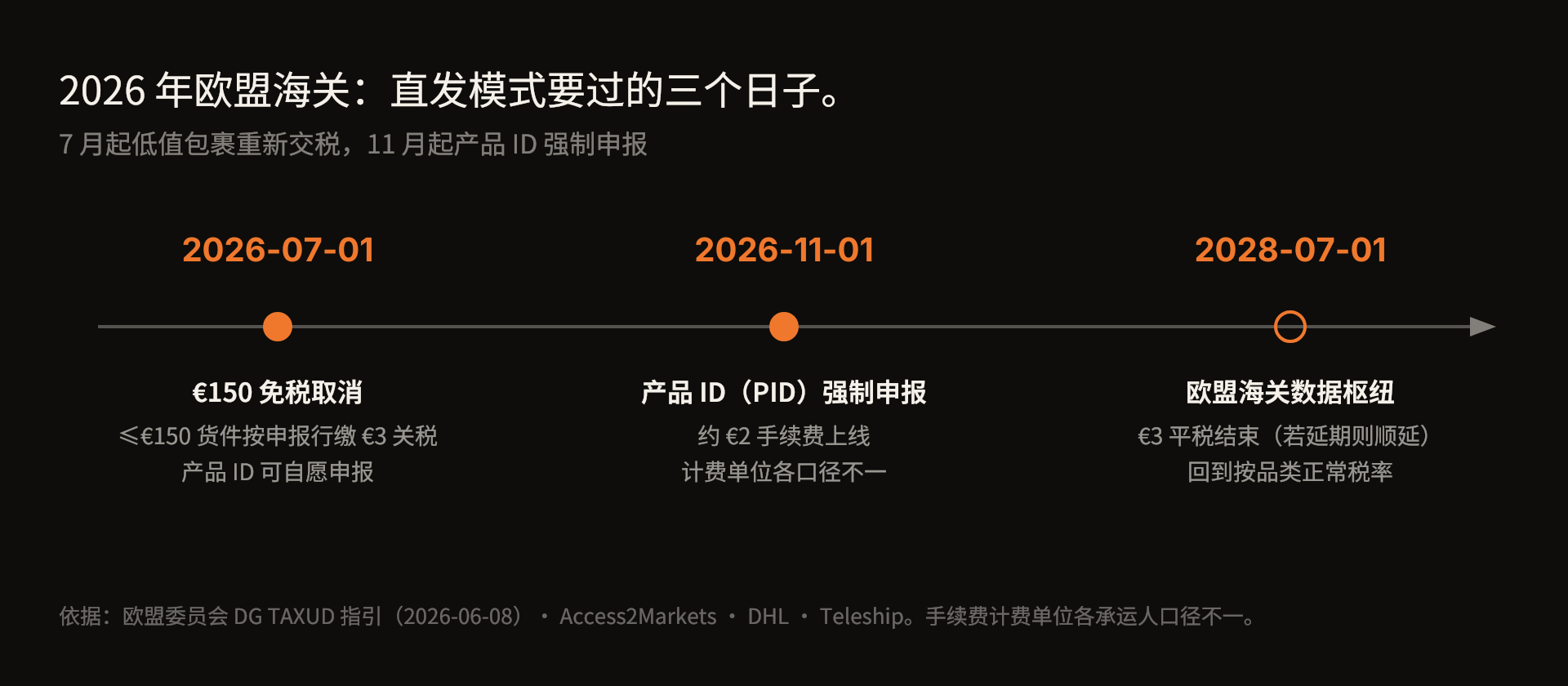
Since 1 July 2026: the €150 duty-free threshold is gone. Low-value consignments now pay a temporary €3 customs duty per declared item, via Council Regulation (EU) 2026/382 — even for categories that never had relief, like alcohol, perfumes and tobacco. The Commission's own FAQ example: five identical T-shirts pay €3; one T-shirt plus one watch pays €6. Simplified declarations group by shared code — H7 at six-digit HS, H6 at eight-digit CN, same-code goods on one line at one charge; full H1 declarations classify to 10-digit TARIC, split by description and origin, with no grouping — worth confirming your declaration type with your broker.
From 1 November 2026: an approximately €2 handling fee. DHL says "approx. €2 per parcel"; Teleship counts it per HS declaration line; nshift per item — the unit differs depending on who you ask. Teleship and nshift both state it applies at any order value; "replaces various national handling fees" is DHL's wording alone; DHL and nshift both state it stacks on top of the duty.
Then VAT. IOSS-registered sellers collect it at checkout. For unregistered sellers, tax-service providers describe the fallback: the carrier collects VAT at your customer's door, usually with a disbursement fee on top.
Until 1 July 2028. That's when the EU Customs Data Hub is scheduled to take over e-commerce consignments. The Commission's wording gives the €3 duty an "unless extended" caveat, with normal per-category tariffs returning once it does end. The context number for all this: nearly 5.9 billion low-value items entered the EU duty-free in 2025.
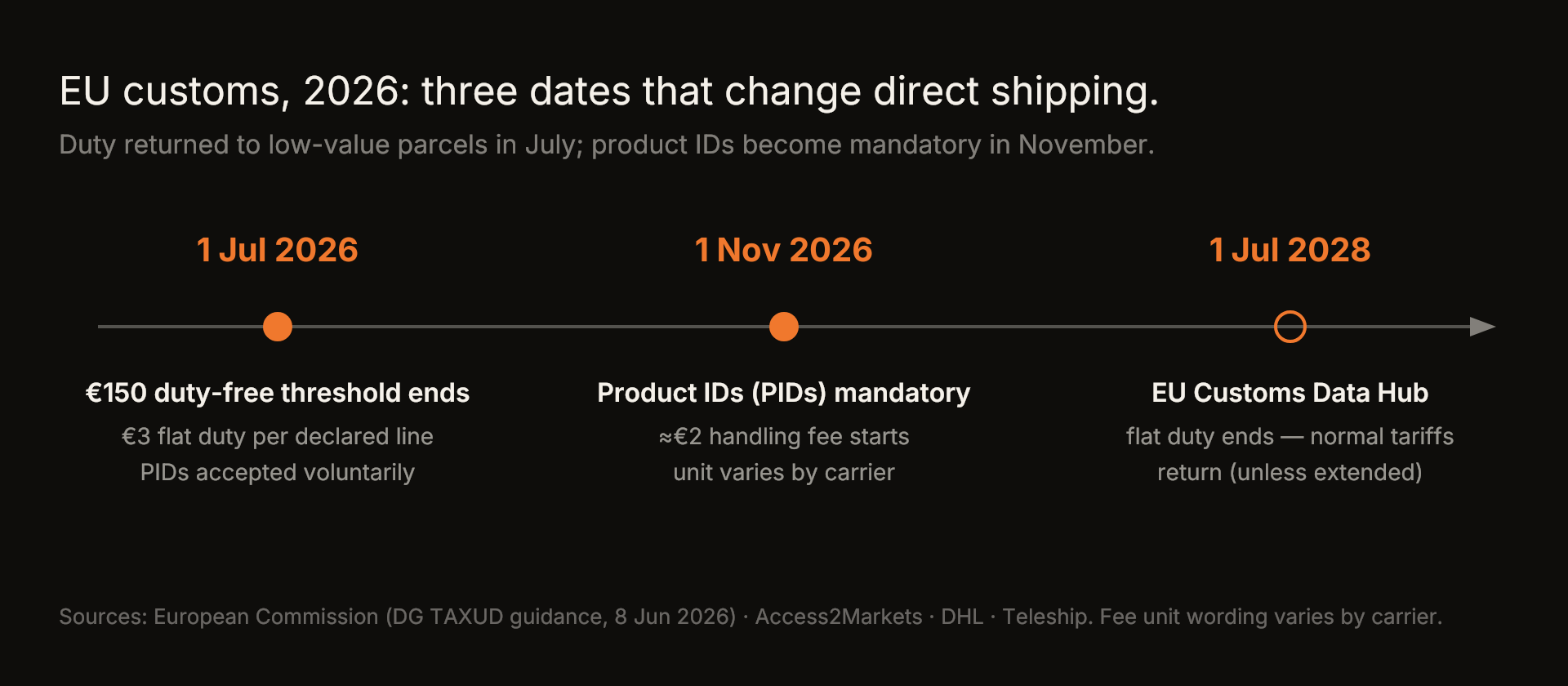
For pricing, take the heavy end of every range: €3 duty per item; handling fees from ~€2 per order, and more if the unit turns out to be per line or per item; plus VAT.
Your checklist for this week
- Build the variant-level ID table. You have the SKUs. The manufacturer codes need to come from your factory or supplier, and marketplace sellers can use the platform's listing ID where the platform says so. Add GTINs where barcodes exist; flag the Y081 exception path where they don't. This table is the data source for every EU order after November 1.
- Fix descriptions and HS codes. The Commission is explicit that "a generic product description will no longer suffice." Write what the item is, in what material, for what use — with a six-digit HS code per variant, and same-code goods grouped onto one line after checking with your broker.
- Check the label data. Every consignment entering the EU needs an import declaration regardless of value — a requirement since the 2021 reform. On the label: true value, specific description, and your IOSS number if you have one, so VAT stays where you collect it. Orders over €150 can't use IOSS at all; they clear formally.
- Test the data pipe now. PIDs travel to customs through your carrier's electronic data. eBay already requires self-shippers to pass them along. Systems have accepted voluntary PID filings since July — testing with a few real orders this week is far cheaper than debugging in production during the first week of November.
- Re-run the money math. IOSS covers VAT only — the €3 duty still applies (nshift's summary is clear on this). On marketplaces, VAT is usually collected and remitted by the platform under the deemed-supplier rule (verified at summary level), but eBay's announcement puts PID data squarely on the seller. Either bake duty and fees into your DDP price or tell DDU customers honestly what they'll pay at the door.
When the math tips toward EU local fulfillment
Bulk stock imports have always paid normal tariffs on customs value — that didn't change this year. What changed is direct shipping for orders of €150 or less: each one now carries €3 plus ~€2 in fixed charges on top of VAT. Orders above €150 keep clearing with normal tariffs, as they always have.
Run the numbers on a clearly hypothetical example: an item with a €10 customs value and a 5% normal tariff. Bulk import: €0.50 per unit in duty. Direct shipping: €3 + €2 = €5 per order. Stretch the same example to a 0% tariff and bulk import pays €0 per unit while direct still pays €5 — the lower the category rate, the wider the gap.
That doesn't mean every brand should rush into warehousing. Direct shipping still makes sense for slow-moving long-tail SKUs and product tests — priced under the new rules, not the old ones. The signals to model the switch seriously: customs delays eating your delivery promises, a pile of "surprise fee at the door" complaints, or EU volume big enough that per-order fixed costs dominate. And the switch doesn't have to mean your own warehouse — a 3PL or EU fulfillment partner converts per-order declarations into one import clearance on arrival.
One red line: the regulation also closes the structures. Goods sold to consumers out of bonded warehouses don't count as distance sales — customs warehouses can't be used for retail, and the supplier must release the goods for free circulation first. And where a declaration groups individual distance sales to cut the number of lines and the tariff, customs applies the duty separately once it's detected. Separately, the warnings that circulated around the US de minimis repeal targeted undervaluation specifically — we've seen them at headline level, not in the underlying texts. Structures built to dodge €3 risk a lot more than €3.
What's still unsettled
Two details this article deliberately doesn't lock down: the €2 fee's unit (per parcel, per line, or per item — sources disagree, and we haven't obtained the official text itself), and whether the PID requirement has a value cap (eBay and several providers disagree). For category- and broker-level decisions, your customs broker's reading of the official texts is the final word — and this piece gets updated as those texts land.
Get the data ready before the deadline does it for you
November 1 is a hard date — and the compliance providers we cited see no grace period coming. The work is finite: finish the variant ID table, test the data pipe during the voluntary window, and reprice your EU lane at €3 per item plus ~€2 per order plus VAT. Sellers who do it this week won't notice the deadline. Sellers who don't will meet it at customs.
Official page: the €3 duty notice
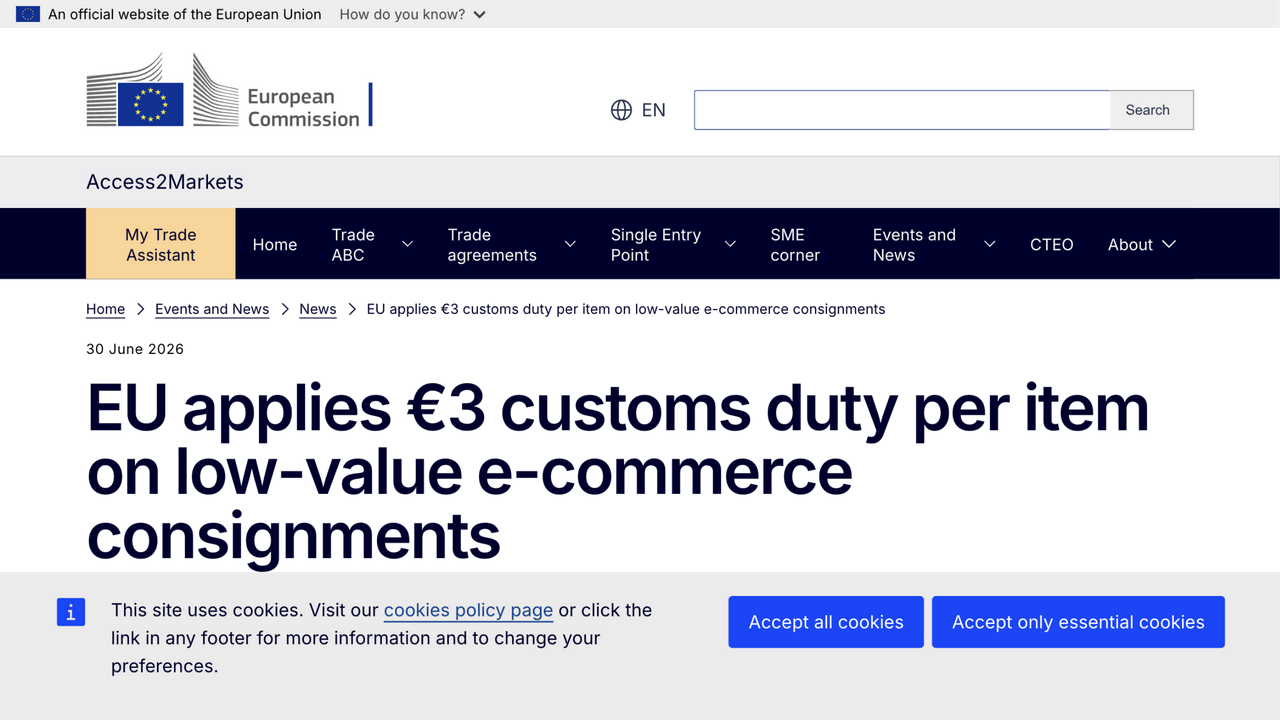
The €3-per-item duty on low-value consignments and the product-ID requirement come from the Commission's own pages — this notice is what the cost math in this article is built on. Read it once before you re-price EU shipping; it is shorter than most forwarders' explanations.
Want a second pair of eyes on your EU lane?
Leave your product category, price point and current fulfillment route — we'll run the numbers for your setup.
Sources
- European Commission, Access2Markets — €3 duty & PID notice — trade.ec.europa.eu
- European Commission, DG TAXUD — guidance & legal texts (flat fee until 1 July 2028) — taxation-customs.ec.europa.eu
- Council Regulation (EU) 2026/382 (as cited on the Commission pages above)
- eBay community announcement — EU customs update: PID requirements — community.ebay.com
- SWAP Commerce — preparing product identifiers for EU customs — swap-commerce.com
- DHL — EU customs changes 2026 — dhl.com
- nshift — EU customs changes for e-commerce 2026 — nshift.com