30-second read
- AI shopping agents already convert: AI-referred traffic converts at 2.47% with 20-38% higher AOV — invisibility has a price.
- Agent-ready means three things: machine-readable product supply, a site agents can read, and ad slots where agents shop.
- Run the self-audit before BFCM — this is the first big season where agents show up at scale.
title: "How to Make Your DTC Brand Agent-Ready for AI Shopping Agents (2026 Guide)" slug: agent-ready-brand-ai-shopping-agents date: 2026-10-27 meta-description: "What AI shopping agents can and can't do today, where they break, and the three checks — shortlist, readable, purchasable — to run on your own store."
# How to Make Your DTC Brand Agent-Ready for AI Shopping Agents (2026 Guide)
Search "agent-ready brand" in 2026 and the front page is full of tools and checklists, not brand owners: Cloudflare's Agent Readiness score, Stripe's retail guide, Forter's readiness article, a scanning app in the Shopify App Store, and Google's own Think with Google page from June 2026, "Beyond the feed: How to build an agent-ready brand in the AI age."
The phrase isn't ours anymore — it's a line official platforms are actively pushing. But a checklist can't answer the question a brand owner actually has: how far do AI shopping agents really get, and which part of my store is stopping them?
This article skips the trend-speak and works through three gates, each backed by published measurements. All the data comes from English-language studies — beauty and skincare plus apparel and footwear, across the Baltics, Germany and Poland, and the United States. There is no equivalent public measurement for Chinese cross-border brands yet, so read these numbers as a map of where agents break, not as a diagnosis of your own store.
Gate 1: Does the Agent Put You on the Shortlist?
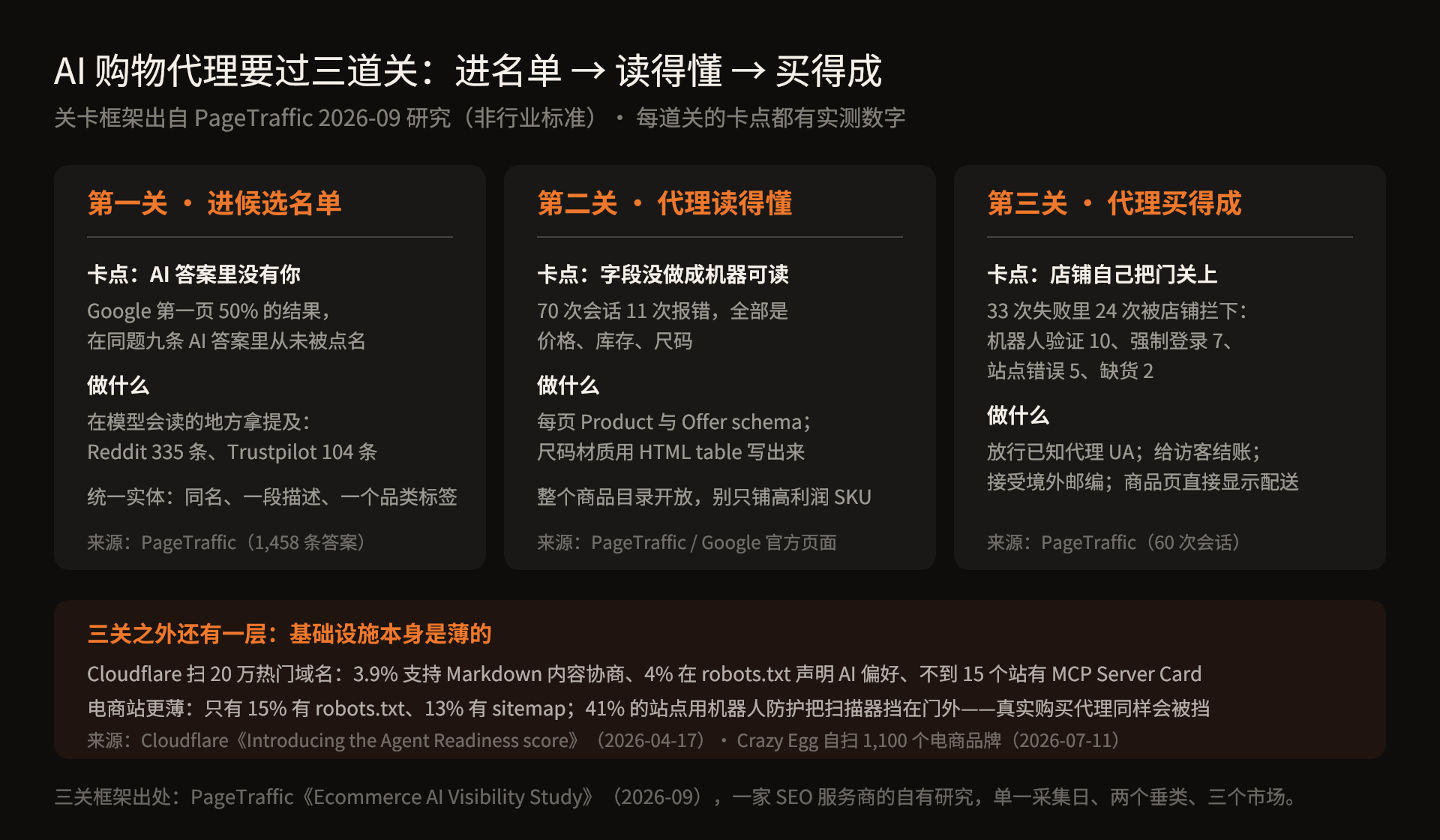
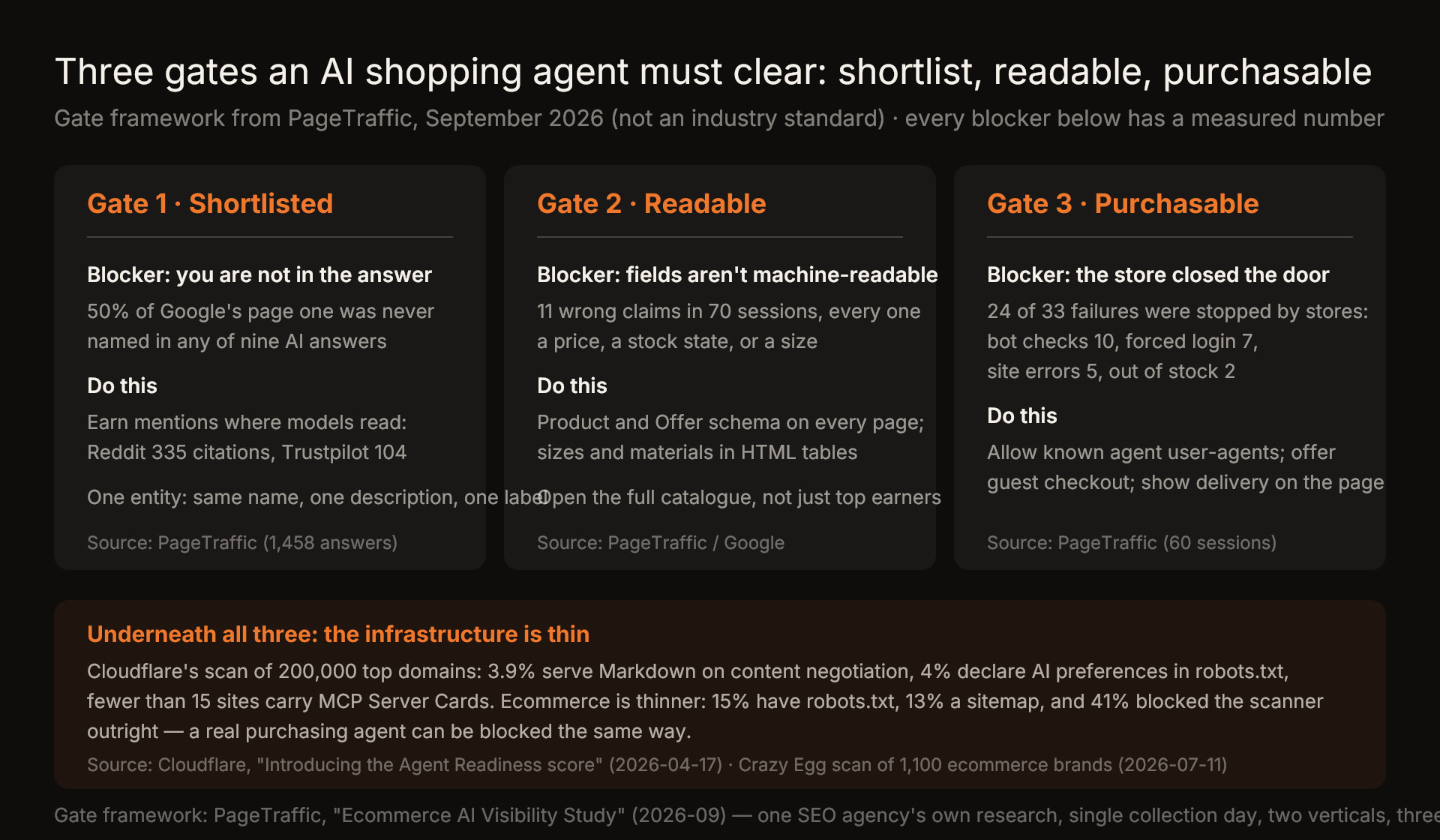
For twenty years, traffic came from search result pages and ranking was everything. Agents work differently: they don't return a list of links. They read a batch of stores' data and hand back an answer. Whether you're in that answer is an entity-level judgment, not a page-level rank.
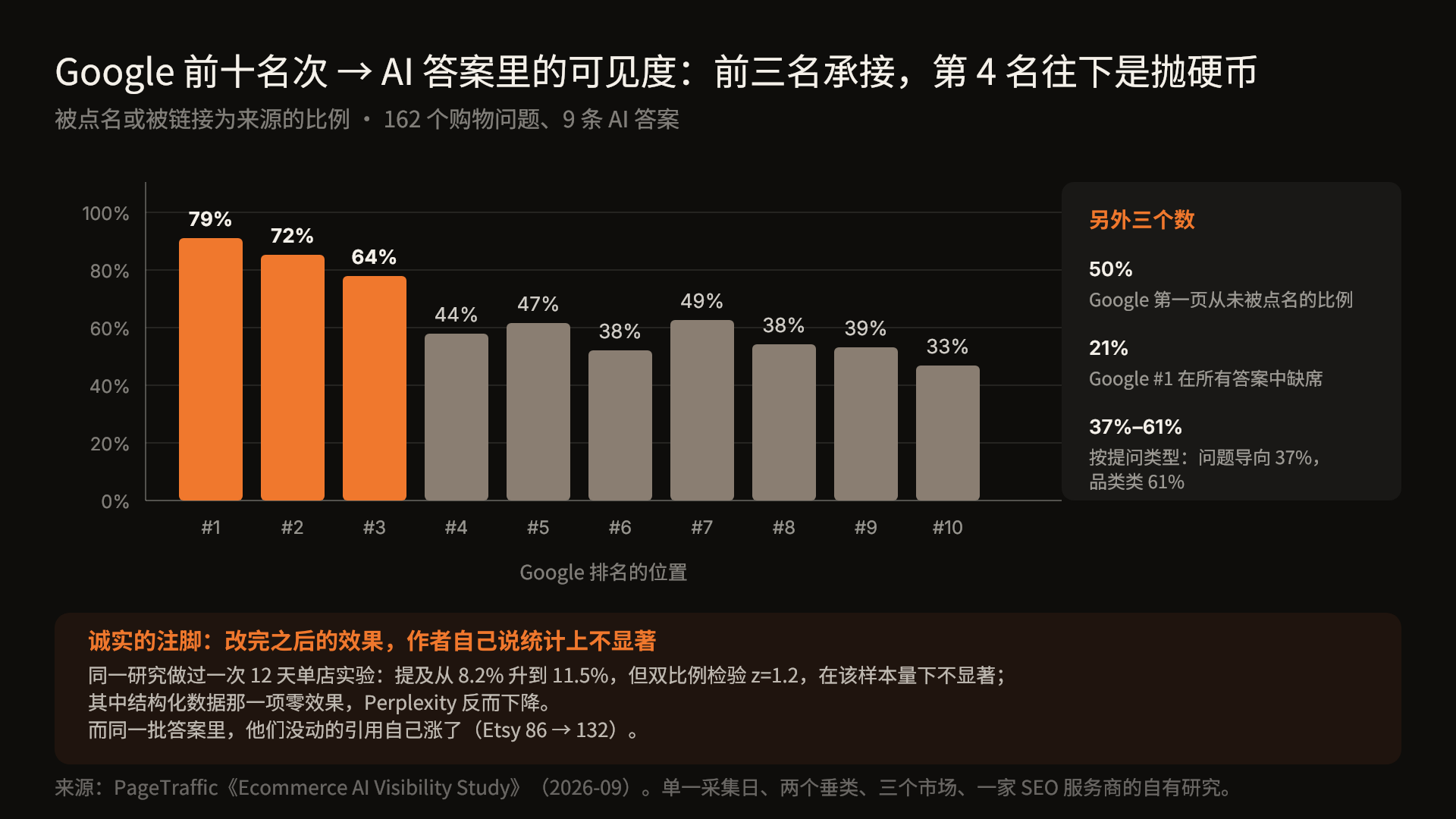
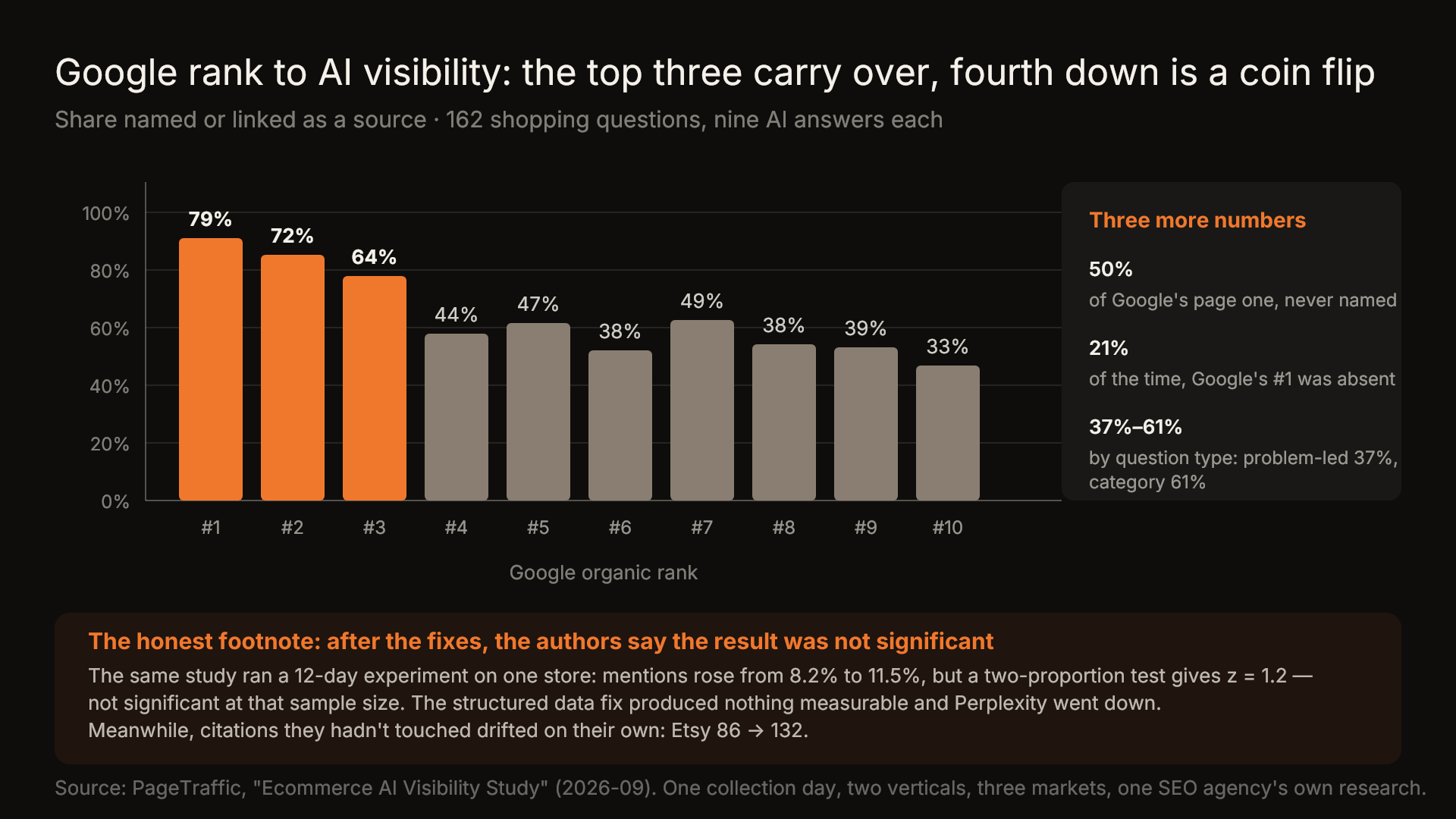
A September 2026 study from PageTraffic did something rarely done: 162 real shopping questions put to ChatGPT, Gemini, and Perplexity, three runs each, 1,458 answers total, compared against the Google top ten for the same 162 keywords. The finding: 50% of Google's page one was never named or linked in any of the nine AI answers to the same question (56% counting only linked sources), and Google's #1 result was missing 21% of the time.
Don't read that as "SEO is dead." The same study breaks it out by rank: 79% of #1 results, 72% of #2, 64% of #3, 44% of #4, then between 33% and 49%. The top three carry over. From fourth down it's a coin flip. The authors' framing is precise: SEO is the entry ticket, not the shortlist.
What changed is how people ask. By question type, the share of Google's top ten appearing in AI answers runs 61% for category queries ("best X under €40"), 58% for local availability, 53% for agentic ("buy me"), 50% for trust, 40% for comparison, and 37% for problem-led queries ("I have dry sensitive skin"). Agents start from the shopper's problem and pull in stores the shopper never named.
Markets follow the same shape. Across the Baltics, Germany and Poland, and the United States, 54%, 48% and 48% of Google's top-ten results were never named or linked. Counting only store domains, 53% of Baltic stores were invisible, against 45% in Germany and Poland and 41% in the US. The gap is widest where the models have read the least.
That gap points at two specific jobs. First, get your brand story where agents read it — not only on your own site. Across all citations in the study, Reddit came first (335 citations) and Trustpilot third (104), while store and brand sites accounted for 57%: models read what other people wrote about you more than what you wrote yourself. Second, make the entity consistent. One case is instructive: bareskin.lt, a Vilnius K-beauty shop, ranked #1 for "where can I buy Korean skincare in Vilnius" and was named once across nine AI answers, never linked. simitri.lt, ranked seventh, was named seven times.
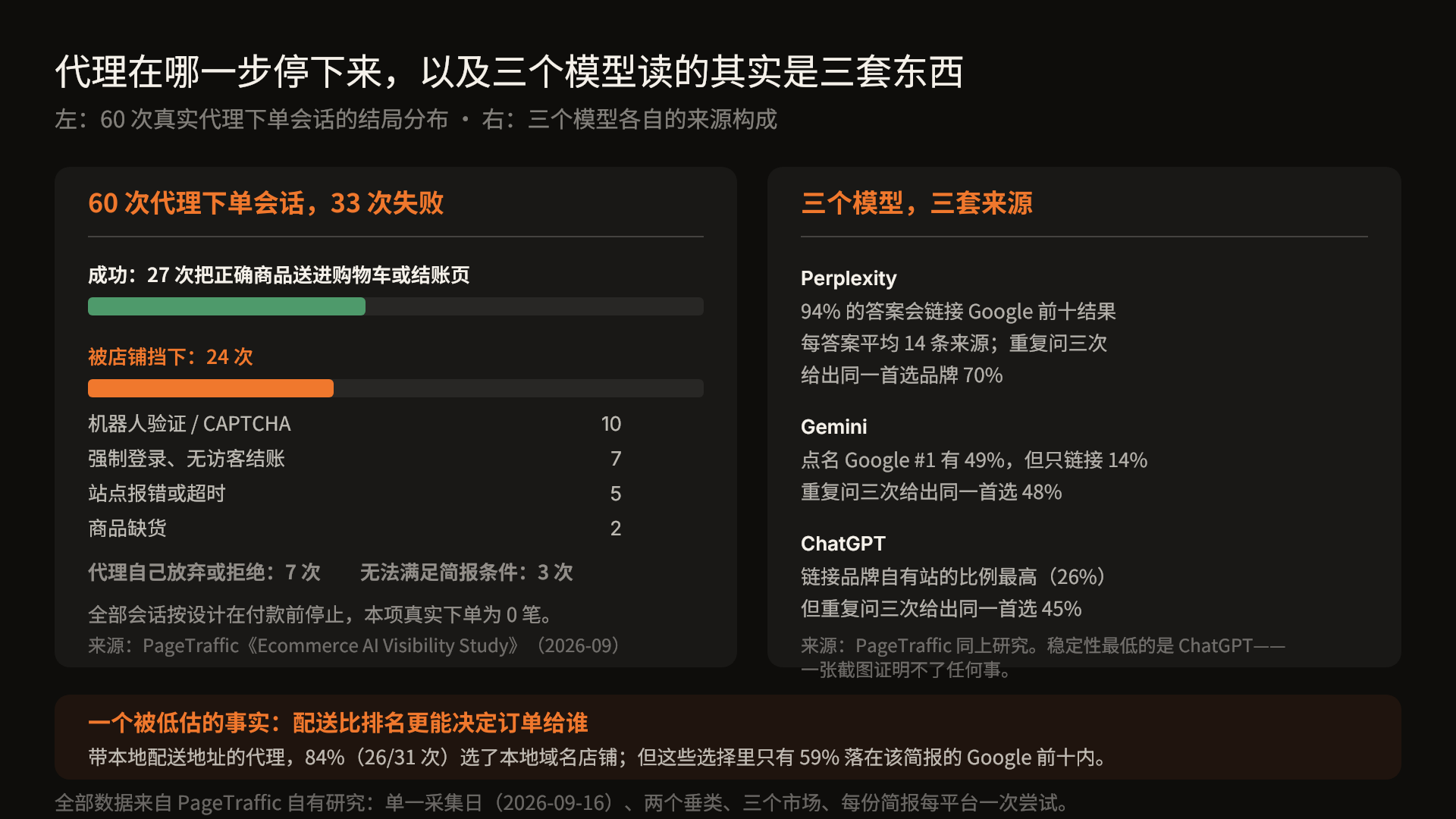
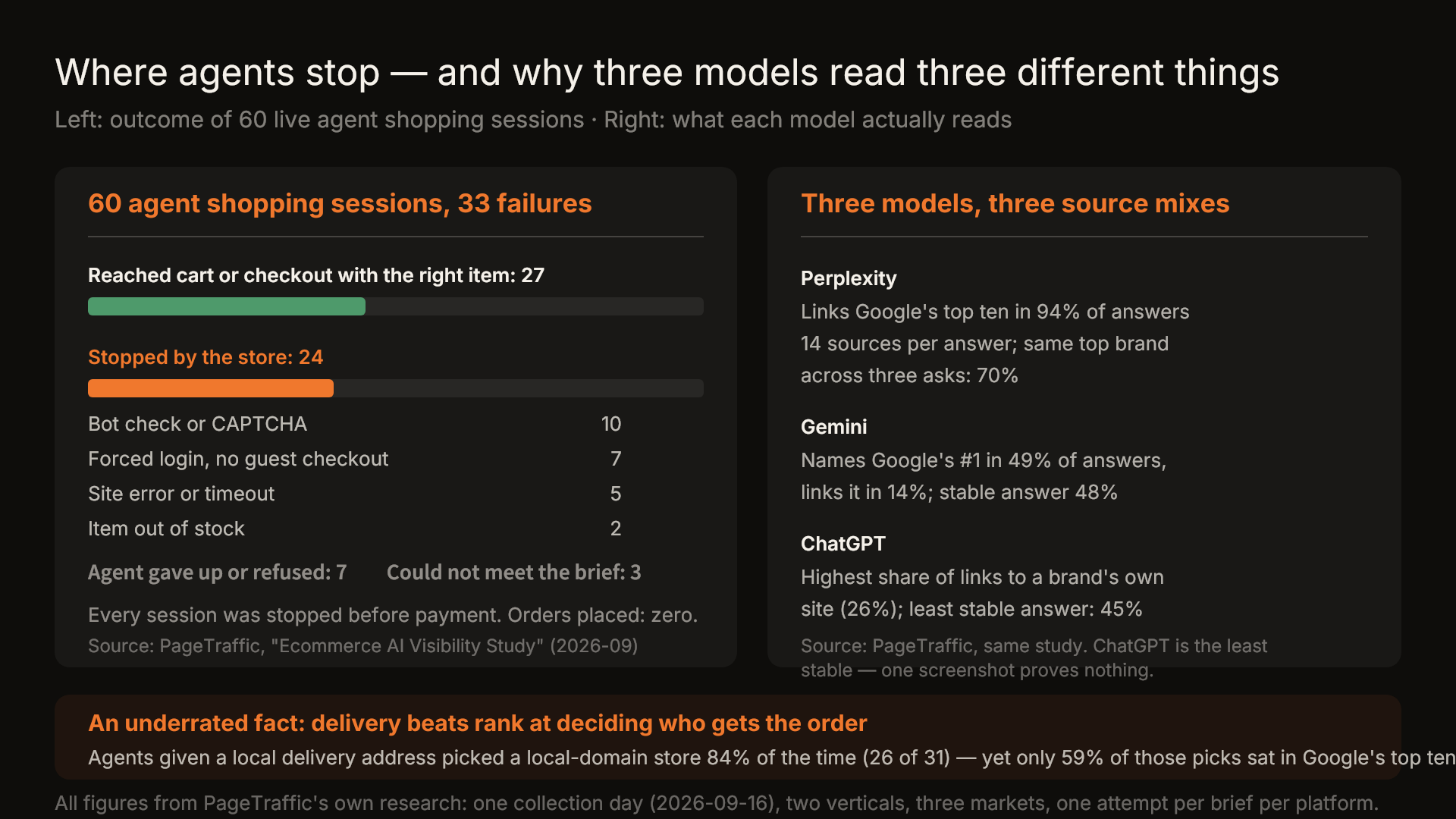
One more thing to separate: the three models aren't reading the same thing anyway. In the same study, Perplexity links Google's top ten in 94% of answers with 14 sources per answer; Gemini names Google's #1 result in 49% of answers but links it in only 14% — it talks about you without sending the click; and ChatGPT has the highest share of links to a brand's own site (26%) while being the least stable on repeat asks. Ask the same question three times and the same top brand comes back 70% of the time on Perplexity, 48% on Gemini, 45% on ChatGPT. "Are you visible to AI" isn't one number, it's three — one per model. And one screenshot proves nothing.
Gate 2: Can the Agent Read What You Sell?
Gate 1 is about being mentioned. Gate 2 is about being usable once mentioned. Agents don't click through a product page and browse. They read structured data.
Failures on this path can be counted field by field. The same study ran 60 live agent shopping sessions: 35 purchase briefs with hard constraints ("black leather jacket, men's L, under €200, delivered to Vilnius this week"), executed in ChatGPT Agent mode (35 sessions) and Perplexity's Comet agent (25 sessions) — Google AI Mode refused all 35 of its attempts, since its checkout opens only on eligible US product listings, which left 60 live sessions. Every session was stopped before payment by design. 27 of 60 got the right item into a cart or at checkout.
The distribution of failures carries more information than the successes. Of the 33 that didn't make it, 24 were stopped by the store itself: 10 hit bot checks or CAPTCHAs, 7 were blocked by forced login with no guest checkout, 5 hit site errors or timeouts, and 2 found the item out of stock. The agents gave up or refused on their own in only 7.
Check every price, stock, and size claim against the store page and 11 of 70 sessions produced a wrong claim — all of them price, stock, or size, and every one fell on a field the store hadn't made machine-readable. The agent reported €199 where the page said €215, reported a size M in stock when it was sold out, quoted a price the store never listed.
Assemble that and Gate 2 asks for something plain: Product and Offer schema on every product page with brand, price, currency, availability, GTIN or MPN per variant, shipping destinations and delivery times, and return policy. Sizes, materials, and comparisons in HTML tables or definition lists — not CSS grids, JavaScript accordions, or a screenshot of a size chart. And the full catalogue open to agents, not just your top earners. Google puts that last point bluntly: listing only your most profitable products in feeds means you're invisible to a huge range of queries.
The infrastructure layer is thin too. Cloudflare's Agent Readiness tool, published April 2026, scanned the 200,000 most-visited domains and found 3.9% serving Markdown on content negotiation, 4% declaring AI usage preferences in robots.txt, and fewer than 15 sites in the whole dataset with MCP Server Cards or API Catalogs. Ecommerce stores do worse: only 15% have a robots.txt and 13% a sitemap, per the same dataset as reported by Crazy Egg. Crazy Egg's own scan of 1,100 ecommerce brands put the majority at Level 1 — basic web presence only — with none reaching Level 3. 41% of sites blocked the scanner outright with bot protection. Those sites didn't score badly; they refused to be assessed. A real purchasing agent can be blocked the same way.
Gate 3: Can the Agent Actually Buy?
The first two gates are about being found and being understood. The third is about money changing hands, and right now the store usually decides that outcome — because what's in the way is usually the store's own configuration.
Those 33 failures already say it: CAPTCHA, forced login, site timeouts. All three are merchant decisions. The Germany cohort managed 2 successes out of 9 sessions for a specific reason — Sephora.pl, Douglas.pl, Allegro, and Morele all blocked the agent browser.
The same study also surfaces an underrated fact: agents given a local delivery address picked a local-domain store 84% of the time (26 of 31 picks), yet only 59% of those picks sat in Google's top ten for the same brief. Delivery beats rank. For a cross-border DTC brand, that is a structural advantage. If you hold local stock and a local returns address in the target market, your odds with an agent are better than your Google position suggests.
PageTraffic's three-gate framework is most specific here: run five agent purchase briefs against your own store and watch where each one breaks; allow the known agent user-agents (ChatGPT-User, OAI-SearchBot, PerplexityBot, Google) in Cloudflare or your WAF; offer guest checkout without a forced login; accept foreign phone and postcode formats; show delivery date and cost on the product page instead of only at the last step; and on Shopify, switch on the agentic sales channels and confirm the catalogue passes discovery.
The Bad News Nobody Puts in the Guide: It Isn't Proven Yet
The sequence above is real. It isn't a return on investment.
PageTraffic ran a 12-day experiment on one store, changing three things: adding product schema (which also corrected a brand name declared as "GlambyRivaaz"), pushing one 60-word description across the site and Instagram, Facebook, Pinterest, TikTok Shop, Etsy, LinkedIn, and Trustpilot, and earning mentions where models actually read — three genuine Reddit answers, one editorial listing, a Trustpilot profile with review invitations. On a rerun 12 days later, the brand was named in 11.5% of unbranded answers instead of 8.2%, and in 4.4% of problem-led answers instead of 0%.
The researchers' own conclusion is the one to plan around: mentions rose from 20 to 28 out of 243, a two-proportion test giving z = 1.2 — not significant at that sample size. The structured data fix produced nothing measurable in 12 days (41 citations before, 41 after). Perplexity went the other way. Meanwhile, in the same answer set, citations they hadn't touched drifted on their own: Etsy went from 86 to 132.
That negative result matters more than any positive number, because it tells you how to measure. One change rarely proves causation, and the answer set itself drifts. Measure monthly, across three models, asking the same questions repeatedly and watching share of mentions — and accept that a single reading proves nothing. The same study measured stability: across three asks of the same question, Perplexity returned the same top brand 70% of the time, Gemini 48%, ChatGPT 45%. One screenshot proves nothing.
One More Thing That's Moving: Where Agents Stopped
In March 2026, OpenAI pulled Instant Checkout out of ChatGPT and pivoted toward letting shoppers find products in conversation, then complete the purchase on the merchant's own site. CNBC reported at the time that OpenAI had underestimated how hard enabling transactions was — merchant onboarding, accurate product data, multi-item carts, and loyalty connections all came up short. The same pivot shows up elsewhere: Stripe splits agentic commerce into three paths — third-party agents buying from you (B2A), a branded shopping assistant on your own property (A2C), and autonomous purchasing agents transacting across stores (A2A) — and says all three share one requirement: structured data, secure transactions, and agent-compatible checkout flows.
So the near-term bet isn't that agents will transact for you. It's that agents will filter for you. They decide whether you're in the running; you still catch the order. That distinction sets the priority: make the store readable and purchasable first, and put ads and creative after you've measured whether it moved anything.
Where We Stand
WayToGlobal is an agency for DTC e-commerce brands and AI-application companies heading overseas: brand positioning and narrative, content and discovery (including visibility on ChatGPT, Perplexity, and Gemini), market entry and growth, and brand assets. Our case results are qualitative; we don't publish unverified metrics.
On this topic specifically, our public technical surface looks like this today: robots.txt, llms.txt, llms-full.txt, and sitemap.xml are all retrievable, AI crawlers are welcome site-wide under those rules, and published articles carry structured data. Markdown content negotiation does not work yet — requesting the homepage with Accept: text/markdown still returns HTML. We haven't run Cloudflare's formal scoring, so we don't claim to have passed any check.
If you want to walk the three gates yourself, start with one pass over each gate, write down the specific field that blocks you, and only then decide how much to spend. The related service page is here. For the EU product-ID requirement coming into force in November, see the checklist we published this week.
Want your brand audited for AI-shopping readiness?
Leave your product category, price point and current channels — we'll come back with a concrete take. And if you want new channels opened and run for you, that is exactly what we do.