
30-second read
- Markets ships on every Shopify plan and manages currencies, pricing, domains and duties from one admin; expansion stores are separate stores — a Plus contract includes ten.
- Choose expansion stores when you need per-currency payouts, local payment gateways, or independently run regional teams; one catalog for the world is fine on Markets.
- Black Friday is 27 November — finish any architecture switch in early November, then freeze structure and touch only creative, pricing and inventory.
On Reddit this month, a UK brand is asking: 80% of our sales are domestic, we run Global-e and Amazon US — do we upgrade to Shopify Plus or stay on Shopify Markets? A French brand is asking how to sequence France, the EU and the UK. Another seller wants to know how expansion stores should be named and whether each can carry its own currency. These questions share one deadline: Black Friday falls on 27 November 2026, and the four weeks before it are the last window of the year to change architecture — nobody touches checkout and payments mid-campaign.
What the three setups actually are
Shopify Markets ships on every plan: one admin managing multiple markets — multi-currency display, per-market pricing, local domains, duties and import taxes, translated content, and (since 2023) per-market product availability. It is fast, cheap, and covers most "testing the water" cases from a single store.
Expansion stores are a Shopify Plus entitlement: one Plus contract includes 10 stores (a primary plus up to nine expansion stores), each with its own catalog, pricing, apps and theme. Off Plus, every additional store is billed at plan rate (roughly $299/month on Advanced), and app subscriptions duplicate per store.
The third route is hybrid: test a market cheaply inside Markets, then graduate it to a dedicated expansion store once it proves out. UK skincare brand Bouclème used both; Wilkinson Sword runs the multi-store route.
Five questions that decide it
First: do you need separate payouts per currency? Markets cannot yet pay out in multiple currencies (it is on Shopify's roadmap but not shipped). A US store banking USD and a UK store banking GBP each on their own terms means expansion stores.
Second: how far apart are your regional pricing, tax and promotion rules? Markets applies promotions across all regions simultaneously, and complex tax and pricing splits are hard to express. Widely divergent markets are simpler as separate stores.
Third: does Shopify Payments serve your target market? Markets leans on it heavily; markets that need local payment gateways often end up as standalone stores.
Fourth: one global team, or regional teams? Expansion stores exist for independently run markets — their own catalogs, their own campaigns, their own checkout configuration.
Fifth: how much does the catalog overlap? Per-market availability in Markets handles "some products not sold in some markets"; but inventory is per store by default and cross-store syncing takes apps. When two markets run genuinely different inventory logic, the architecture choice is really an inventory-architecture choice.
The Black Friday clock: switch now, freeze soon
An architecture switch touches domains, redirects, payments and duties configuration, and SEO equity needs weeks to re-settle. Late October is the last evaluation window: finish any switch in the first week of November, then freeze structural changes and touch only creative, pricing and inventory. Rewiring checkout during BFCM is experimenting with live orders.
Actually switching to an expansion store: a five-step list
One — fix naming and domain structure first (the most-asked question on Reddit). Regional subdomains (us.brand.com) or separate domains? Draw the redirect map in the same week; old URLs should not shed their search equity.
Two — catalog and inventory policy: which products enter the new store, and whether stock syncs via app or by hand.
Three — app and cost inventory: before you exhaust the ten-store allowance in a Plus contract, the real cost is usually not the stores but the per-store app subscriptions.
Four — email and translation: transactional email runs on Shopify's Translate & Adapt; marketing email is smoothest through Klaviyo. Email translation compatibility under Markets is limited — a common reason sellers split stores.
Five — verify checkout per market: run test orders through duties display, currency switching and the payment gateway before letting real traffic in.
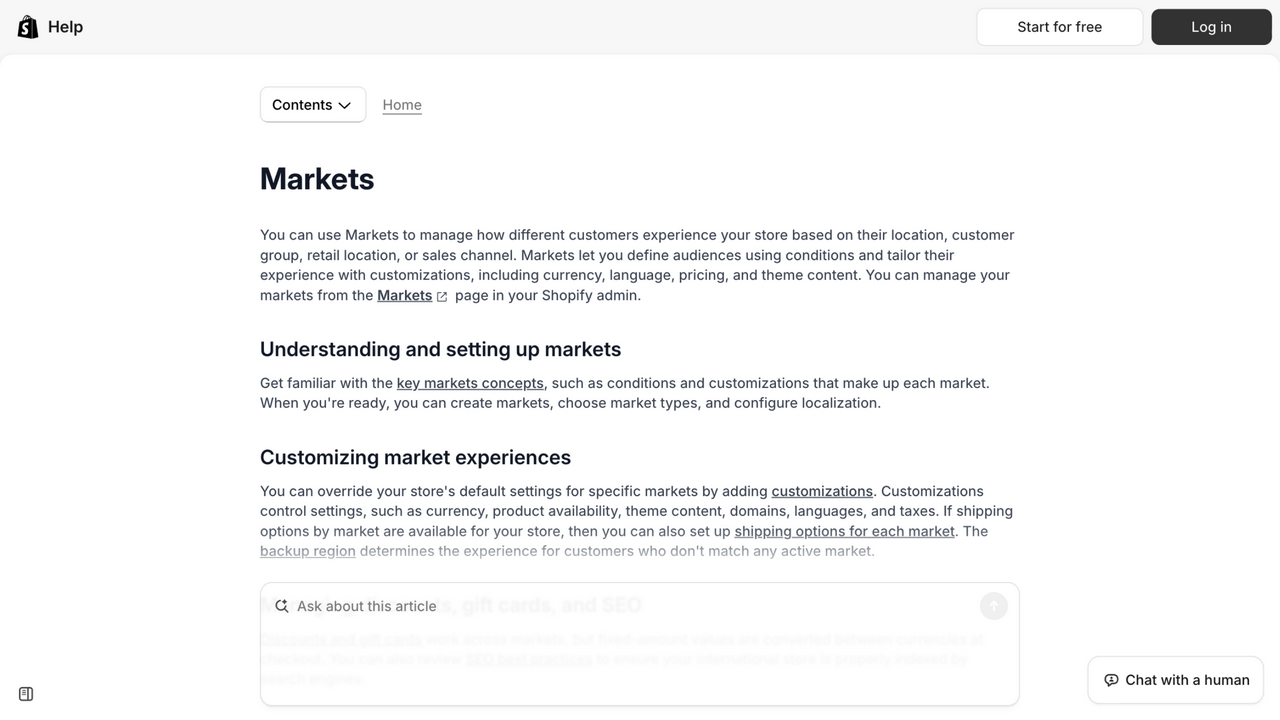
Sources: Shopify Help Center (Markets documentation, screenshotted above); Swanky, "Shopify Markets vs. Expansion Stores" (ten-store allowance, multi-currency payout limitation, Bouclème / Wilkinson Sword cases); Reddit r/shopify, r/shopifyDev and r/internationalbusiness decision threads, October 2026; Black Friday date 27 November 2026 (confirmed in r/shopifyDev). This is an architecture decision guide — no proprietary client data.
Not sure which setup your markets need?
Tell us your markets, catalog and current setup — we'll come back with a concrete architecture read. Store setup, migration and multi-market operations are part of what we run for brands.