
30-second read
- 94M ad-tier users and a ~$3B 2026 revenue target — premium inventory, programmatically buyable via Netflix Ads Suite.
- This is brand building in a brand-safe environment, not direct response — set the KPI accordingly.
- Worth it for high-AOV DTC; skip it if you need last-click conversions.
Netflix's ads business has hit its scale-up moment: the company's own 2026 framework targets 12-14% total revenue growth and roughly $3 billion in advertising revenue — more than double the prior year. The demand-side base is set: the ad tier reached 94 million monthly active users (May 2025), and in ads markets about 55% of new sign-ups choose the ad plan. The other 2026 development is the Netflix Ads Suite — an in-house ad stack progressively replacing Microsoft, with programmatic buying staying open. For DTC brands, this is premium-brand-safety inventory with real scale.
What it gives you, and what it doesn't
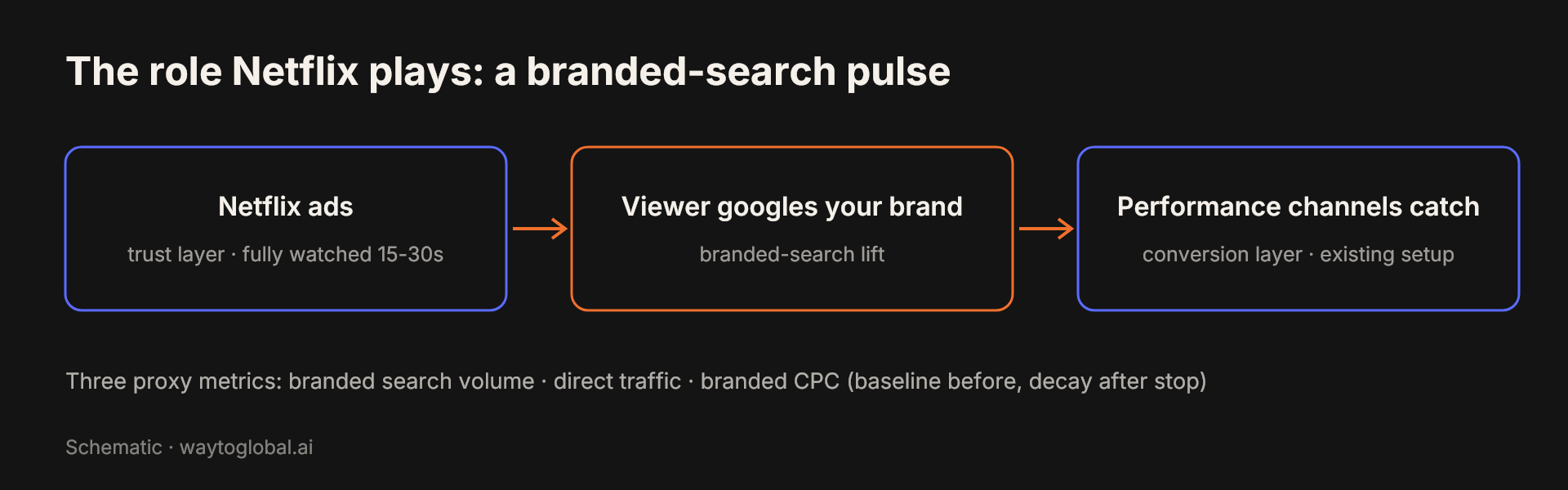
Start with what it doesn't: Netflix is not a performance channel. There is no click-to-cart journey, and targeting is coarse — age, generation, content affinity, not Meta-grade signals. What it gives you is three scarce things. Attention quality: inside prestige content there is no scroll decay — a 15-30 second spot gets watched. Absolute brand safety: your brand shares the screen with licensed headliners, no UGC risk. High frequency: binge viewing naturally builds repetition, which is what brand names need. The right role: for higher-AOV DTC (appliances, furniture, durable parenting, health services) that has already maxed the consideration stage on performance channels, Netflix builds the trust layer — viewers Google you afterward, and your performance channels catch them.
Why now
Two reasons. Supply is expanding: doubling ad revenue means inventory and sales capacity are both growing, and early negotiating terms beat the mature-market terms that follow. And the channel-combination logic finally works at small scale: when Meta and Google have saturated the research-compare stage and conversion stalls on trust, a premium brand environment supplies the missing piece — at monthly stoppable budgets, on per-market targeting, at far lower trial costs than television ever allowed.
Getting started
Buying runs programmatic (Ads Suite and partner DSPs); the shortest path for smaller budgets is a DSP or agency already connected, targeting by market and content genre. Set the role first: this is a brand assist, so KPI it on branded-search lift and direct traffic, never CPA. Budget tier: a few thousand dollars a week for 3-4 weeks across one or two core markets. Creative to TV standard: 15- and 30-second cuts, brand on screen within five seconds — nothing scrolls past, but there are no second chances either. Timing: run against launches or promo beats so the branded-search pulse lines up with what your performance channels can catch.
Risks and measurement
Three cautions. The attribution gap: conversions happen elsewhere, so measurement is a composite of branded search volume, direct traffic, and branded CPC moves — any one alone misleads. Minimums: programmatic paths carry budget floors; below them, test "TV-style" creative on Meta Reels first and bank the assets. Frequency: binge contexts over-deliver impressions — rotate two or three cuts across four weeks or the audience tires. Measure with a baseline week before launch, weekly lifts during, and a fall-off check after stopping: positive lift that decays on stop means the money bought real memory.
Sources: Netflix 2026 framework (Seeking Alpha, April 2026); 94M ad-tier MAU (Dig.watch, May 2025); 55% of new sign-ups (Adweek); in-house Ads Suite (Yahoo Finance). Verified 2026-10-29. Buying paths and measurement are practical guidance, not platform terms.
Official showcase: the case-study library
Netflix runs a public case-study library at advertising.netflix.com — brands shown turning premium-content attention into action. Early movers on the ad tier included Louis Vuitton, Subway, Duracell, Cadillac and CeraVe (per Marketing Brew launch coverage), with DoorDash, Target and TurboTax later testing Netflix AI-powered ad matching (Marketing Dive).
Sources: advertising.netflix.com/case-studies; Marketing Brew; Marketing Dive.
Series: all ten emerging-media platforms compared on one page — Emerging Media Buying Guide 2026. 系列:十个平台一张对照表——《2026 新兴媒体投放总览》。
Should brand budget go here? Let's run the math.
Netflix Ads buying runs through DSPs with budget floors — if you want us to scope the onboarding path and manage the first flight, that conversation starts here. Leave your product category, price point and current channels — the account comes next.