30-second read
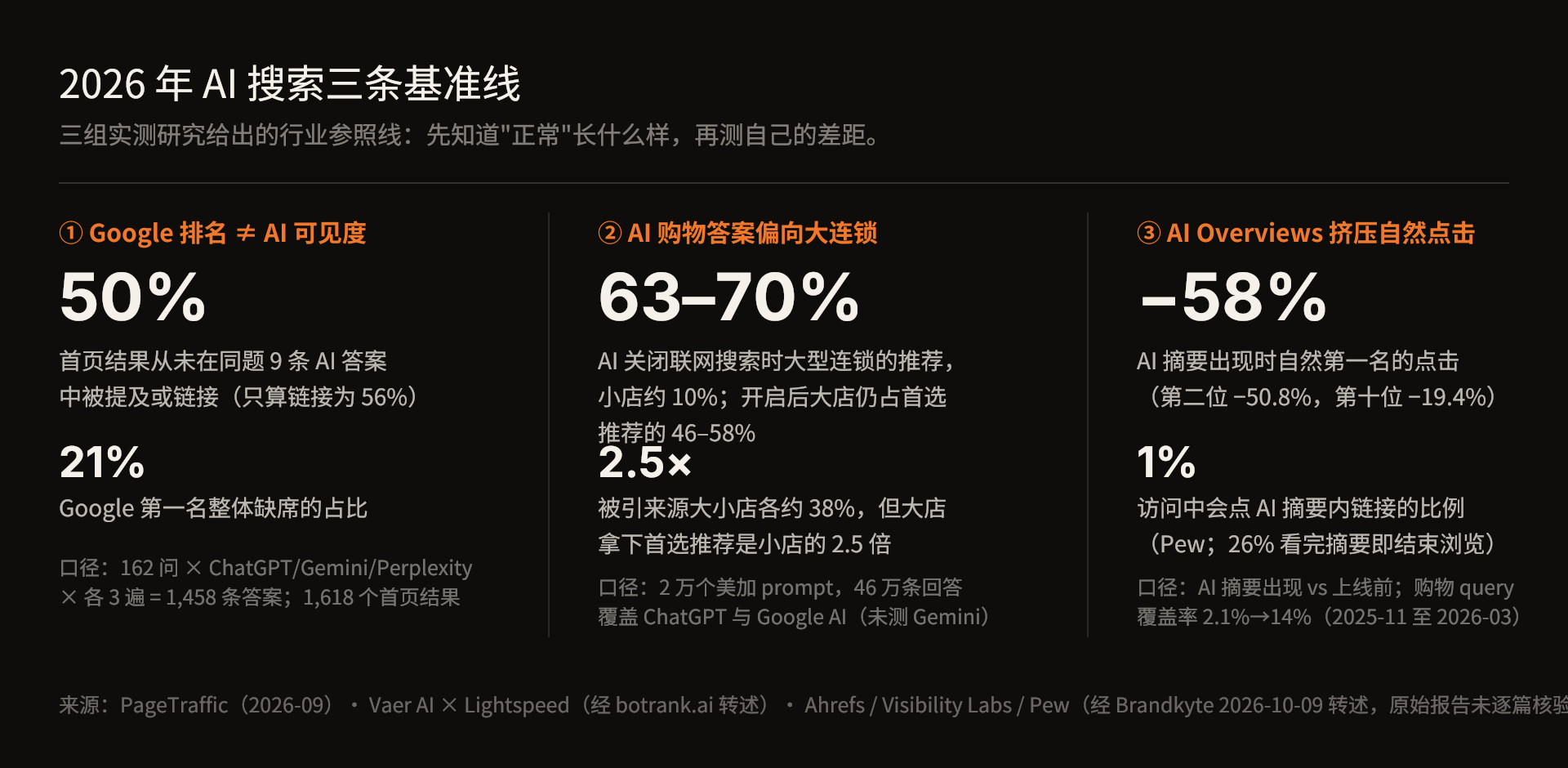
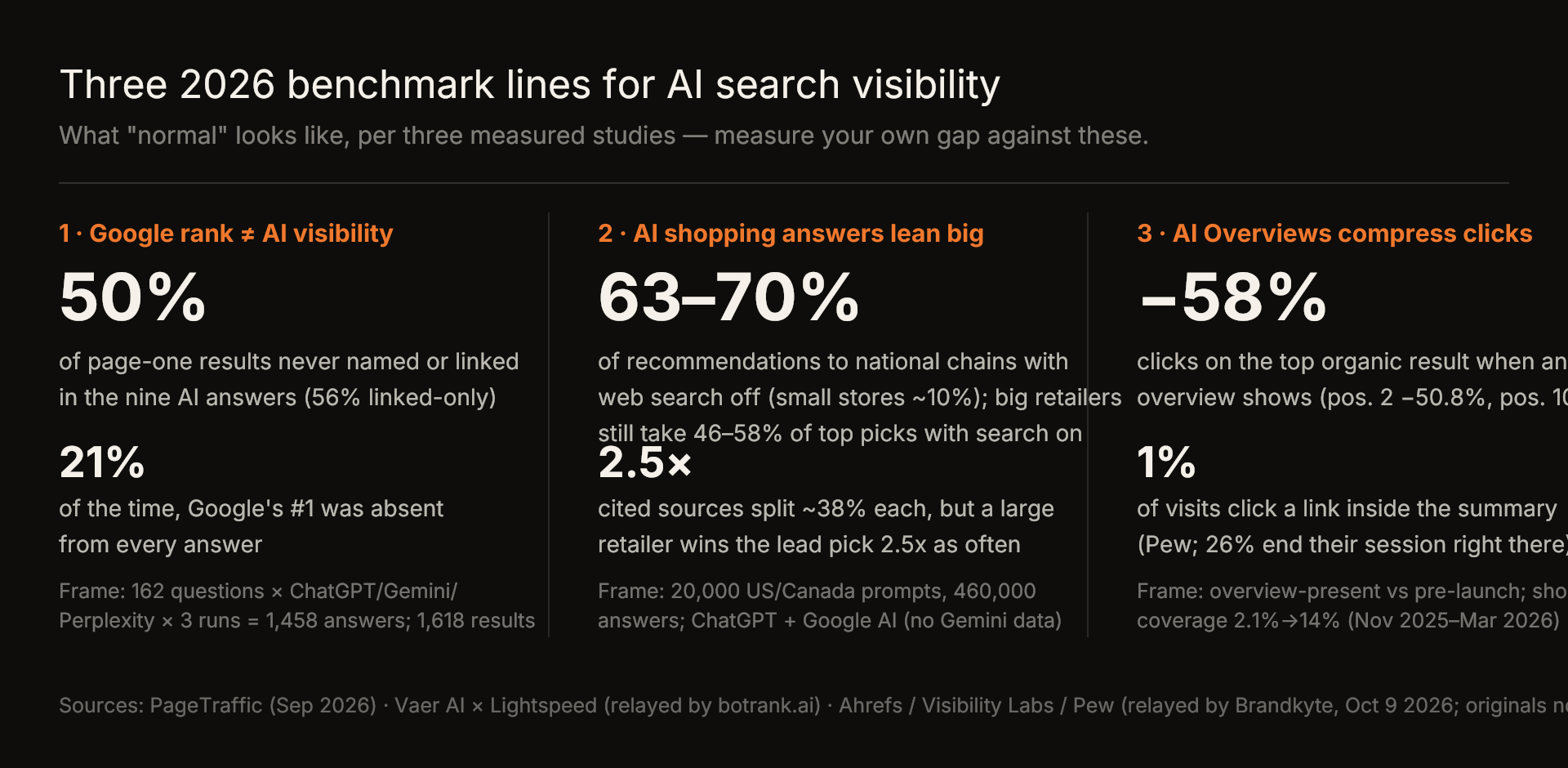
- SEO rank no longer implies AI visibility: in the 1,458-answer study, half of Google page-one results were never mentioned by the AI answers, and the #1 result was absent 21% of the time.
- AI shopping answers structurally favor big retail: 63-70% of recommendations with web search off (small stores ~10%), still 46-58% of top picks with it on. "Mentioned" and "recommended" are different numbers — record both.
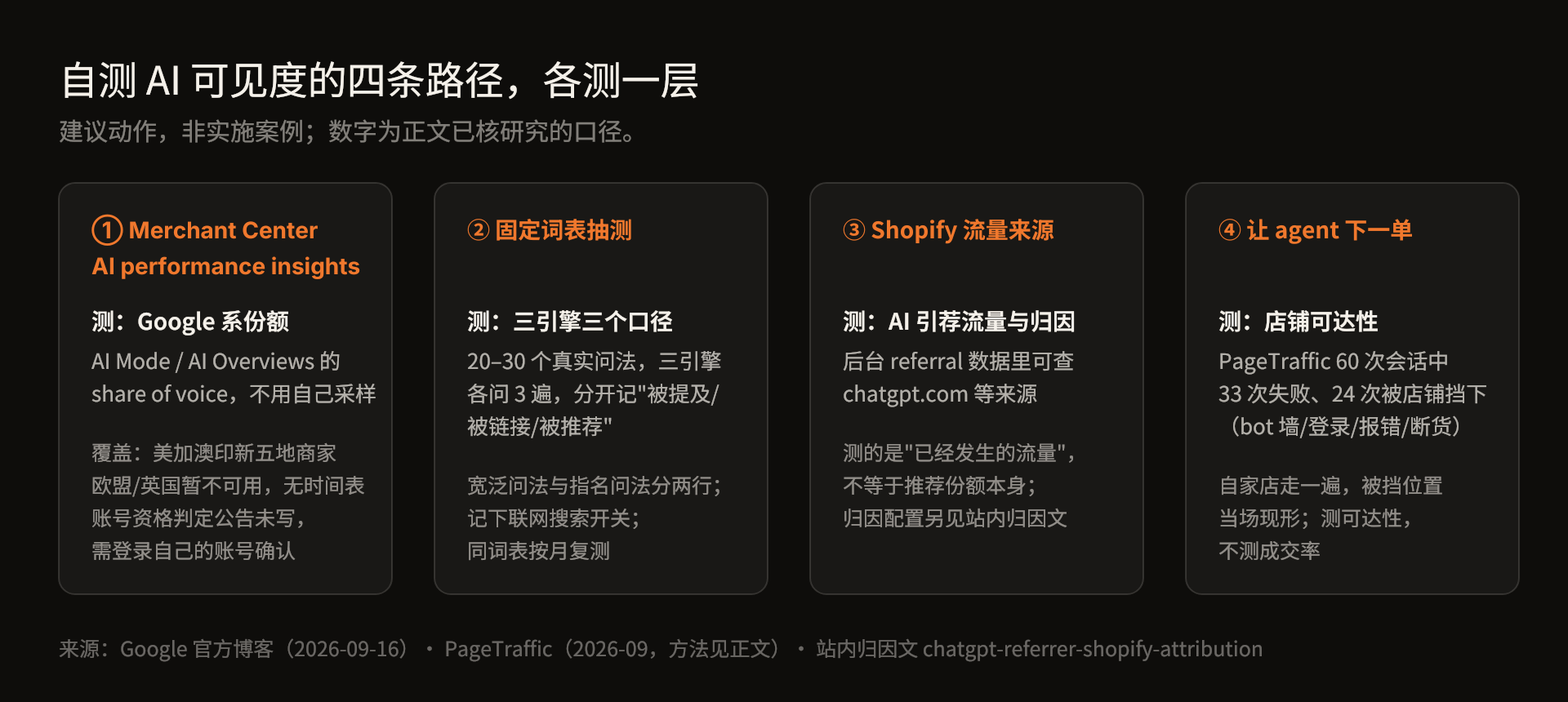
- Google opened AI performance insights (share of voice) in Merchant Center on Sep 16, for US/CA/AU/IN/NZ. Outside that list: a fixed prompt set, referral data, and one agent test order cover the rest.
Half of Google's page-one results never appear in the AI answers to the same question. That's the headline finding from PageTraffic's September 2026 study, which ran 162 real shopping questions through ChatGPT, Gemini and Perplexity three times each and compared 1,458 AI answers against Google's top ten.
If you're weighing whether to invest in GEO (generative engine optimization), that number is your starting point. The debate tends to run on belief — agencies quote wildly different prices, and a 36Kr report this month quoted Xu Jixiang, marketing lead at Konggu Network, saying GEO is young and vendors "may not have had time to settle their methodologies," while merchants remain "surrounded by information from all sides" without a clear picture. Belief wars end when someone produces a measurement. Buyers, meanwhile, moved first: the Sendcloud E-commerce Delivery Compass 2026 (8,000 consumers, 8 markets), cited by PageTraffic, found 43% of European consumers had already used an AI tool to decide where to buy, and 18.75% said it directly influenced their final purchase decision. This year, for the first time, you have industry benchmarks and an official report to measure against: three studies put hard benchmark lines on the board, and Google itself just shipped an AI visibility report inside Merchant Center. Here's what the data says, and how to read your own share of it.
What the 2026 benchmarks say
Your Google rankings don't predict your AI visibility
PageTraffic put 162 real shopping questions (beauty and apparel, three markets) to ChatGPT, Gemini and Perplexity, three runs each. Of the 1,618 Google page-one results across those keywords, 50% were never named or linked in any of the nine AI answers to the same question — 56% if you only count linked sources. And 21% of the time, Google's #1 result was missing from every answer.
The reverse also holds: 79% of the time the top result did show up. Rankings still matter. They just no longer imply "AI can see you" — and the gap between those two statements is exactly what measurement is for.
AI shopping answers lean big — by mode and by query
A Vaer AI study commissioned by Lightspeed analyzed 20,000 US and Canadian shopping prompts — 460,000 answers in total (200,000 with web search off, 260,000 with it on), across ChatGPT and Google's AI Mode and AI Overviews. With web search off, national chains took 63%–70% of recommendations while small independents got about 10%. Turn web search on and large retailers still take 46%–58% of top recommendations.
Two details matter more for measurement. First, cited and recommended are different metrics: among stores cited as sources, large and small retailers were roughly even at about 38% each — but a large retailer won the lead recommendation about 2.5 times as often. Counting mentions flatters you. Second, the query changes the distribution: broad prompts gave small stores roughly a third of top recommendations; prompts naming a specific product dropped them to about 10% (big chains rose from ~40% to 60%). One more control worth knowing: adding the word "independent" to the prompt lifted small stores to nearly four-fifths of picks.
So any test you run needs a fixed keyword panel — and so does any "AI exposure" number an agency shows you. Ask which metric it is.
AI Overviews compress the clicks that remain
A Brandkyte roundup from October 9, 2026 (relaying Ahrefs, Visibility Labs and Pew; originals not re-verified here) puts numbers on the click side. When an AI Overview shows, the top organic result earns about 58% fewer clicks than before the feature existed — with losses on every page-one slot, from about 50.8% at position 2 to 19.4% at position 10. The share of shopping queries showing an AI Overview climbed from 2.1% in November 2025 to 14% by March 2026 (Visibility Labs, 20.9 million shopping results). Pew found shoppers click a link inside the AI summary in just 1% of visits, and 26% end their session on an AI Overview page versus 16% on standard results.
Note the framing: these are "AI Overview present versus before" comparisons, not year-over-year traffic totals. Healthy numbers in your SEO dashboard are exactly the ones most exposed here — the higher you rank, the more the summary stands in for you.
Google's new AI performance insights: what it measures, who gets it
On September 16, Google's official blog made AI performance insights generally available in Merchant Center for businesses in Australia, Canada, India, New Zealand and the US. In Google's wording, it shows retailers "a clear view of how their brand and products are being discovered by comparing their share of voice with other brands across surfaces like AI Mode and AI Overviews," with suggested actions to improve discoverability.
Two boundaries to state plainly. The report is not yet available in the EU or UK, and Google has published no timetable for other markets — if you sell primarily into Europe, you can't read your own number there yet, and the self-test routes below are your only option. And the announcement doesn't spell out how eligibility is judged at the account level, so sellers based outside the five markets but selling into the US should confirm inside their own Merchant Center account.
Two context signals point the same way. The blog post itself notes that the Universal Commerce Protocol (a direct-checkout protocol used across Google) already enables checkout for "hundreds of thousands" of brands. And per the Brandkyte roundup of Alphabet figures, AI Mode crossed 1 billion monthly users as of May 2026. The platform is moving traffic and transactions into AI surfaces — and handing merchants the ruler at the same time.
Is the metric worth reading? Platform data from SHOPLINE, reported by 36Kr on October 23, offers one proxy: average conversion rate on AI-referred traffic is up 53.9% year over year — from 38% *below* traditional traffic last year to 41% above it this year (AI-channel visitors up ~775%). The same report adds a category caveat: parameter-rich categories like electronics, home and beauty get cited more easily; visually-driven categories like apparel and jewelry convert weaker even when they win AI traffic.
How to measure your own AI visibility
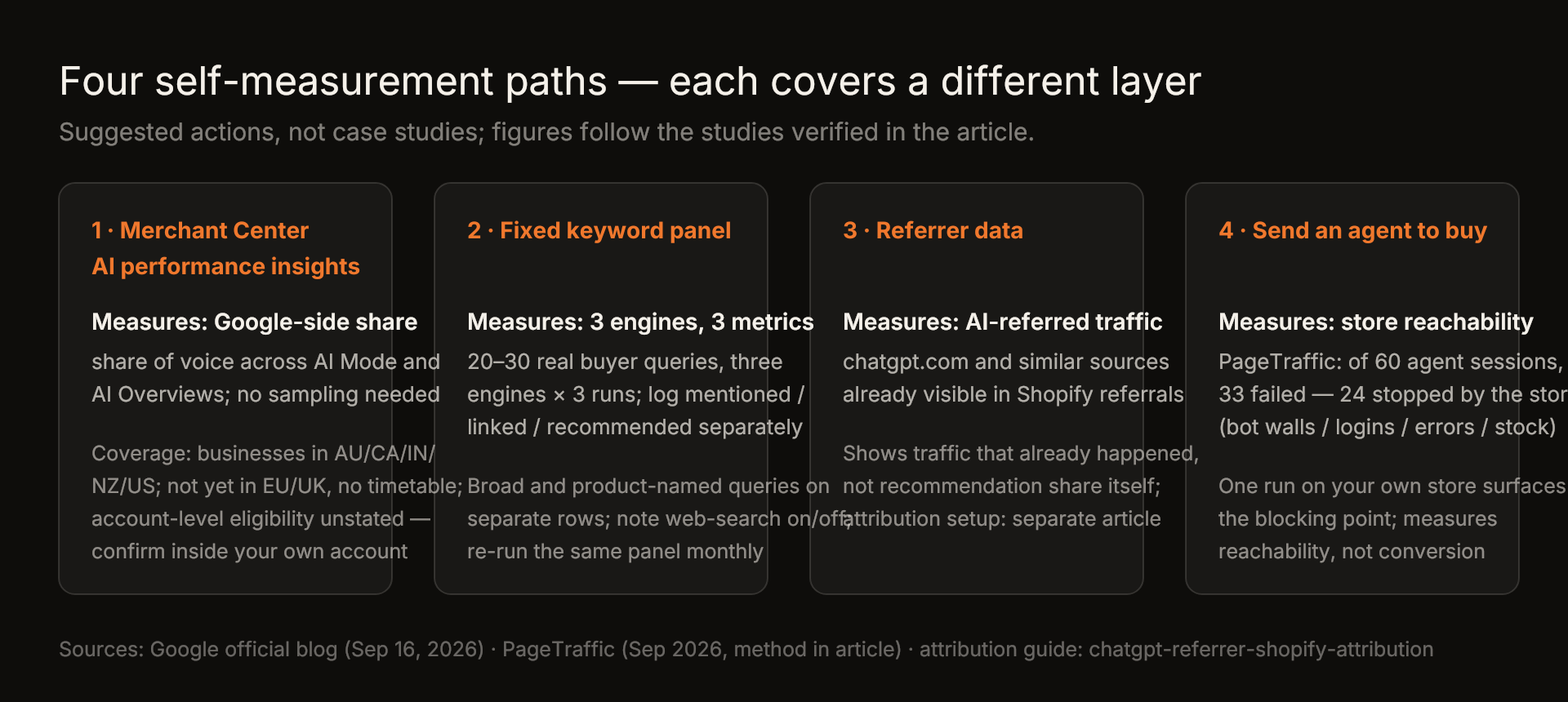
Four moves, each measuring a different layer. These are actions you can take — not case studies we've run.
- Read your official share of voice. AI performance insights in Merchant Center gives you the Google-side comparison number with no sampling effort on your part. The trade-off: it doesn't cover ChatGPT or Perplexity.
- Run a fixed-keyword panel. Scale down the PageTraffic method: pick 20–30 real buyer queries — broad ones ("best portable coffee maker") and product-named ones ("is [brand] coffee maker worth it") on separate rows — ask each across three engines, three times, and log three separate metrics: mentioned, linked, recommended. Record whether web search was on or off. Re-run the same panel monthly; only then do the numbers show a trend.
- Check your referrer data. chatgpt.com already shows up in Shopify's referral reports. We cover how to find it and set up attribution in a separate article.
- Send an agent through your own checkout. In PageTraffic's 60 live agent sessions (35 ChatGPT Agent, 25 Perplexity Comet; Google AI Mode refused all 35 briefs), 27 reached a cart or checkout. Of the 33 failures, 24 were stopped by the store itself — bot walls, forced logins, site errors, out-of-stock. Sessions stopped before payment by design, so this measures reachability, not conversion. One agent run on your own store surfaces the blocking point immediately.
What the benchmarks can't tell you
Set your own numbers against the benchmarks and "should we do GEO" turns into "which layer are we behind on, and by how much." Two things the benchmarks won't settle. First, the engines read different materials — SHOPLINE's summary: ChatGPT weighs entities and structured parameters, Gemini leans on Google's index, Schema and Merchant Center, Perplexity on real-time sourced footnotes, Claude on documented facts. One store, four different results; no single tool reads it all. Second, cross-engine attribution has no unified metric yet — that's the industry's own open problem, per the same 36Kr report.
Every benchmark here also carries its sample frame: 162 questions in two verticals, 20,000 US/Canada prompts, 20.9 million shopping results. They are reference lines from those samples, not your category's share. Use them as the lines to measure yourself against — then measure.
Measure the gap before you buy the fix
The 2026 data makes one thing testable: your distance from the benchmarks. Read your share of voice in Merchant Center if your market has access (EU and UK sellers are not on the list yet, with no official timeline — the self-test paths above cover the gap), run the panel for the engines Google doesn't cover either way, and send one agent through checkout to find your own blockers. What you do about the gap — in-house or with an agency — is a decision you'll make with numbers instead of nerves. If you want a second pair of eyes on verifying an agency's AI-visibility claims, we wrote an honest buyer's guide here.
Want help benchmarking your category and markets? Leave your product category and primary markets via the WayToGlobal contact form.
Want us to run the baseline numbers for your store?
Leave your category and target markets — we'll run a free AI-visibility baseline and show you the numbers before anything is signed.