30-second read
- The US $800 de minimis exemption ended August 29, 2025, and EO 14388 keeps the suspension through 2026 — every US-bound order now goes through duty assessment.
- The EU adds a €3 duty per item since July 2026 plus a ~€2 handling fee from November 1; the fee's billing unit still varies by provider.
- Landed cost is four blocks — product, shipping, duties and import taxes, carrier charges; carrier brokerage fees are never part of Shopify's checkout duty calculation.
- On returns, DDP label costs are gone and import taxes need a separate recovery process — reserve for both in margin.
If you sell into the US or the EU, nearly every cross-border order you ship now carries a cost that your pre-2025 duty-free playbook never accounted for. On August 29, 2025, the $800 de minimis exemption died for imports from every country — and in February 2026, Executive Order 14388 kept it dead. The order's own words: the exemption "shall not apply to any shipment of articles not covered by 50 U.S.C. 1702(b), regardless of value, country of origin, mode of transportation, or method of entry."
The question is no longer "should we go international." It's who pays that cost, when, and how you show it to the customer before they buy. This playbook walks through the four blocks of a landed cost, the DDP-versus-DAP decision, what Shopify's checkout collection actually covers, and what happens to the duties you already paid when a package comes back.
What actually changed, in two paragraphs
The US ended duty-free small parcels — indefinitely, for now. Executive Order 14324 suspended duty-free de minimis treatment for all countries effective August 29, 2025. EO 14388, signed February 20, 2026, continued the suspension through 2026 — including postal shipments, where carriers must now collect and remit duties to CBP, with the item's value and country of origin declared. CBP's own e-commerce page shows de minimis volume — counted in bills of lading — falling from about 1.36 billion in FY2024 to 942.5 million in FY2025. The channel is still there; the tax-free ride isn't.
The EU stacked fees on low-value orders. Consignments up to €150 have carried a temporary €3 customs duty per item since July 1, 2026 (running until the EU Customs Data Hub takes over in July 2028), per the European Commission's guidance page. On November 1, carriers and fulfillment providers began applying a roughly €2 handling fee on top — though the billing unit varies by provider (per parcel, per declaration line, or per item), and the Commission's page as updated in July still lists the fee's amount and date as "to be determined." We cover the product-ID filing side of the EU rules in a separate checklist; this piece is about pricing and collection.
The seller side of this pain is loud and current. A mid-October r/shopify thread with 20+ comments (seen via search snippets; thread bodies not individually verified) runs the list: "The headaches are mostly duties/taxes, expensive returns, longer delivery, fraud, currency, support and country-specific consumer rules." And the customer side is worse: the same Reddit discussions describe Canadian buyers hit with roughly 30%–35% in surprise charges and UK buyers with 35%–40%.
Landed cost is a four-block sum, and the leaks are in blocks three and four
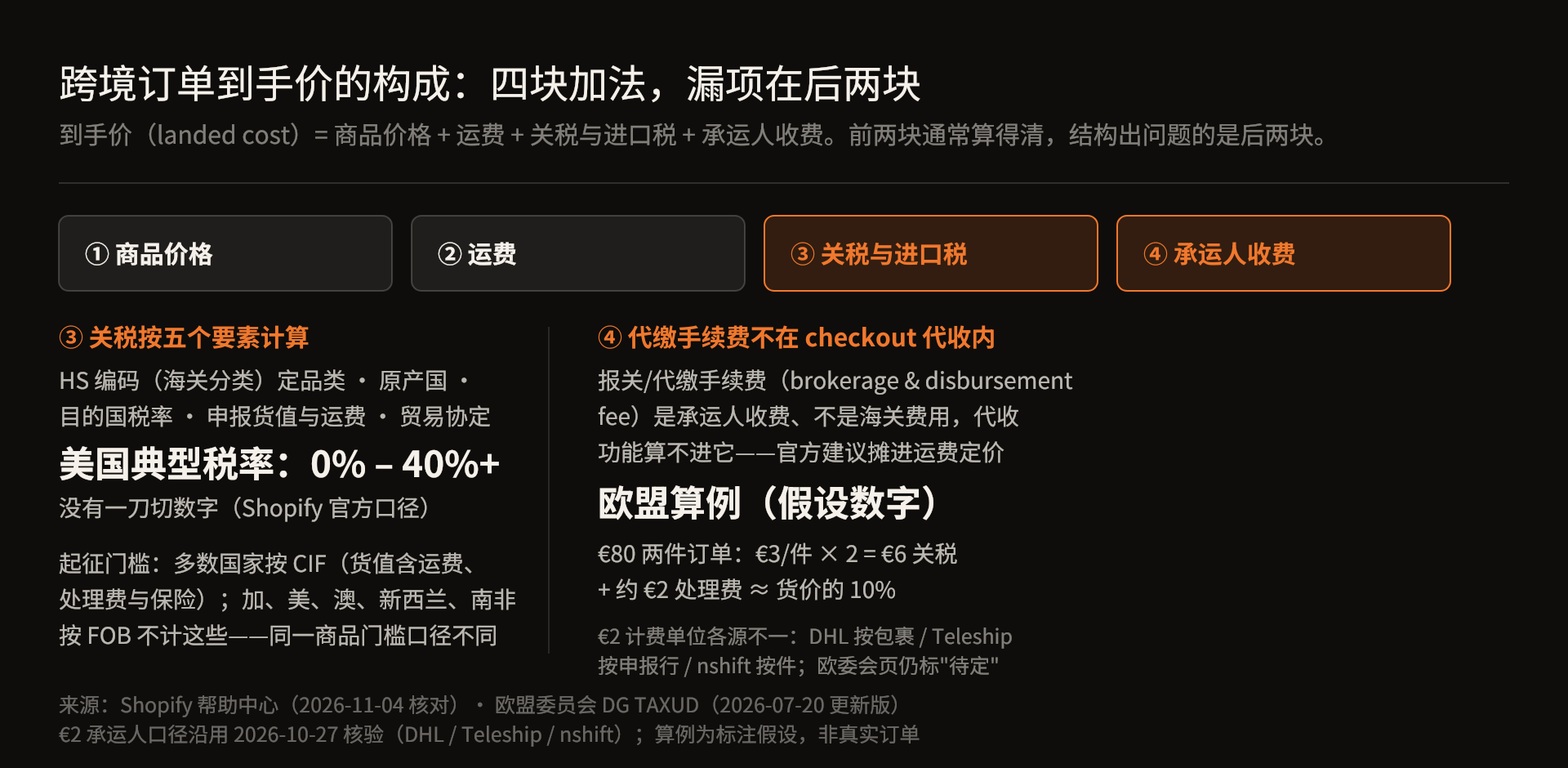
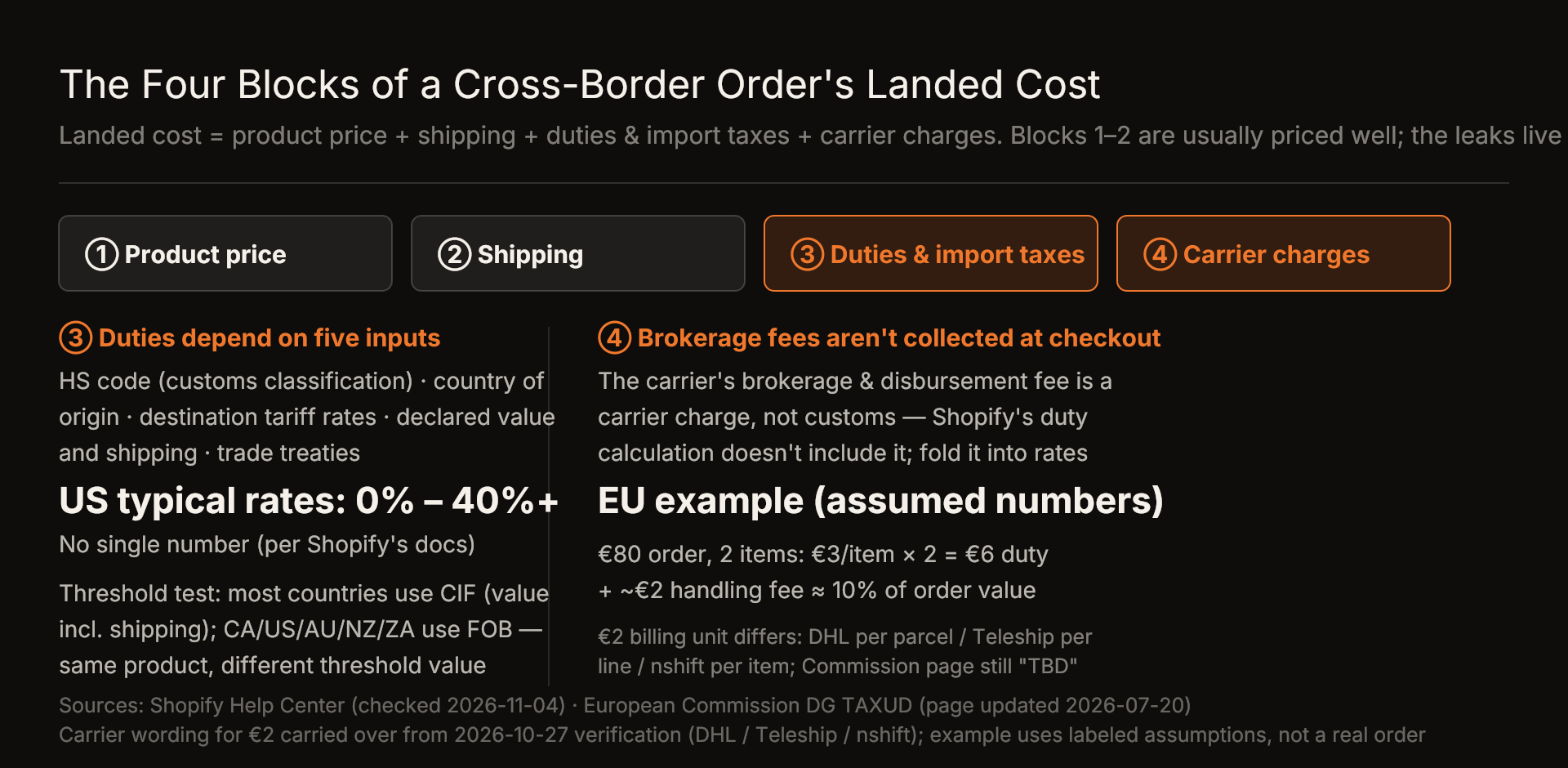
Landed cost = product price + shipping + duties and import taxes + carrier charges. Most stores price blocks one and two carefully. The structure of blocks three and four is where international margins die.
Duties depend on five inputs. Per Shopify's help center: declared value and shipping costs, the product category set by its HS code (the customs classification for your product), country of origin, the destination's tariff rates, and applicable trade treaties. For the US, Shopify puts typical rates at "0% to over 40%." There is no single number.
Even the threshold test varies by destination. Most countries include shipping, handling, and insurance (CIF) when determining whether a shipment is above duties and import tax thresholds; Canada, the US, Australia, New Zealand and South Africa exclude those costs (FOB). The same product shipped to Germany versus the US is measured against a different customs value.
Carrier fees are the quiet fourth block. The brokerage and disbursement fee your carrier charges for clearing customs is a carrier charge, not a customs duty — so it is not included when Shopify calculates duties at checkout. Shopify's own advice: if you need to pass it on, bake it into your shipping rates. (Specific carrier fee schedules weren't verifiable this round; treat the fee as a real line item with an amount you confirm with your carrier.)
A rule-based example for the EU, using assumed numbers: an €80 order with two items picks up €6 in flat duty (€3 per item) plus roughly €2 in handling — about 10% of order value at €8 total, or €10 if your provider bills the handling fee per item. Because the €2 billing unit has no single official answer yet, no one can compute an EU order's landed cost to the cent today. The workable move is to cover the big blocks and label the euro or two of uncertainty as an explicit buffer, not to pretend precision.
DDP or DAP: you're choosing who faces the uncertainty
Two shipping terms decide who pays, and they're a pricing decision before they're a logistics one. Per Shopify's definitions:
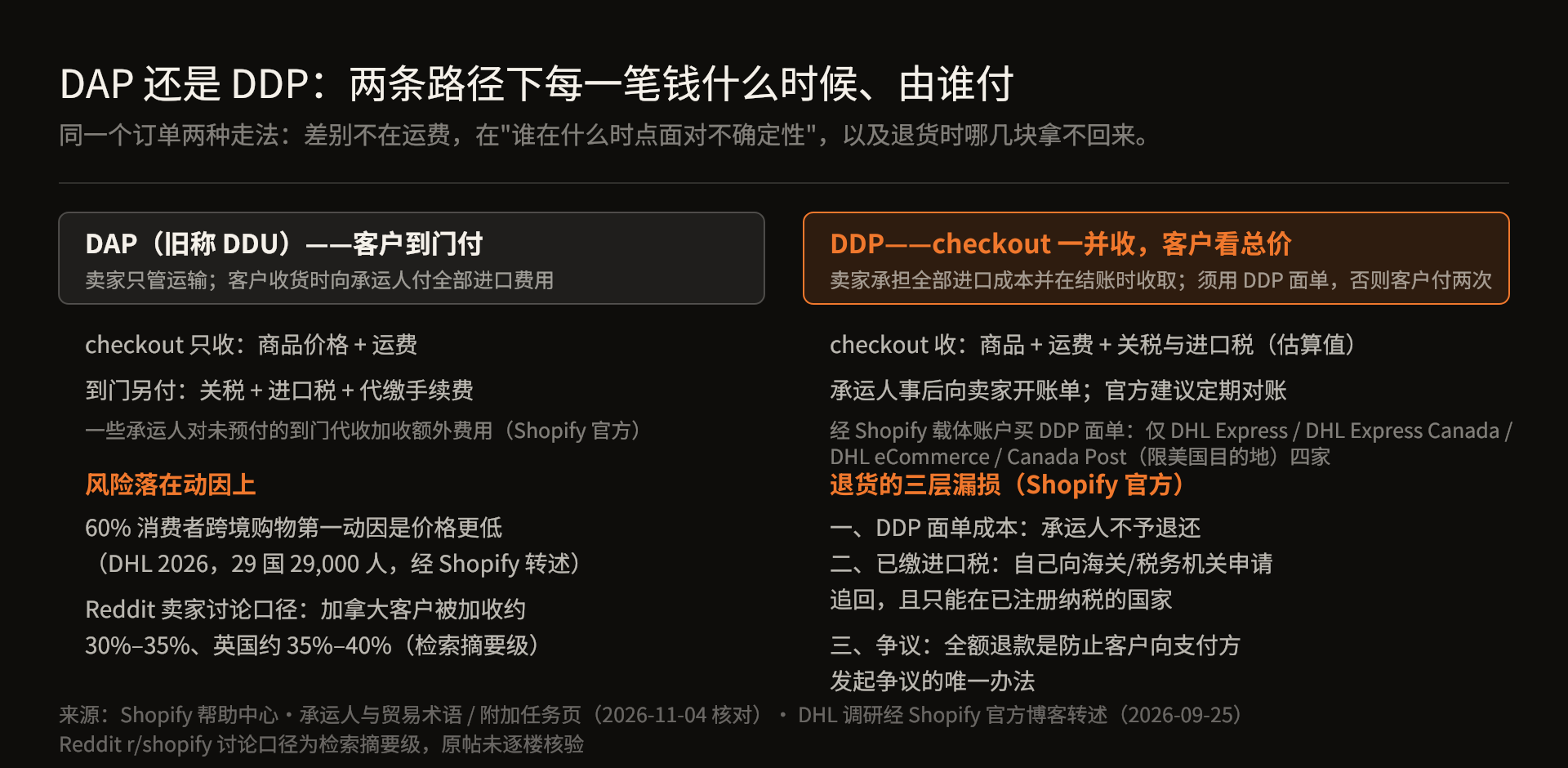
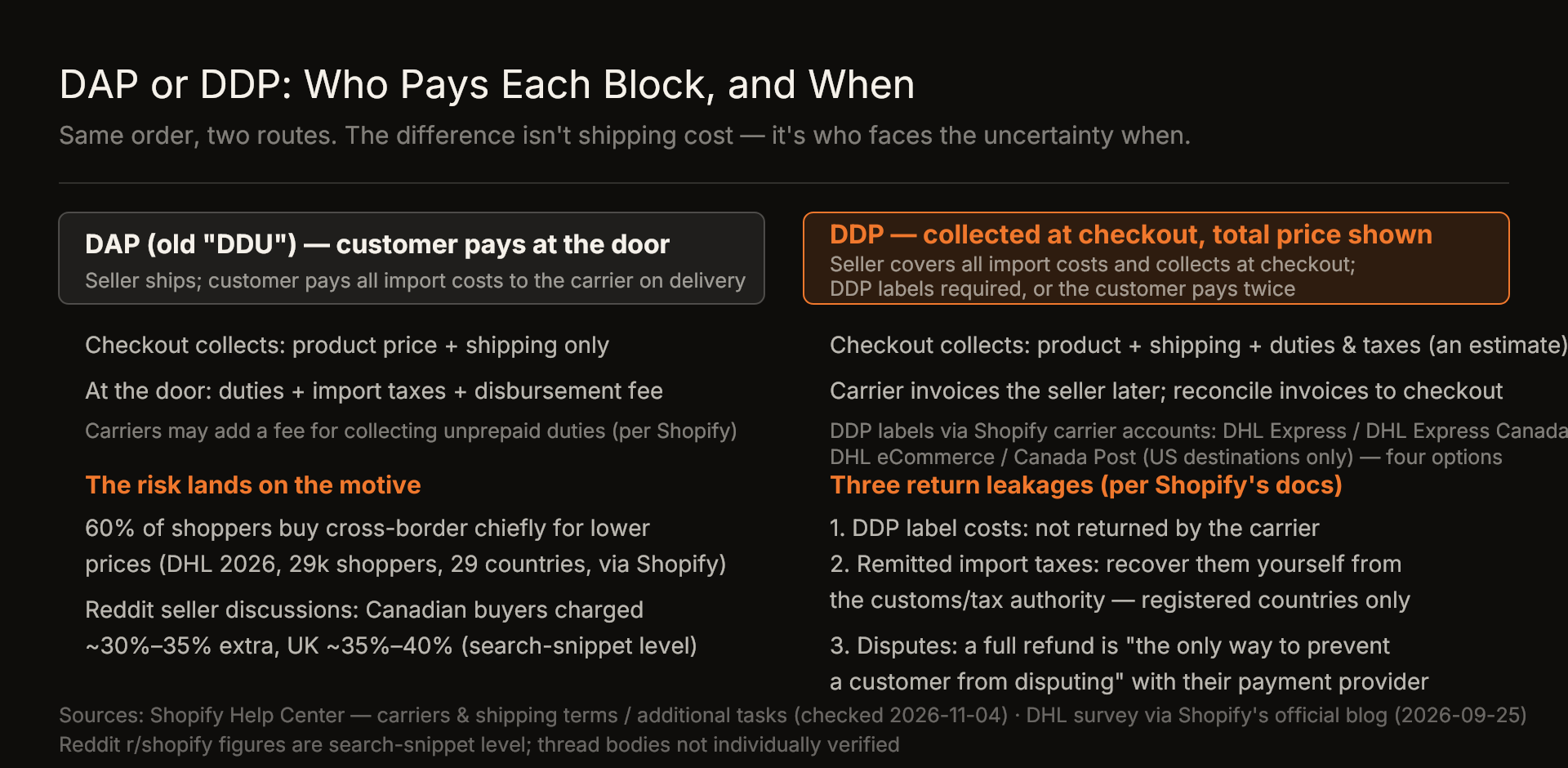
- DDP (Delivered Duty Paid): the seller covers all import costs — duties, import taxes, brokerage and disbursement fees — and can collect them at checkout. The customer sees a total price, and it helps avoid delivery delays.
- DAP (Delivered at Place; the old "DDU"): the seller ships, and the customer pays the carrier all import charges on delivery. Some carriers charge an extra fee for collecting duties at the door if they weren't prepaid.
The stakes aren't abstract. DHL's 2026 survey of 29,000 shoppers across 29 countries (cited by Shopify's international sales guide) found the #1 reason people buy cross-border is lower prices — 60%. A doorstep bill for duties plus a collection fee lands exactly on that motivation, and it's where those Reddit-reported 30–40% markups come from.
DDP moves the uncertainty to your side of the table: you have to estimate it, collect it, and recover it. For low-AOV, price-sensitive segments, that trade is usually worth it. Three execution constraints to know first: in most cases, Shopify recommends DDP for regions with a low-value goods tax like the EU and UK so over-threshold orders also get duties and import taxes calculated at checkout; buying DDP labels directly through Shopify's carrier accounts currently supports only four options — DHL Express, DHL Express Canada, DHL eCommerce, and Canada Post for US destinations — other carriers mean setting up DDP with the carrier yourself; and you can't offer DDP and DAP in the same country, so the choice is per-market, not per-order.
Showing landed cost at checkout: what it does, what it doesn't
Shopify's duty collection exists for the DDP path: the customer sees a duty-and-tax total at checkout, you hold the money, and the carrier invoices you later. Four boundaries, all from Shopify's own documentation — the duties overview, considerations, and additional tasks pages:
- It's an estimate. The collected amount is an estimate at order time; customs has the final word, and a wrong HS code produces a gap. Shopify recommends periodically reconciling carrier invoices against what checkout collected.
- There's a transaction fee on any checkout that calculates duties — including test orders. Shopify's own blog states that "optional duties calculation currently carries a temporary 0.5% fee."
- Collecting duties obligates you to DDP labels. Skip them and "your customer pays for the duties and import taxes twice." The commercial invoice must match the order on five fields: HS code, origin country, discounted price, quantity, and duties collected.
- No "Rest of world" zone. Duty collection needs each destination country set up as its own shipping zone; domestic and intra-EU shipments don't calculate.
These are operating costs, not reasons to opt out. Every US-bound order now goes through duty assessment (the rate can be zero; the process can't be skipped); the realistic comparison is a transparent total at checkout versus a surprise bill at the door.
The returns math: paid duties don't automatically come back
International returns leak in three layers, and all three are documented behavior, not edge cases:
- DDP label costs are gone. On fulfilled-order refunds, Shopify states plainly: "any funds that you have used to purchase DDP labels aren't returned to you by the carrier."
- Import taxes need a separate recovery process. You must contact the destination customs or tax authority to recover taxes you remitted — and only in countries where you're registered. Skip the process and it's a pure loss.
- Disputes leave you one option. In Shopify's words, a full refund is "the only way to prevent a customer from disputing an order with their payment provider."
Pricing implication: reserve (return rate × (shipping + label cost + potentially unrecoverable taxes)) in your margin for international orders, rather than treating each return as a surprise.
Price the uncertainty; don't hide it
Shopify's own checklist for US-bound sellers is the starting point: add HS codes and country of origin to every product, re-review pricing to absorb the new costs, consider collecting duties at checkout, ship on DDP labels, update your shipping and returns policies, and test the checkout as a US customer. The same list applies to the EU, plus the product-ID filing requirement that took effect November 1 — our EU customs checklist covers that layer, and this guide covers which store architecture to run it on.
What's still honestly unresolved: carrier disbursement fee schedules and the US postal surcharge rate weren't verifiable from official pages this round — and the EU's €2 handling fee is three days old, so no real invoices exist to reconcile billing units against. When those numbers land, landed-cost estimates narrow by another notch. Until then, computing all four blocks and labeling the residual uncertainty beats quoting a false total — for your margin and for the customer deciding whether your price is still the reason to buy from abroad.
Want a landed-cost structure rebuilt for your category and target markets?
Leave your product category and primary markets — we'll run the four-block math for your setup.
Sources
- Executive Order 14324 — suspending duty-free de minimis treatment for all countries — federalregister.gov
- Executive Order 14388 — continuing the suspension (2026-02-20) — federalregister.gov
- CBP — e-commerce & de minimis statistics — cbp.gov
- European Commission, DG TAXUD — €3 flat fee guidance (until 1 July 2028) — taxation-customs.ec.europa.eu
- Shopify Help Center — understanding customs fees — help.shopify.com
- Shopify Help Center — carriers and shipping terms (DDP / DAP) — help.shopify.com
- Shopify Help Center — duties overview / considerations / additional tasks — help.shopify.com
- Shopify blog — international sales tools (DHL 29,000-shopper survey) — shopify.com