30-second read
- ChatGPT Ads hit a $1B annual run rate in under 200 days — the fastest new ad surface open to brands in years.
- A category playbook: which DTC verticals test first, with what creative and budgets.
- Measurement is the open question — set the attribution story before the spend.
title: "ChatGPT Ads for DTC Brands: A Category-Level Q4 Playbook" slug: chatgpt-ads-for-dtc-brands date: 2026-10-27 meta-description: "How ChatGPT Ads actually works, what two verified ecommerce campaigns returned, and how to set attribution so you can judge the channel yourself."
# ChatGPT Ads for DTC Brands: A Category-Level Q4 Playbook
You're weighing a Q4 budget for ChatGPT Ads. So you search, and you find a dozen confident answers pointing in opposite directions: some say AI-referred traffic converts better than Google, some say AI crawlers take your site and send nobody back, and some describe ChatGPT advertising as "keyword ads, but smarter."
Each of those is partly right. What they get wrong is scope. This article assembles the verifiable pieces: the ad system mechanism OpenAI has published, two ecommerce campaigns with public results, and how attribution actually works — because most of the contradiction comes from nobody stating which methodology produced which number.
Three things are settled before we start.
This is a real channel you can buy. On August 31, 2026, OpenAI announced that ChatGPT Ads had reached $1 billion in annualized revenue run rate less than 200 days after launch, with more than 100,000 advertisers running campaigns. On September 23 it added seven Asian markets — Indonesia, Malaysia, the Philippines, Singapore, Thailand, Vietnam, and Taiwan — bringing availability to more than 60 countries. One detail is easy to miss: ads are shown only to Free and Go subscribers. Pro and Enterprise plans stay ad-free.
The mechanism is not keyword advertising. Plenty of write-ups — including several in Chinese — compare ChatGPT Ads to "smarter keyword ads." The direction is right. The mechanics will mislead how you set up the campaign.
The channel has no published benchmark, so you build your own. OpenAI publishes no CTR, conversion rate, or customer-acquisition-cost figures. The only numbers available are brands' own, and the comparison has to be yours. So the useful question isn't "is this channel good" — it's "what am I comparing it against?"
1. The Unit of Decision Is a Conversation, Not a Query
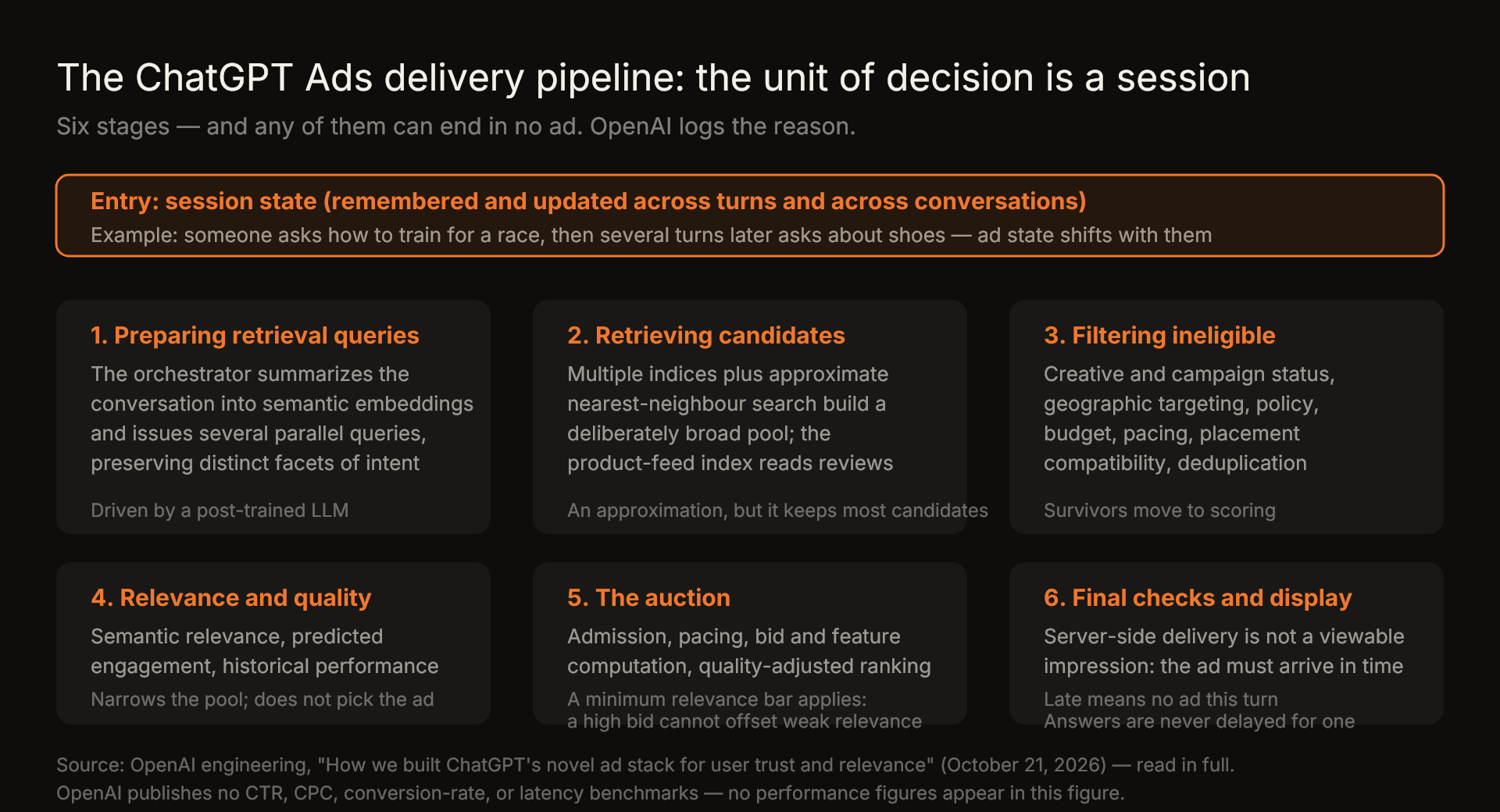
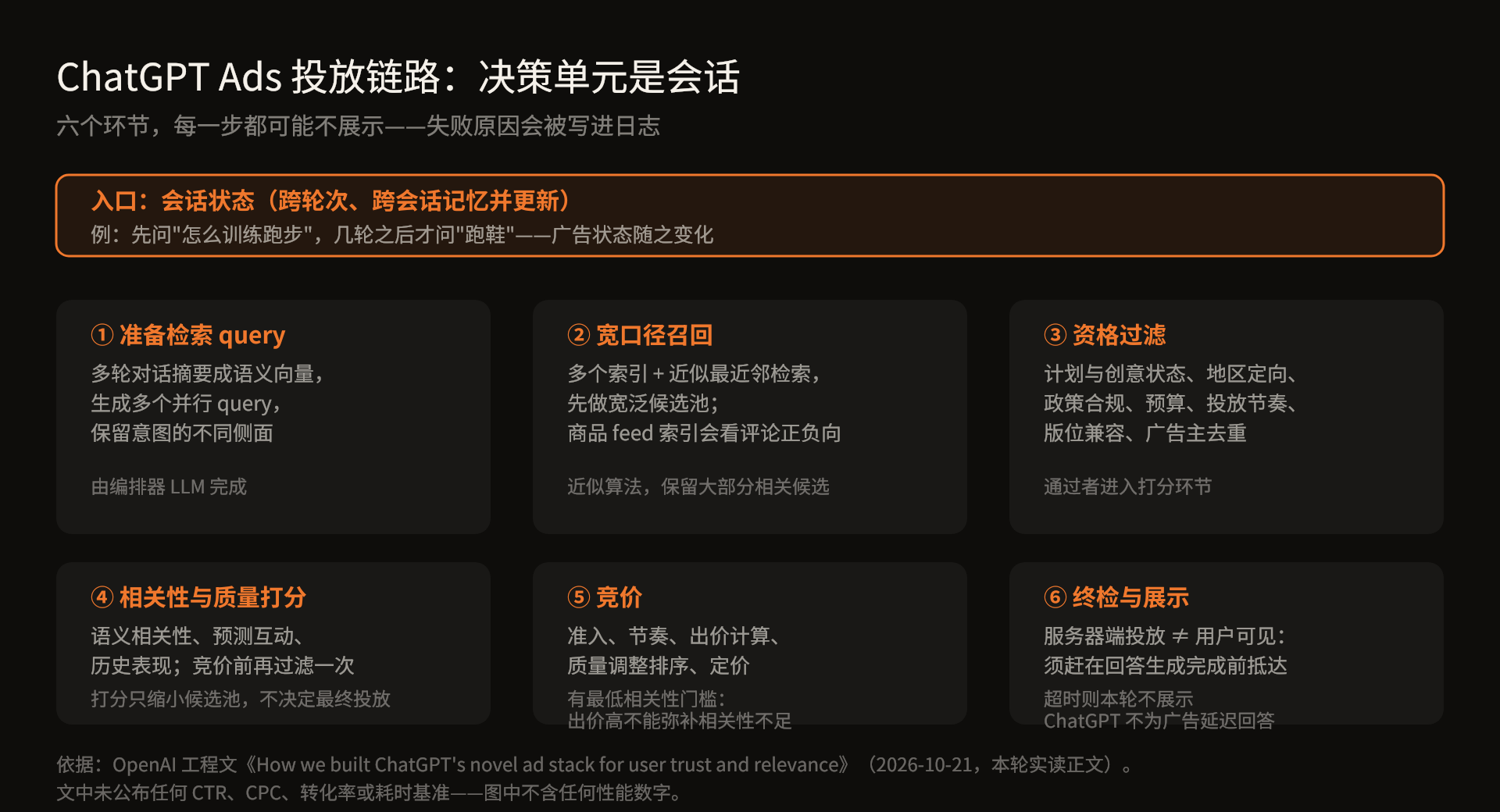
On October 21, 2026, OpenAI's engineering team published a complete technical description of the ad system — currently the only first-party account of how it works. The most important line: the ChatGPT ads system does not run on its own models and its own code. It runs alongside answer generation, independently, in its own service. That architectural boundary produces two consequences. If the ads system fails or slows down, ChatGPT's answers are unaffected. And showing no ad is an ordinary, successful outcome — the system delivers only when an ad is clearly beneficial to users and advertisers alike.
What decides how you operate the campaign is the unit of decision. Conventional ad systems start from discrete events: a search submitted, a page viewed. People arrive at ChatGPT with a goal, and the goal gets more specific across a conversation. OpenAI's own example: someone asks how to train for a race, and several turns later asks about shoes. The unit of decision is therefore the session — ad state is remembered and updated across turns and across conversations.
The operational consequence is concrete: your creative has to match the thing the user is discussing right now, not a category keyword. Tecdo's October 24 explainer, "The Trigger Logic of ChatGPT Ads: Intent Resonance," puts the rule plainly: an ad is displayed when the user-side and advertiser-side intents match. Their example is small-apartment bedroom storage — a user asks how to save space, ChatGPT infers "space-saving bedroom cabinets suitable for small apartments," and matches ads against that.
The full pipeline runs in six stages (see Figure 1): preparing retrieval queries → broad retrieval → eligibility filtering → relevance and quality scoring → the auction → final checks and display.
Two details are worth keeping. The auction enforces a minimum relevance bar — the orchestrator only nominates contextually appropriate candidates, and pricing belongs to a separate auction tool. And server-side delivery isn't the same as a viewable impression: the ad has to arrive before ChatGPT finishes generating its answer, or it doesn't appear that turn. The system logs why — the turn wasn't eligible, retrieval returned no candidates, candidates failed hydration or eligibility, or an ad was delivered and received an interaction. So zero impressions are diagnosable, not a black box.
2. Two Verified Ecommerce Campaigns, and Their Caveats
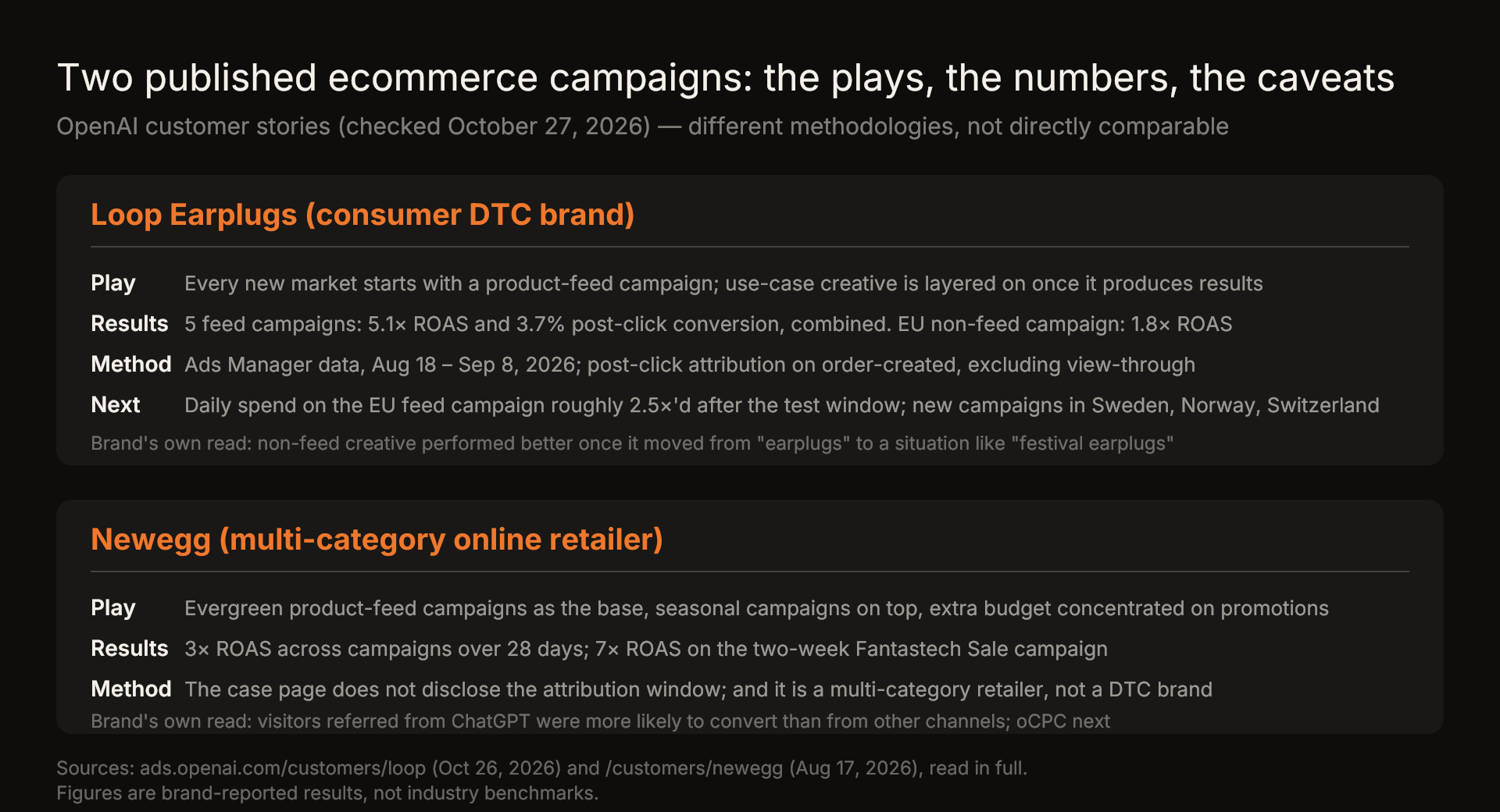
OpenAI's customer stories page carried seven case studies on October 27. Only two are consumer ecommerce purchases: Loop Earplugs and Newegg. The rest are tools, lead-gen, and developer products. A thin case list isn't evidence of weak performance — OpenAI only publishes brands that agree to be published — but it does mean the verifiable ecommerce sample is small.
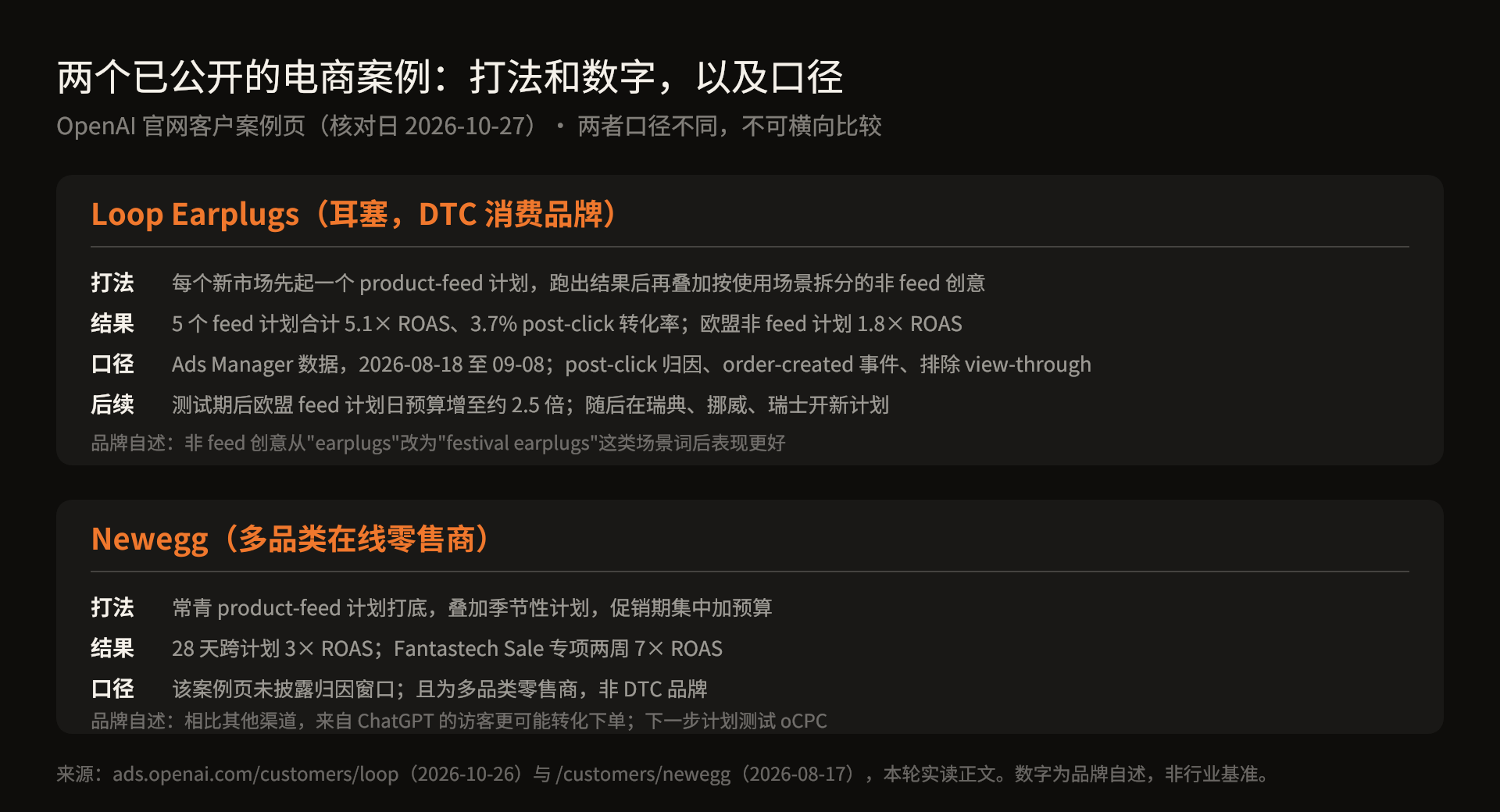
Loop Earplugs is the more transferable of the two, because the structure of the approach transfers: for each new market, start with a product-feed campaign, then layer on non-feed creative split by use case once the feed campaign has results. A product feed is a catalog — name, description, price, images, availability — and ChatGPT Ads uses it to generate ads featuring specific items. Loop prepares a feed per market with the right language, currency, and pricing.
The numbers (per the case page footnote: Loop's Ads Manager data, August 18–September 8, 2026; post-click attribution on the order-created event, excluding view-through conversions): five live product-feed campaigns returned 5.1× ROAS and a 3.7% post-click conversion rate combined; a non-feed EU "concerts and music" campaign returned 1.8× ROAS. After the test window, Loop roughly 2.5×'d daily spend on the EU feed campaign and opened new campaigns in Sweden, Norway, and Switzerland.
Loop's own read on why is more useful than the ROAS: non-feed creative performed better once it moved from generic "earplugs" to a specific situation like "festival earplugs." In their words, "someone describes a situation, not a product category, so a campaign built around a situation has something to connect to."
Newegg took a different shape: evergreen product-feed campaigns as the base, seasonal campaigns layered on, and extra budget concentrated on promotion windows. It recorded 3× ROAS across campaigns over 28 days and 7× ROAS on a two-week Fantastech Sale campaign. Performance marketing manager Alec Shao also noted that, compared with other channels, visitors referred from ChatGPT were more likely to convert and purchase. Two caveats matter: Newegg is a multi-category retailer rather than a DTC brand, and the case page does not disclose the attribution window — so 3× and 7× cannot be set directly beside Loop's 5.1×.
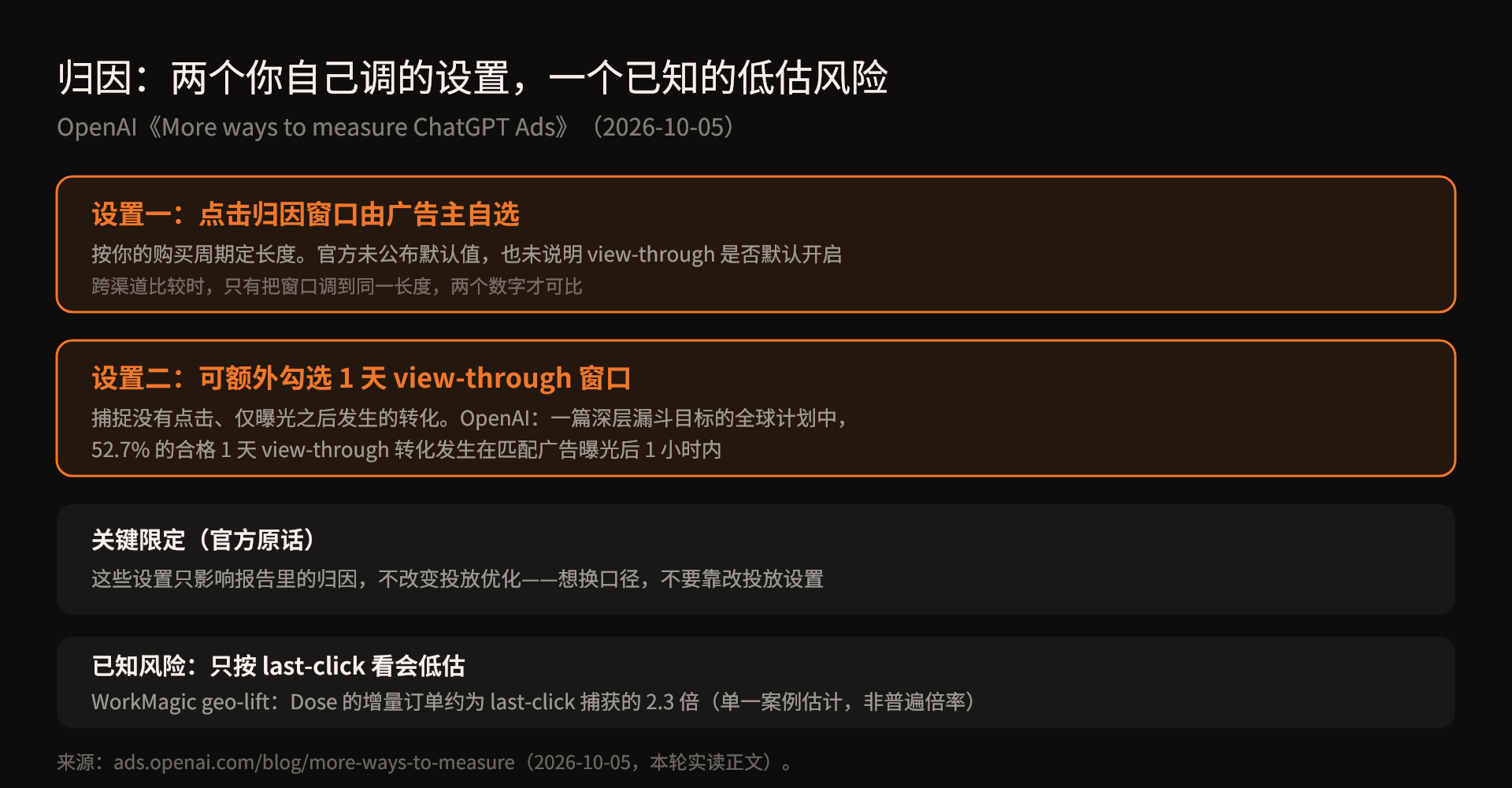
That is precisely why you build your own control. In OpenAI's October 5 measurement update, DV Rockerbox measured WeightWatchers' attributed CPA on ChatGPT Ads at 15.3% below its blended paid-search benchmark, and WorkMagic's geo-lift study estimated 2.3× more incremental orders for Dose than last-click attribution captured. The first is a brand measured against itself; the second shows last-click understates the channel. But 2.3× is one brand's estimate, not the channel's typical multiplier.
3. How to Account for It: You Set the Attribution Window
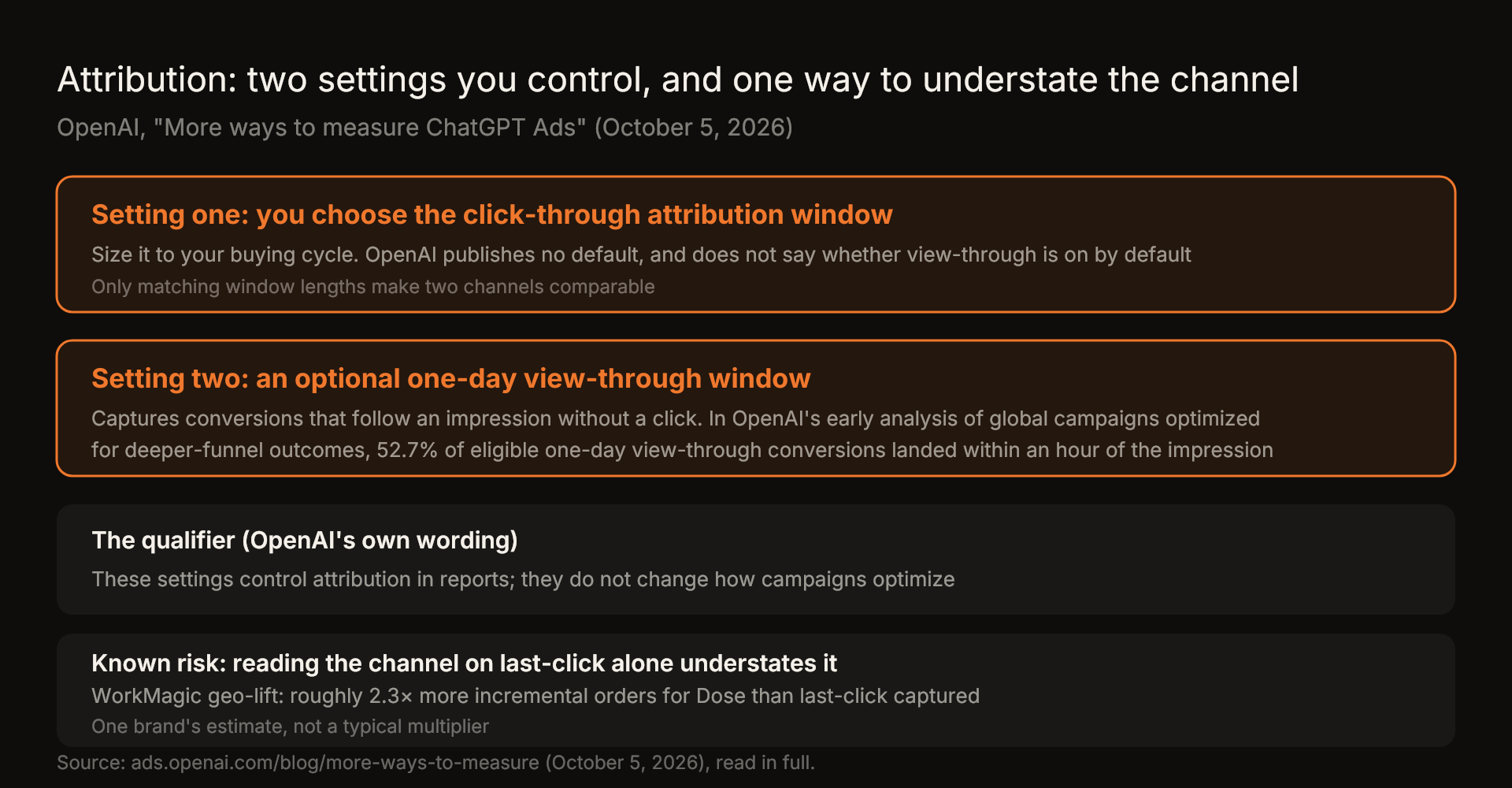
This is the most practical section of the article. ChatGPT Ads gives advertisers two adjustable attribution settings. You choose the click-through attribution window, sized to your buying cycle. You can additionally enable a one-day view-through window to capture conversions that follow an impression without a click. And one qualifier has to be quoted exactly: these settings control attribution in reports; they do not change how campaigns optimize.
That is not a minor point. If you read the channel on last-click alone, you will also understate it — in OpenAI's early analysis of global campaigns optimized for deeper-funnel outcomes, 52.7% of eligible one-day view-through conversions occurred within an hour of the matched ad impression. But you also can't put ChatGPT Ads on the same ruler as your existing paid search while running last-click only.
The measurement stack is in place. Pixel and Conversions API send purchases, leads, installs, and sign-ups back and feed optimization. Ten attribution and reporting partners are listed (AppsFlyer, Triple Whale, Adjust, DV Rockerbox, Northbeam, and others), with Hightouch, Tealium, and LiveRamp on the data-ingestion side, Haus, Measured, and WorkMagic on geo incrementality experiments, and DoubleVerify and IAS piloting brand-suitability evaluation. An Event Quality Score rates the quality of your conversion signals, and qualifying advertisers can use Negative Phrases to block contexts they don't want.
And the honest headline: OpenAI publishes no industry benchmarks — no CTR, no average CPC, no acquisition-cost reference. "Is this channel good" has no answer until you have your own comparison data. The method is straightforward: same attribution settings, same time window, ChatGPT Ads against the paid search or social channels you already run.
Two boundaries belong in your compliance checklist. Advertisers don't get access to private conversations. And placement guardrails keep ads out of emotionally vulnerable, sensitive, or otherwise unsuitable contexts. Which means you cannot determine from public material whether a sensitive category is eligible in your market — only OpenAI's sales support can answer that.
4. The Q4 Calendar, and What to Finish Before the Rush
OpenAI's holiday page lays out a specific calendar. These figures are all OpenAI internal data and cannot be independently verified, so that qualifier travels with every number:
- - More than 1.7 billion retail and ecommerce conversations on ChatGPT each week (internal data, September 1–30, 2026);
- - Approximately 43% of shopping-related ChatGPT conversations involved comparing and evaluating options (internal data, September 21–October 18, 2026);
- - U.S. product-search activity on ChatGPT rose 52% during the 2025 holiday season (internal data, Nov 1–Dec 31 versus matched weekdays Oct 4–31);
- - During Cyber Five 2025, U.S. product-search activity increased 47% on average and 94% on Black Friday versus matched weekdays across the prior four weeks.
OpenAI's recommended order of operations: complete account, conversion measurement, and product catalog setup before holiday demand builds; align campaigns and budgets with key shopping dates; build distinct creative around seasonal products, holiday offers, and shipping deadlines; optimize continuously on early signals. There's also a new-advertiser offer: spend $500, get $500 in ad credit, ending December 31.
On timing, CommerceV3's September 30 Q4 Playbook offers a comparison worth borrowing: ads can go live quickly, while earned AI visibility takes weeks to accumulate, so the work belongs in September and October rather than November. That's a vendor's view rather than a platform rule, but it lines up with Loop's timeline — first campaign in June, budget increased late August, results in early September.
5. What This Evidence Doesn't Cover
Beyond the missing benchmarks, two gaps are worth naming. There are no published rules on which categories placement guardrails restrict, so a DTC brand in a sensitive category has to ask the platform directly. And this article covers only the paid side: no verifiable public experiment establishes a causal relationship between AI organic visibility (GEO) and paid ad performance. You can do both; you cannot assume the first makes the second work better.
A few widely repeated claims did not survive this review. Botify's "5.4x" means AI bot traffic growth in 2025 in one of its posts, and a 5.4x jump in genuine human visits from ChatGPT after OpenAI's agentic commerce launch in another — different metrics, and mixing them produces a completely wrong conclusion. A PerkFuel article claiming "ChatGPT converts better than Google" attributes that to an academic study whose public abstract describes "a descriptive study of 973 ecommerce websites," with no mention of "50,000 transactions" — and PerkFuel itself sells AI-referred traffic. Category-level ChatGPT Ads content is genuinely thin in Chinese too: Tecdo's GEO blog has seven posts, only two of them on ChatGPT Ads and both general explainers; YinoLink's Q4 content is a generic calendar; MeetSocial's focus is gaming.
Where We Fit
WayToGlobal is an agency for DTC e-commerce brands and AI-application companies heading overseas, as described on our site: brand positioning and narrative, content and discovery (including visibility on ChatGPT, Perplexity, and Gemini), market entry and growth, and brand assets. Our case results are qualitative; we don't publish unverified metrics. If you're deciding whether to put budget into ChatGPT Ads, build the comparison this article describes before you commit.
Sources and verification. All OpenAI data and cases come from OpenAI's own site (engineering post, October 21, 2026; milestone announcement, August 31, 2026; Asia-Pacific expansion, September 23, 2026; measurement update, October 5, 2026; holiday page and customer stories, checked October 27, 2026). Academic paper metadata comes from Crossref, Semantic Scholar, and OpenAlex publication records. Tecdo, Botify, and CommerceV3 pages were opened and read directly, with their stated methodologies carried into the text.
Want a category plan for ChatGPT Ads — not a generic one?
Leave your product category, price point and current channels — we'll come back with a concrete take. And if you want new channels opened and run for you, that is exactly what we do.