At a glance
- Mobile games offer another setting in which brands can reach consumers. Orders, customers and incremental impact establish its value.
- Products, creative, the shopping experience and reliable purchase signals work together.
- Start with a defined product and business objective, then prepare onboarding, integration and the first test.
One person is playing Sudoku on their phone. Another is choosing a rug for their home. A media plan might classify those activities separately. In real life, they could involve the same person, just minutes apart.
Someone playing a match-three game could also be a pet owner, an outdoor enthusiast, or a shopper looking for a gift for their family.
Brands can readily plan advertising around shopping behavior: what people search for, browse, and have bought before. Further growth opportunities also exist before consumers start shopping. Can a product reach them in that moment, spark their interest, and lead to a purchase? That is a commercial opportunity worth studying over time.
AppLovin gives brands a way to reach consumers in these settings.
The company has spent years in mobile gaming advertising, developing capabilities in user acquisition, ad recommendation, and performance optimization. As the platform opens to ecommerce and a broader range of advertisers, those capabilities are becoming available to more businesses with products, defined customers, and ambitions to grow sales. About AppLovin
For Chinese brands expanding internationally, the value of studying AppLovin can be framed as a practical question: once a brand has products, a website, and advertising assets, how can it establish another customer-acquisition channel it can measure and improve over time?
Answering that question requires an understanding of both the platform and the brand.
Where does the platform reach consumers? How do its ads work, and what guides its optimization? What products, content, data, and fulfillment capabilities does a brand need to turn that reach into business?
This article follows that path. We begin with AppLovin's development, then examine how its ecommerce advertising works, what international brands have learned, which conditions matter for Chinese brands, and how to prepare a first campaign.
A growth platform worth sustained attention ultimately needs to demonstrate its value in its customers' business results. That is the starting point for a serious assessment of AppLovin.
What AppLovin Is Bringing from Mobile Gaming to Ecommerce
To understand AppLovin, start with its development.
Founded in 2012, AppLovin initially built its core business around mobile game developers' growth needs: helping games find users, then using advertising technology and ongoing optimization to connect user acquisition more effectively with commercial returns.
According to the company's official timeline, the first Axon machine learning model launched in 2020, Axon 2.0 followed in 2023, and the platform began onboarding its first ecommerce clients in 2024. AppLovin's development timeline
That history helps explain its move into ecommerce: the company is extending an established advertising business and its optimization capabilities.
Gaming advertising needs to find people likely to take action and create value for a business. Ecommerce advertising faces a related challenge, with the desired outcome shifting from game downloads and subsequent activity to product purchases, new customers, and order revenue.
The differences between the businesses still matter. Ecommerce involves specific products, average order values, shipping, refunds, and repeat purchases. A brand's message, website experience, and profit per order directly affect its returns. For platform capabilities to work in this context, integrations, optimization objectives, and measurement methods need to develop accordingly.
AppLovin's ecommerce opportunity can therefore be examined along two tracks: the advertising capabilities it has built over time, and the product development that supports ecommerce businesses.
In October 2025, AppLovin opened its self-service advertising platform on a referral basis. The announcement described work on product ads, Shopify integration, billing, and measurement. On June 22, 2026, the company announced that registration was open to all advertisers. Self-service launch announcement, public launch announcement
For brands, this creates a more direct route to the platform. They can begin planning integrations, creative, and campaigns around their own products and objectives, with a clearer basis for assessing fit than industry discussion alone.
A few names also need to be distinguished.
AppLovin is the company; AppLovin Ads is the advertising platform; Axon is the AI system behind ad recommendation and optimization. The company clarified these names in its 2026 public launch announcement. Official naming explanation
For website-based ecommerce, the practical model is to show product ads within the platform's mobile gaming inventory, then bring interested consumers to the brand's website to complete a purchase.
The responsibilities are clear. The brand supplies products, content, and business objectives. The platform handles ad delivery and related optimization. The brand's website explains the products, completes transactions, and sends back purchase signals.
As the system handles more of the advertising process, the brand's priorities shift accordingly. Product appeal, clarity of communication, and reliable purchase data already matter to the business; they also become more direct inputs into campaign performance.
Finding Ecommerce Opportunity in Everyday Entertainment
The phrase “mobile gamer” can easily suggest a particular type of person.
Consumers' lives are much broader than media categories. Someone might play a puzzle game on the commute, watch short videos at lunch, search for kitchen products in the evening, and buy through a familiar ecommerce platform. Their attention changes throughout the day, and purchase interest can develop in different settings.
The inventory AppLovin currently presents spans puzzles, match-and-sort games, casual and action titles, and word and card games. Its official materials describe an audience that extends across adult consumer groups. Mobile gaming inventory
For ecommerce brands, the useful starting point is to consider the needs these people have in daily life.
Pet owners care about travel and cleaning products for their pets. Home shoppers think about space, storage, and comfort. Sports enthusiasts care about how their equipment performs. A brand needs to consider whether its product can make one of those needs clear and relevant during a brief break in entertainment.
That gives product communication a different setting.
Fullscreen presentation is an important feature of AppLovin's ad experience. In its official description, interstitial ads appear at natural breaks, such as between game levels, while rewarded ads are associated with in-game rewards. Interactive experiences and product catalogs can continue the message after the video. The AppLovin ad experience
The opportunity for a brand is to explain a product within a focused visual sequence: the problem it addresses, how to use it, the details that matter, and why someone might want to learn more.
A portable storage product, for example, might communicate only its dimensions and appearance in a static image. A continuous demonstration can show it unfolding, being filled, and fitting into a travel bag. The consumer gains a clearer picture of how the product could fit into their own life.
A fullscreen appearance provides an opportunity to present the product. Whether someone wants to continue depends on the relevance of the message, the credibility of the content, and the appeal of the product.
Brands can begin their assessment with three questions.
Can I help consumers quickly recognize a problem they have? Can I show the difference my product makes? Can I make it easy for them to follow that interest through to learning more and buying?
For brands already advertising across search, shopping, or social channels, AppLovin offers a complementary direction they can test separately. They can observe whether their product proposition generates additional purchases in a different setting.
One distinction remains essential: the same consumer can appear on multiple platforms. The commercial value of a new advertising setting needs to be assessed through new customers, orders, and actual incremental impact.
Brands therefore do not need to decide immediately how much budget to move from their existing media when they first study AppLovin. Starting with a defined product, a set of creative assets, and a test objective can produce evidence that makes later decisions easier.
A fuller understanding of consumers helps brands identify touchpoints they have yet to develop.
From Video to Order: How the Advertising Journey Works
With the setting understood, consider how an individual ad works.
Take a hypothetical home product: a brand wants to promote a rug designed for easy storage and everyday cleaning. A consumer sees a video during a break in gameplay. The video begins with a practical problem, then demonstrates how the rug is cleaned and stored.
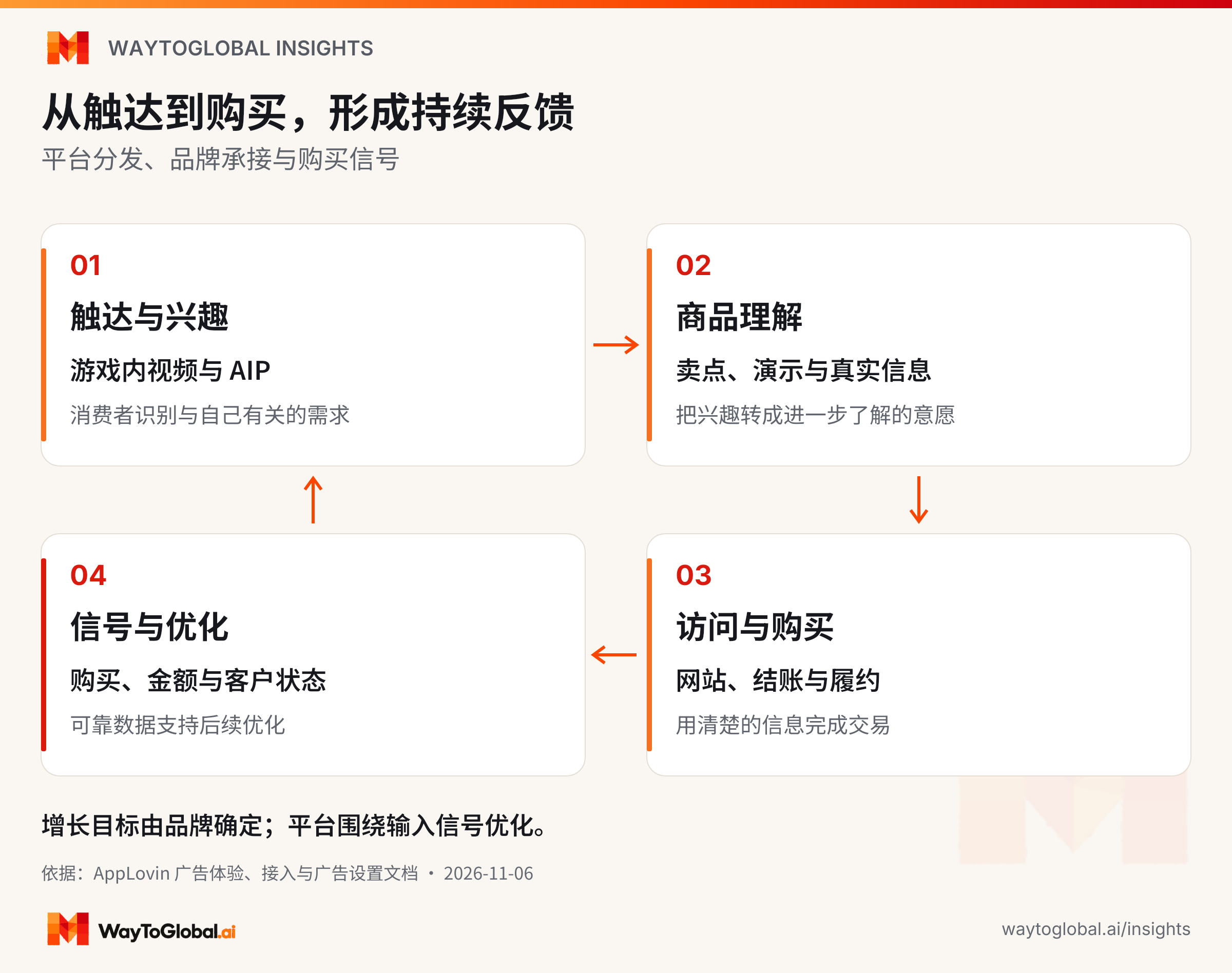
If the consumer is interested, subsequent ad elements can reinforce the product's benefits and lead to the brand's website. There, the consumer checks sizes, pricing, delivery, reviews, and returns information before purchasing. Purchase signals are then sent back to the platform through the chosen integration to support ad optimization.
The journey can be summarized as follows:
Ad exposure → Product understanding → Website visit → Purchase → Data feedback.
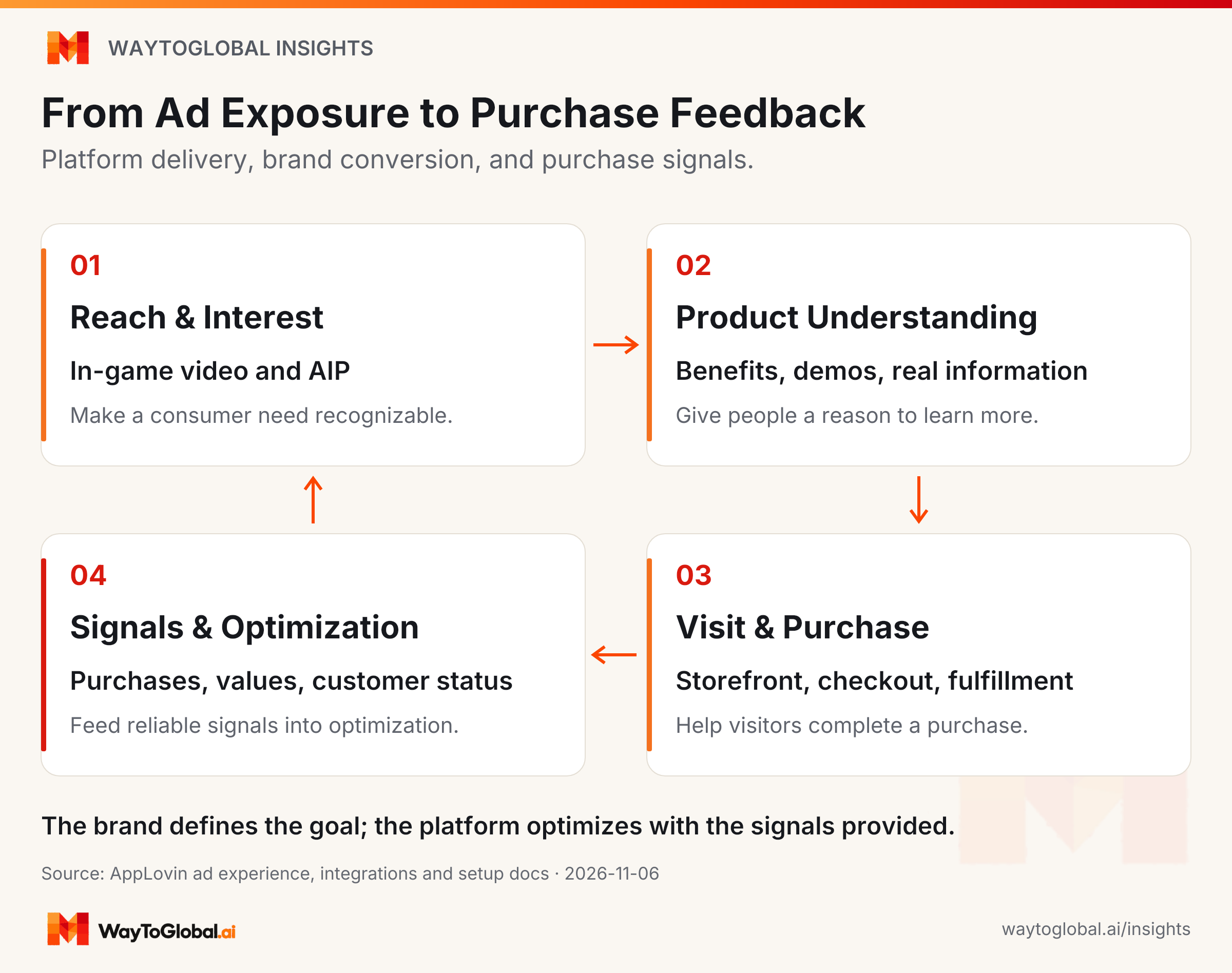
Each step has a different job.
The video's first task is to make the product relevant to the consumer. With an unfamiliar brand, viewers often need to understand quickly why it matters to them. A recognizable situation, a clear problem, and a visible demonstration can all help.
AppLovin's video creative guide recommends attention to the opening seconds, clear captions, and product education. It also suggests combining existing assets into more complete videos. Brands can use the material they already have as a starting point, then refine their message in response to performance. Official video creative guide
The AppLovin Interactive Page, or AIP, follows the video and provides another opportunity to explain the product and encourage action. It can use a static image or HTML interactive content, so brands can begin with a clear product presentation. Creative FAQ
A brand can use this space to focus on a specific purchase reason: a product feature, genuine customer reviews, variant choices, or an offer that is actually available. Keeping the AIP consistent with the video makes it easier for consumers to continue from their initial interest. Interactive creative guide
Brands with broader product ranges can also assess dynamic catalogs to connect subsequent displays with their assortment. Whether to use them, and how to organize them, depends on the catalog integration and campaign setup. The AppLovin ad experience
The website then takes responsibility for converting interest into a transaction.
After seeing a product in use, consumers should be able to find that product and the relevant information quickly on arrival. If the ad emphasizes easy cleaning, cleaning instructions should be easy to find on the landing page. If it features a bundle, the product combination and price should match the page.
The information needed to make a purchase also needs to be in the right places. Dimensions, materials, use cases, delivery times, and the returns arrangements actually offered can all influence whether a new visitor is willing to buy.
The final part of the journey is data.
To optimize for purchases, the system needs to recognize purchases. To account for order value, the brand needs to check that values and currencies are accurate. To prioritize new customers, the system needs the historical signals required to distinguish customer status.
This work turns an advertising entry point into a process a brand can continue to run and improve.
When selecting objectives, brands first need to establish their priorities. For website-based ecommerce, common optimization options include return on ad spend, or ROAS, and cost per purchase, or CPP. ROAS concerns the relationship between revenue and ad spend; CPP focuses on the cost of generating a purchase. Official campaign setup guide
Total purchases, new-customer purchases, and new website visitors can also call for different audience strategies.
| Strategy | Main focus | Question for the brand |
|---|---|---|
| Universal | Overall purchase performance across new and returning customers | Is the immediate priority to grow total sales? |
| Prospecting | People who have not purchased before | At what cost do we want to expand our customer base? |
| Discovery | Purchases from people who have not visited the brand's website | Do we want to expand our reach among new website visitors? |
These distinctions follow the official product descriptions. The completeness of identification depends in part on the historical customer and visit data available. Prospecting introduction, Discovery introduction
For teams getting started on the platform, this table helps establish a shared business objective before launch. Define the growth outcome first, then choose the corresponding settings. Later conversations about performance can then address the same objective.
Lessons from International Brands
When evaluating a growth platform, both the case results and the work behind them deserve attention.
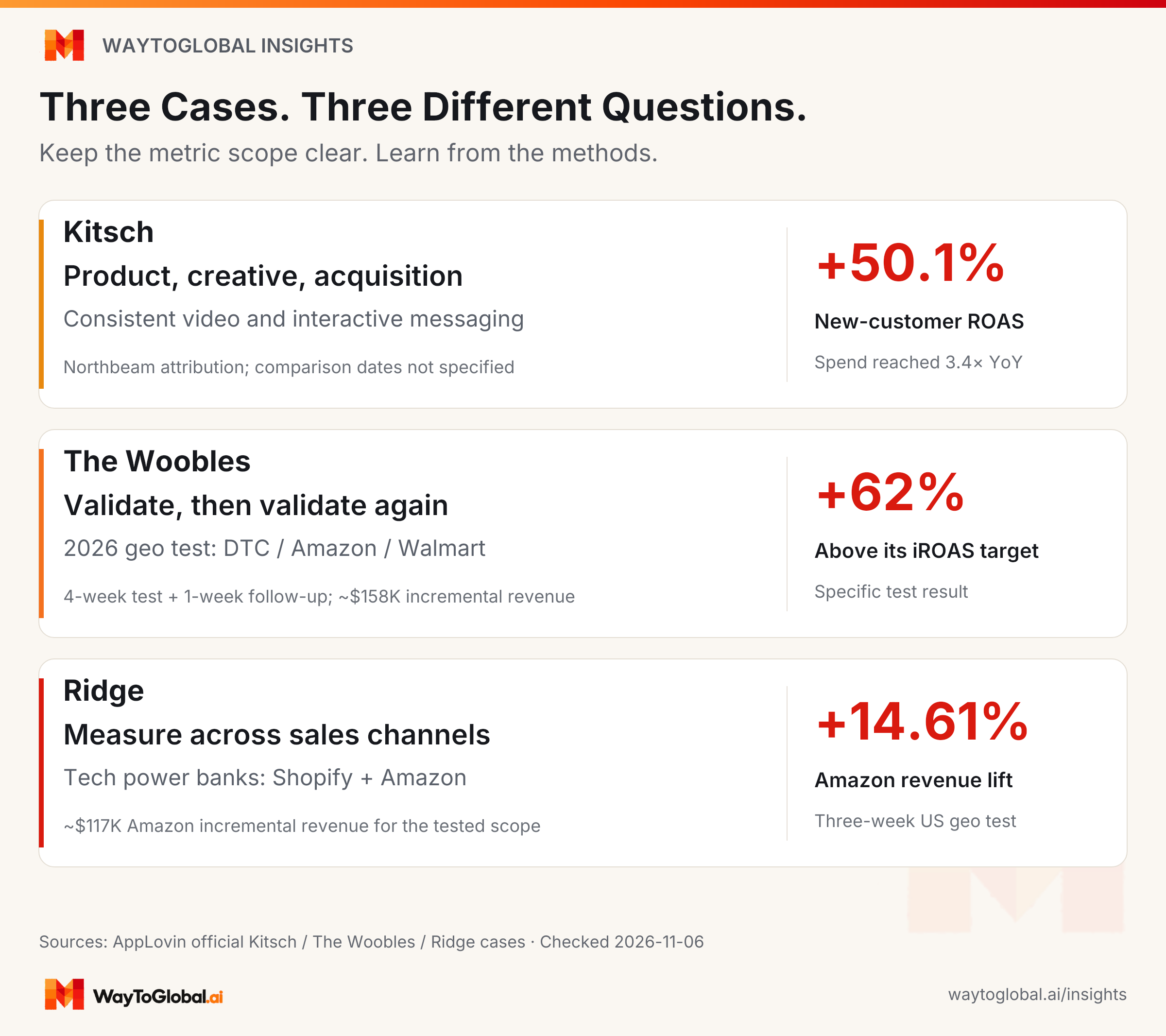
The following three brands illustrate different approaches to matching products with content, validating performance over time, and measuring impact across sales channels. All results come from public case studies and refer to particular products, periods, and measurement methods.
Kitsch: Aligning Products, Content, and New-Customer Objectives.
Kitsch is a beauty and haircare brand. Its official case study describes organizing campaigns around specific products and keeping creator demonstration videos consistent with the interactive experience.
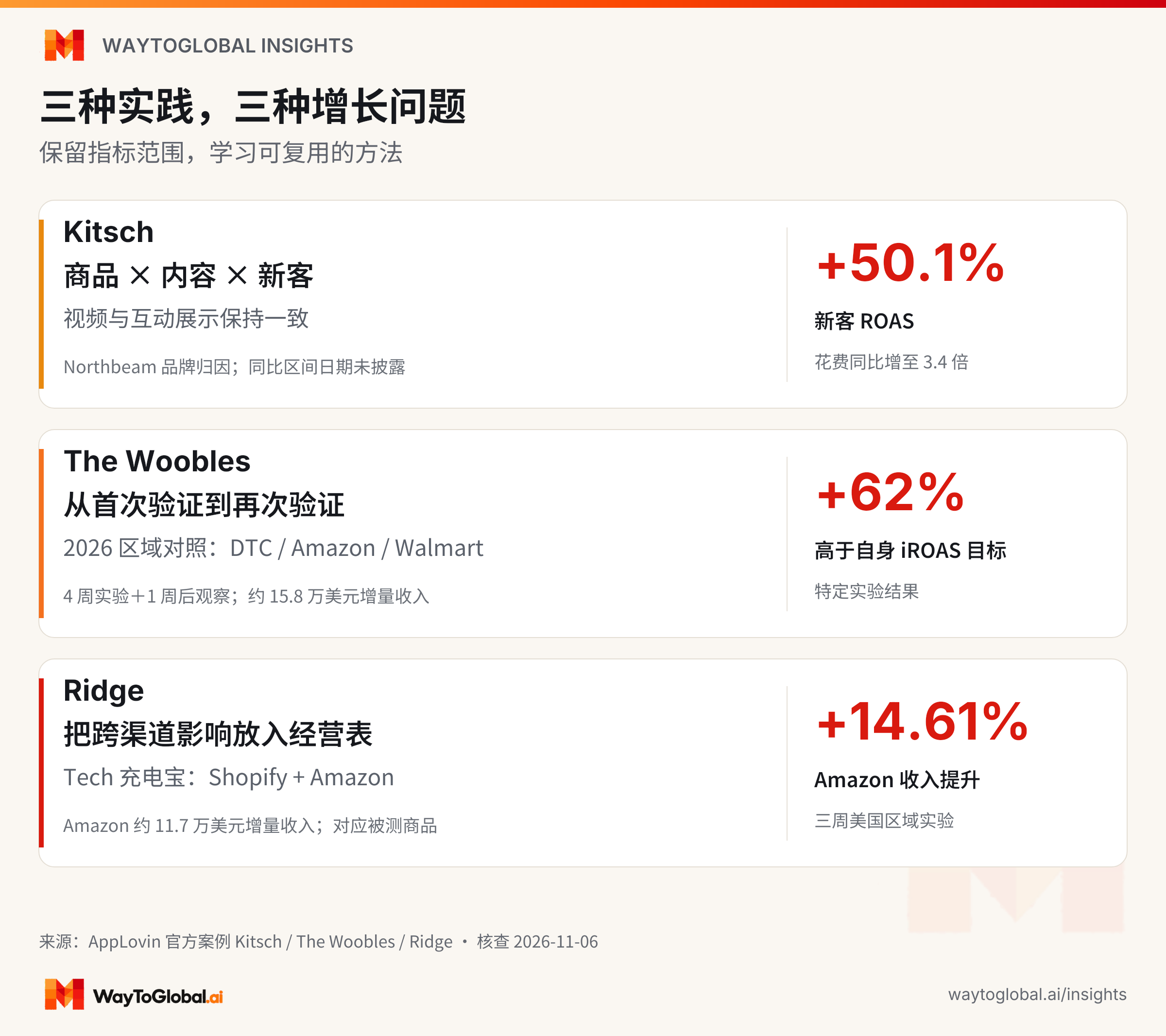
According to Northbeam attribution data cited in the case, Kitsch's AppLovin spend reached 3.4 times its prior-year level while new-customer ROAS improved by 50.1%. These figures describe this brand's results. The page does not specify the dates of the year-over-year comparison. Kitsch's official case study
Kitsch · Official Case-Study Ads
Source: AppLovin official case study. Original visuals and brand marks preserved. Read the original case ↗
Creative observation: the portrait example shows a scalp-oil applicator in use, the interactive sample presents product and usage information, and the catalog broadens product choice. The useful principle is continuity: each format gives the shopper a reason to take the next step.
Other brands can learn from the connections Kitsch made: which product to promote, how the content explains it, which customers the campaign aims to acquire, and which metrics to use to assess the outcome.
That is particularly useful for teams with multiple products. People may buy different products for different reasons. Creative can address specific needs, with data guiding further investment in the messages that work.
Campaign structure still needs to reflect the business's stage. A mature brand's assortment and resources may support more detailed organization. A team running its first test should continue to prioritize clear objectives, concentrated budgets, and results it can understand.
The Woobles: Validating Value, Then Assessing Performance as Investment Grows.
The Woobles sells crochet kits for beginners. Its product lends itself to demonstration: the journey from a pack of materials to a finished piece helps consumers understand what they are buying.
The updated official case study documents another test conducted with Haus in 2026. It ran from May 7 through June 3, followed by a one-week post-treatment observation period, with 20% of regions held out as a control. It measured revenue across DTC, Amazon, and Walmart. The case reports approximately $158,000 in incremental revenue, with incremental return on ad spend (iROAS) 62% above the brand's target for that year. The Woobles' official case study
The Woobles · Official Case-Study Ads
Source: AppLovin official case study. Original visuals and brand marks preserved. Read the original case ↗
Creative observation: the video makes a finished character immediately visible, the interactive sample continues the colorful craft setting, and the catalog offers different characters. For a beginner product, this can help viewers imagine what they want to make before exploring the kit and tutorials.
That 62% is the amount by which performance exceeded the brand's own target. It needs to be understood alongside the product, test period, and measurement scope.
The commercial lesson is that a brand can update the questions it asks as the business develops. Early testing may focus on whether a channel generates purchases worth paying for. Later work can examine efficiency at higher investment levels and the channel's contribution to overall sales.
When a product has a process people can watch, learn, and share, content can explain the product while building interest. Chinese brands in hobbies, crafts, and other process-led categories can take inspiration from that approach, then test it against their own business conditions.
Ridge: Looking at the Brand Website and Other Sales Channels Together.
Ridge's case study focuses on power banks in its Tech category. Working with Haus, the brand ran a three-week US geo-holdout experiment from April 21 to May 11, 2026, measuring Tech revenue across Shopify and Amazon.
The case reports a 14.61% revenue lift on Amazon, representing approximately $117,000 in incremental revenue. Those figures apply to the tested products and the corresponding sales channel; they do not describe the brand's entire business. Ridge's official case study
Ridge · Official Case-Study Ads
Source: AppLovin official case study. Original visuals and brand marks preserved. Read the original case ↗
Creative observation: the portrait video combines a presenter with physical products, the interactive sample explains charging, capacity and power, and the catalog shows variants. The useful principle is to connect technical specifications to visible use, then answer questions about features and choice.
For brands operating both a direct-to-consumer website and marketplace stores, this work illustrates how the place consumers discover a product can differ from the place they eventually buy it.
After learning about a product through advertising, a consumer may visit the brand's website or choose a shopping platform they already know. Understanding that journey helps the brand consider advertising, products, and sales channels within the same commercial plan.
Whether this effect exists for a particular brand, and how large it is, still requires measurement suited to that business. The case provides a question worth investigating and an example of how to build evidence around it.
Across the three cases, several practices recur: a clear reason to buy the product, consistency between creative and the shopping experience, explicitly defined growth objectives, and continued validation as investment increases.
Measurement company Haus also gave a positive assessment of AppLovin's DTC performance in its 2026 analysis. Brands in its sample spent an average of approximately $3 million a month on digital advertising, while the average AppLovin test involved roughly $4,800 in daily spend. Keeping those sample conditions in view helps teams of different sizes decide how to use the findings. Haus analysis
Brands may operate at different scales, but the method is practical: define the question, then use the appropriate data and test to answer it.
Which Chinese Brands Expanding Overseas Should Evaluate This Opportunity First?
The international cases offer several approaches worth studying. For Chinese brands, the next question is more specific: which capabilities they already possess could work well in this advertising environment?
We suggest starting with six considerations. These help assess launch readiness; account onboarding and ad review remain subject to the platform's current requirements.
First, can the product's value be demonstrated clearly?
Products whose value translates well to video often offer a clearer starting point for creative. Fashion accessories can be shown in use and in different outfits. Home products can demonstrate how they change a space. Consumer electronics can demonstrate specific functions. Hobby products can show the journey from getting started to completing a project.
These examples are not a ranking of high-return categories. Even within one category, products can differ substantially in competitiveness, pricing and the website experience that supports conversion. Initial product selection should focus on a specific item, the people it serves and the value it offers them.
Teams with established product development and supply chain capabilities should give this step particular attention. A product's materials, construction, ease of use and details can often provide stronger video content than an abstract brand slogan.
Second, do the margins support customer acquisition?
Average order value is a useful reference, but a brand's affordable advertising cost also depends on product costs, fulfillment, payment fees, refunds and the profit it needs to retain.
Two brands can generate the same $80 order value and have very different advertising economics. A business with lightweight products, low fulfillment costs and manageable returns needs different acquisition targets from one facing higher shipping and after-sales costs.
Brands that want to account for repeat purchases beyond the first order also need verifiable retention and repurchase data. Basing budgets on customer value that has already been observed makes the commercial plan more dependable.
Third, can the website convert people who do not yet know the brand?
An existing customer may know where to find sizing information and be willing to wait for a response from customer service. A new visitor arriving from an ad needs more direct answers.
They need to understand the product, whether its price meets their expectations, whether it can be delivered to their location and what support they will receive after purchasing. Key pages should answer these questions with minimal searching or guesswork.
Before launching, it is worth completing the entire journey on a phone: view the ad, open the landing page, select the product, check delivery information and proceed to checkout. A working journey gives the team a baseline for troubleshooting later.
Fourth, can the team keep developing its creative?
That capability can begin with existing assets. Product demonstrations, real-world use, creator content, packaging details and frequently asked questions can all provide new ways to present the product.
AppLovin's creative guidance encourages brands to keep adding variety. It also notes that the strongest assets on social platforms may not be the strongest performers in this environment. Creative volume and diversity guidance
Brands can include proven creative in the initial selection while leaving room to test other ways of explaining the product. A continuing supply of content helps the team develop experience with the messages that work in this setting.
Fifth, does someone own the purchase data?
Installing tracking is the beginning. Someone also needs to confirm that real purchases reach the system correctly, values and currencies match, purchases are not recorded twice and historical customer signals meet the needs of the selected strategy.
For brands building a long-term DTC business, this work can strengthen their own data foundation. Adding a new advertising platform is an opportunity to check whether information remains consistent across the business.
Sixth, does the test have a budget and an execution plan?
The brand should know what its first test is meant to answer, how much it can invest, who owns creative, the website and data, and when the team will review results.
Brands with existing advertising channels and an order history can often establish reference points more easily. New brands can evaluate the platform too, but need room to explore unknown purchase costs and conversion performance. AppLovin explicitly states that it can support new brands that have not yet validated their offer on other platforms. Official getting-started FAQ
Together, these six considerations describe a more useful prospective advertiser: a brand with clear product value, a website capable of taking orders, the resources to prepare creative and return data, and a willingness to test against genuine business objectives.
The opportunity for Chinese brands can be understood through these practical capabilities.
Teams with established product iteration and responsive supply chains can turn product details into content more quickly. Teams familiar with feedback from overseas customers can turn common questions into creative ideas. Those with a DTC store and reliable fulfillment can provide a consistent purchasing experience for visitors arriving from a new advertising source.
The closer the connection between product, content, data and delivery, the easier it becomes to apply lessons from one test to the next round of improvements.
One part of this work is easy to underestimate: expressing product capabilities as reasons to buy that make sense to local consumers.
Consider a hypothetical storage brand preparing a test. Its product information already lists capacity, materials, folding mechanisms and several sizes. Customer feedback, however, centers on whether the item fits a small space, whether it is easy to move when full and whether it is difficult to clean. The first round of content can address those specific questions through separate demonstrations.
Capacity can be shown through the objects it holds, fit through dimensions in a real room and convenience through the complete handling process. Captions and landing pages can then supply measurements in familiar local units, pricing and delivery information. Product features become an experience consumers can understand and assess.
This remains a hypothetical example. The actual presentation must reflect the product's real performance and genuine customer feedback. The direction is clear, however: a brand that understands why customers hesitate is better placed to create relevant content.
Brands at different stages can also enter a test with different tasks.
A single-product brand with a steady order history can first evaluate whether its established product attracts purchases at an acceptable cost in a new setting. A brand with a wider range can start with a selection that has clear reasons to buy, sufficient creative and reliable inventory, then consider expansion based on the results.
For products that require more explanation or have longer purchase decisions, teams should prepare fuller landing-page information and allow for delayed purchases in their review schedule. For everyday consumables and products with frequent repeat purchases, they should distinguish total purchase goals from new-customer acquisition.
These different tasks call for launch plans built around the specific business. Understanding the product and its customers before configuring a campaign helps brands develop their own approach and provide more useful feedback to the platform.
Market selection should also precede launch. Brands need to verify whether their target regions are currently supported, whether they can ship there and whether their pages and pricing suit local consumers. At the time the sources for this article were checked, the official web campaign guide still stated that Western Europe was not supported. This should be confirmed for each launch plan. Geographic availability guidance
Sellers whose primary sales channels are marketplaces such as Amazon need further discussion of the destination for ad traffic, purchase signals and measurement. Cross-channel case studies offer useful questions to explore; DTC integration instructions must be applied according to each seller's actual setup.
The most valuable assets a brand can bring to a new platform are its understanding of its products and its ability to run the business. Media creates opportunities to reach consumers; the brand turns those opportunities into lasting reasons to buy.
Taking the First Campaign from Preparation to Launch
Once a brand decides to evaluate AppLovin, launch preparation can be organized into seven steps. Each should produce something the team can check, so account creation is followed by a prepared website, creative and data setup.
Step one: define the test.
Choose the primary markets and products, then decide whether the first round should prioritize total purchases, new customers or purchases from people who have not visited the website. Bring together reference purchase costs, available creative and the budget range so the team understands the question it is trying to answer.
A short launch brief can include:
| Item | What to establish before launch |
|---|---|
| Product and markets | Which product to test and where to sell it |
| Reason to buy | Why a consumer would take a closer look and purchase |
| Business objective | Total revenue, cost per purchase or new-customer growth |
| Reference data | Current purchase costs, order values and website conversion performance |
| Resources | Initial creative assets, test budget and owners |
| Review plan | Observation window, measurement definitions and conditions for continuing or adjusting |
This brief should guide account setup, creative preparation and subsequent performance discussions.
Step two: prepare the account and business information.
Follow the current registration process to prepare business, website and payment information. Establish who manages the account, reviews data and handles payments. Where several people are involved, arranging access in advance makes the work easier to coordinate.
For an international business, the account's brand information, promoted website and actual products should be consistent. Before uploading ads, review product descriptions, promotional terms and the services being offered for accuracy. Official ad content requirements
Ad credits, payment arrangements and other promotions are governed by the current terms for the specific account. Budget plans should distinguish confirmed resources from offers that remain unverified.
Step three: complete the integration and validate purchase signals.
The integration route depends on the brand's ecommerce platform. AppLovin provides official integration documentation for Shopify, SHOPLINE and Shoplazza. Other websites can explore approaches such as Google Tag Manager. Shopify, SHOPLINE, Shoplazza, GTM
After installation, follow a purchase through the complete journey. Check whether the real events on the website appear in the relevant management interface, whether product and order information match, and whether duplicate installations have caused a purchase to be recorded twice.
Teams preparing to use new-customer strategies should also check the integration of historical purchase data. The platform needs the relevant signals to recognize existing customers. New-customer strategy integration guidance
The brand's technical team, ecommerce service provider and advertising lead can work together on this. Someone should confirm the results before launch and know who will address any issues that arise later.
Step four: organize creative around ideas that can be tested.
The first batch should offer more than different sizes of the same video. A more useful approach is to give each creative group a specific question to answer: do consumers care about this use case, understand this feature or respond to this presentation?
The same travel product, for example, could be presented through storage capacity, portability, a travel scenario or real use. Existing footage can provide a starting point, supplemented by missing explanations and demonstrations.
The video, AIP and product page should form a continuous experience. When the products, prices and features shown in the ad match the page, consumers can continue their decision with less friction.
The current official setup guide requires creative sets to include video and an interactive or image asset. Check the latest specifications during preparation; complex interactive formats are not a prerequisite for getting started. Creative set setup guidance
Step five: align campaign settings with the business objective.
A brand primarily seeking new customers should reflect that priority in its objective and audience strategy. A brand with a broader product range and substantial variation in order values can assess ROAS-based optimization.
It is also important to distinguish the optimization window from the windows available in reporting. An approach that optimizes for a longer conversion window needs time for those purchases to occur; results from the first day or two alone will not describe the full outcome. Window guidance
Initial campaigns can use a relatively consolidated structure. AppLovin recommends concentrating early budgets and creative in a well-structured campaign, then expanding as data and resources increase. Initial campaign structure guidance
For a new team, answering the main test question before introducing more detailed segmentation makes the results easier to understand.
Step six: work back from the commercial objective to a test budget.
Budget planning can begin with the economics of one order.
Suppose a product generates $80 in revenue after discounts, excluding tax. Product, fulfillment and payment costs, together with an allowance for after-sales costs, total $45. The brand wants to retain $10 in contribution profit on the first order. Under this simplified model, its allowable cost per purchase is approximately $25.
This is a hypothetical calculation to illustrate the method. Each brand should use its own costs, refunds and profit targets. If repeat purchases are included, the plan should also state the time horizon and evidence supporting that assumption.
Budgeting then needs a separate reference point: based on existing channels or an initial test, what is the expected cost per purchase during launch? The allowable cost per purchase is a commercial requirement; the forecast cost helps size the test. They serve different purposes. AppLovin recommends supplying enough purchase signals for learning and suggests a budget capable of supporting roughly ten purchases a day as an initial reference. Official budget FAQ
Now make an independent assumption: the team forecasts a launch CPA of $30. Planning for ten purchases a day gives a daily budget of about $300, or approximately $4,200 in media spend over fourteen days. This forecast is above the earlier $25 commercial target. The difference needs to be accounted for in the test plan, with the review assessing whether optimization can bring performance closer to the target.
These figures form a budget plan. Actual purchase costs and volume must be established through delivery. Creative, service fees and other expenses should be included separately.
The value of this approach is that it links spending to the volume of useful signals the team hopes to obtain. The brand can make a more informed decision about the appropriate test scale and the latest point at which results need to be reviewed.
If the available budget cannot support the expected purchase volume, the team can adjust the test question and pace accordingly. It needs to recognize the limits of the information it can obtain and match the investment to the question being asked.
Step seven: plan launch checks and the first performance review.
After launch, first confirm that ads are serving, the website opens correctly, and payments and purchase signals are working. Performance assessment can then develop as data accumulates.
Keep two types of observations separate: whether the setup is functioning and how the business is performing. Missing tracking events, broken pages and out-of-stock products should be addressed promptly. Judgments about cost and return should reflect the conversion cycle and the sample already available.
Record the reason for each adjustment as well. Does the creative need to explain the product more clearly? Is the product page failing to convert interest? Is the cost per purchase too high, or has the observation window yet to mature? Clear reasons for changes give the next test something to build on.
A well-prepared launch helps the brand and the platform begin optimizing around the real issues sooner.
Once Orders Arrive, How Should a Brand Assess the Quality of Growth?
As the account starts generating purchases, more questions follow: how many buyers are new customers, how much revenue remains after refunds, whether other channels have been affected, and whether the next increase in budget is worthwhile.
These questions require several perspectives.
Start with the platform's view. The advertising system connects ad engagement and purchases according to its rules, helping the brand review performance and supporting model optimization.
Then examine the orders. The merchant needs to verify completed transactions, cancellations and refunds, new and returning customers, and product profitability to understand whether the purchases meet its business requirements.
Finally, consider the wider business. Consumers may see an ad, search for the brand later or buy through another retailer. One tool may not describe that entire journey.
AppLovin's current measurement documentation provides two reporting modes: clicks only, and clicks plus view-through attribution. Switching modes changes reporting only; it does not change ad optimization, targeting or billing. AppLovin also explains that measurement tools can produce different results and recommends combining platform reporting, other measurement approaches and incrementality experiments when assessing impact. Measurement and attribution guidance
When results differ, brands can first align the underlying definitions: are they looking at the same period, region and type of revenue? Do both include returning customers? Are they using the same observation window?
Comparing two ROAS figures before those definitions match can easily produce conflicting conclusions.
We suggest maintaining at least three groups of observations during the initial phase.
The first is campaign performance: spend, purchases, cost per purchase and attributed revenue. These help the team understand how the campaign is running.
The second is customers and profit: new-customer counts, products purchased, average order value, refunds and contribution profit. These help the team understand the commercial value of the orders it has generated.
Cost per purchase and new-customer acquisition cost should be tracked separately. The former is calculated per purchase; the latter is calculated per new customer acquired. An order from a returning customer can generate valuable revenue, but it cannot also be counted as a newly acquired customer. When the primary objective is to expand the customer base, the final assessment needs to use the corresponding new-customer definitions.
The third is wider business change: performance on the website and other sales channels, brand searches and subsequent purchases. These provide clues about effects that merit further investigation.
The three groups complement one another. Brands with sufficient budgets and sample sizes can then use a properly designed controlled experiment to get closer to answering: what would sales have looked like without this advertising spend?
Early-stage teams do not need to reproduce a large brand's complete measurement system at the outset. Establishing consistent order, customer and profit definitions, then improving the ability to validate results as the business grows, is useful in its own right.
Decisions about increasing the budget should also consider the return on the additional investment.
Good performance at a lower spend level is a signal worth investigating. As budgets expand, the audience reached, creative mix and order composition can change. Brands therefore need to keep checking whether additional investment meets their cost and profit requirements.
For mature brands, this develops media management from finding a platform that generates orders into continually assigning growth tasks across different channels. With clearer roles for each channel, budgets are easier to allocate based on evidence.
The case studies above share this approach to continued validation: products and content remain aligned, customer objectives are distinguished, measurement continues as budgets change, and results across sales channels are examined.
This way of working also supports a more productive relationship between the platform and the brand. The platform receives clear business objectives and reliable signals. The brand receives feedback it can understand and act on. Both can move forward around results.
Bringing the Platform Opportunity into Chinese Brands' Growth Plans
Chinese brands expanding overseas can build capabilities across products, content, websites and delivery. Helping those capabilities reach more of the right consumers is a question worth sustained investment.
AppLovin's ecommerce opportunity adds a concrete direction to explore.
Mobile games provide the consumer setting. Ad formats carry the product message. The AI system distributes and optimizes ads around the chosen objective, while the brand converts visitors on its website and fulfills their orders. Connecting these elements gives new advertising reach the opportunity to become customers and revenue.
Teams with the necessary foundations can begin with markets they can serve reliably, a primary product and a clearly defined test. First validate the fit between the product and the setting, then use the evidence to decide how to expand creative, budget and product selection.
For teams that serve brands, expertise also shows up in this practical work: helping clients understand the platform, select suitable products to test, prepare the right data and creative, and give the first campaign a clear execution and review plan.
A media relationship becomes more valuable as the brand continues to acquire customers through it.
Our interest in AppLovin is practical: helping Chinese brands with clear products and growth plans evaluate the opportunity carefully and prepare a sound launch.
Ready to plan your first AppLovin test?
We provide ad account onboarding support and campaign launch guidance. Share your website, product category and primary markets so we can discuss the right preparation and next step.
Sources checked on November 6, 2026. Brand case studies come from the linked public materials, and hypothetical calculations are identified in their respective sections. Regional availability, account requirements, creative specifications and promotional terms remain subject to the platform's latest rules.