AXON opened self-serve to non-gaming advertisers in June 2026, which gave DTC brands one more option: hand budget to an ad machine that bids into trillions of auctions daily and optimizes toward conversion goals on its own. Our earlier guide covered how AXON differs from Meta, whether the timing is right, and where the risks sit. This one covers a different thing — what to prepare before you spend, what order to move in, when to scale, and when to stop.
First, the size of the thing
AppLovin reported $1.84 billion in Q1 2026 revenue, up 59% year over year, with adjusted EBITDA margins of 84-85%. AXON bids into trillions of auctions a day, almost fully automated: you give it an optimization goal and conversion events, it decides who sees what, and there is very little room for manual targeting.
A few figures AppLovin has published for ecommerce: Northbeam-measured figures shared by the company show new-customer ROAS +50.1%, new-visitor share +20.9%, and advertiser spend on the platform up 3.4x year over year; the official blog calls early ecommerce Discovery Campaign alpha results "very strong"; industry tracking attributes a roughly $1 billion ecommerce run-rate to AXON. One thing to keep straight: applovin.com does not yet carry named ecommerce case pages, so all of the above are the company's own published numbers.
That is exactly why this checklist matters. It is not here to make you believe those numbers — it is here to give you a verification path that produces your own numbers to compare against.
Four things that have to be in place first
One: accounts and conversion events. AXON optimizes toward conversion goals; without clean event return there is nothing to learn on. The first job is not opening an account, it is confirming your purchase events return properly — deduplication, timestamps, currency, value. If this is not right, everything after it is waste.
Two: creative. AXON assembles and tests creative combinations on its own, and assets that perform on Meta usually transfer — a genuine advantage. The catch: your creative needs enough variation to explore. Different selling points, different scenes, different openings. Too little variety and the automation degenerates into automated repetition.
Three: budget and learning phase. Start at $50-100 per day, three to five creative groups, and leave the learning phase alone for at least two weeks. That is not timidity — the algorithm needs enough conversion events to converge.
Four: which numbers count. Platform-reported attribution and your own backend will not match; the working assumption is to discount platform numbers by 20-30% before deciding anything. This point is developed in our AXON mechanics guide; here it just needs to be settled upfront — decide which set of numbers you will accept before launch, and don't swap mid-flight.
How the 90 days run
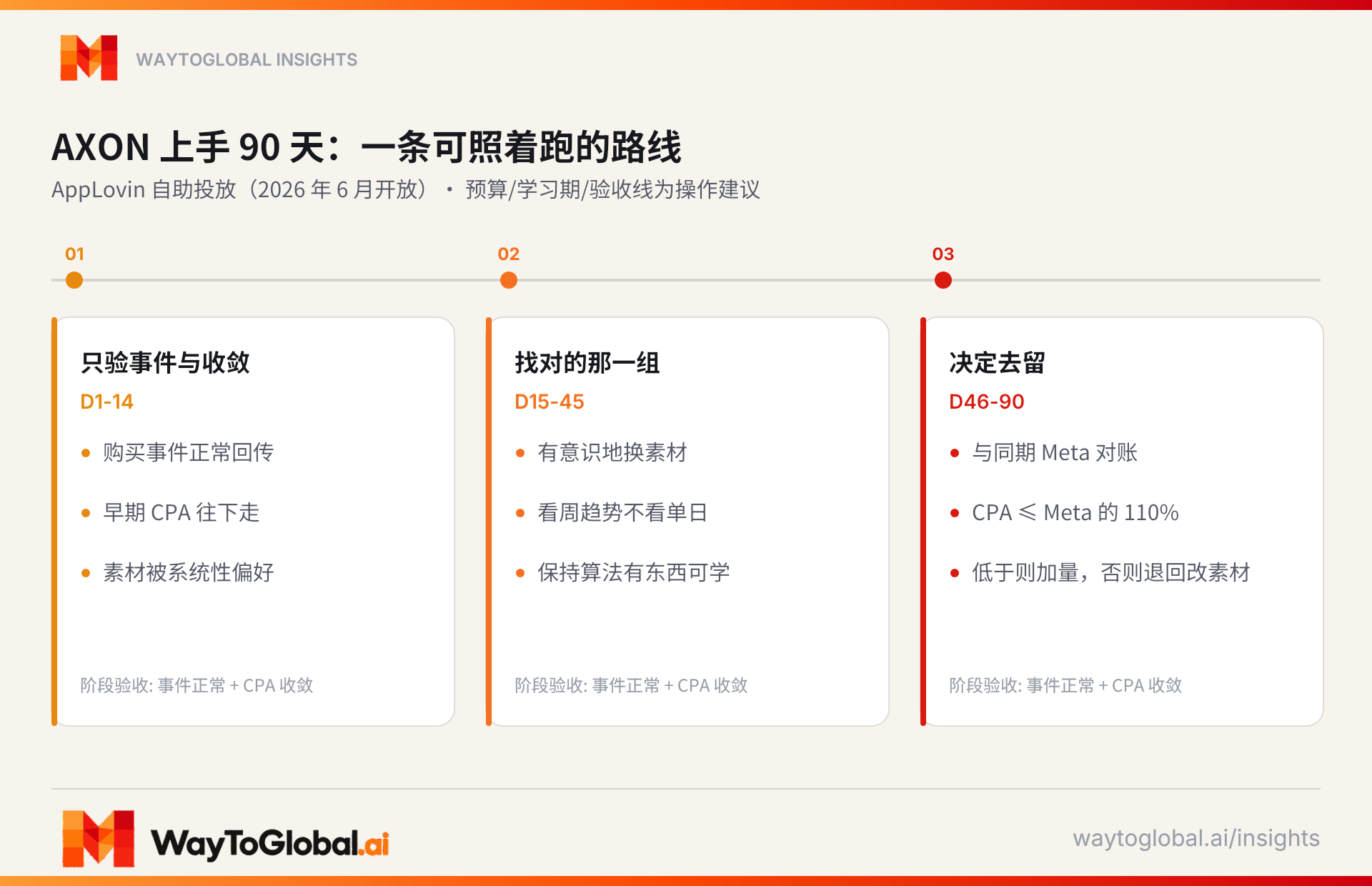
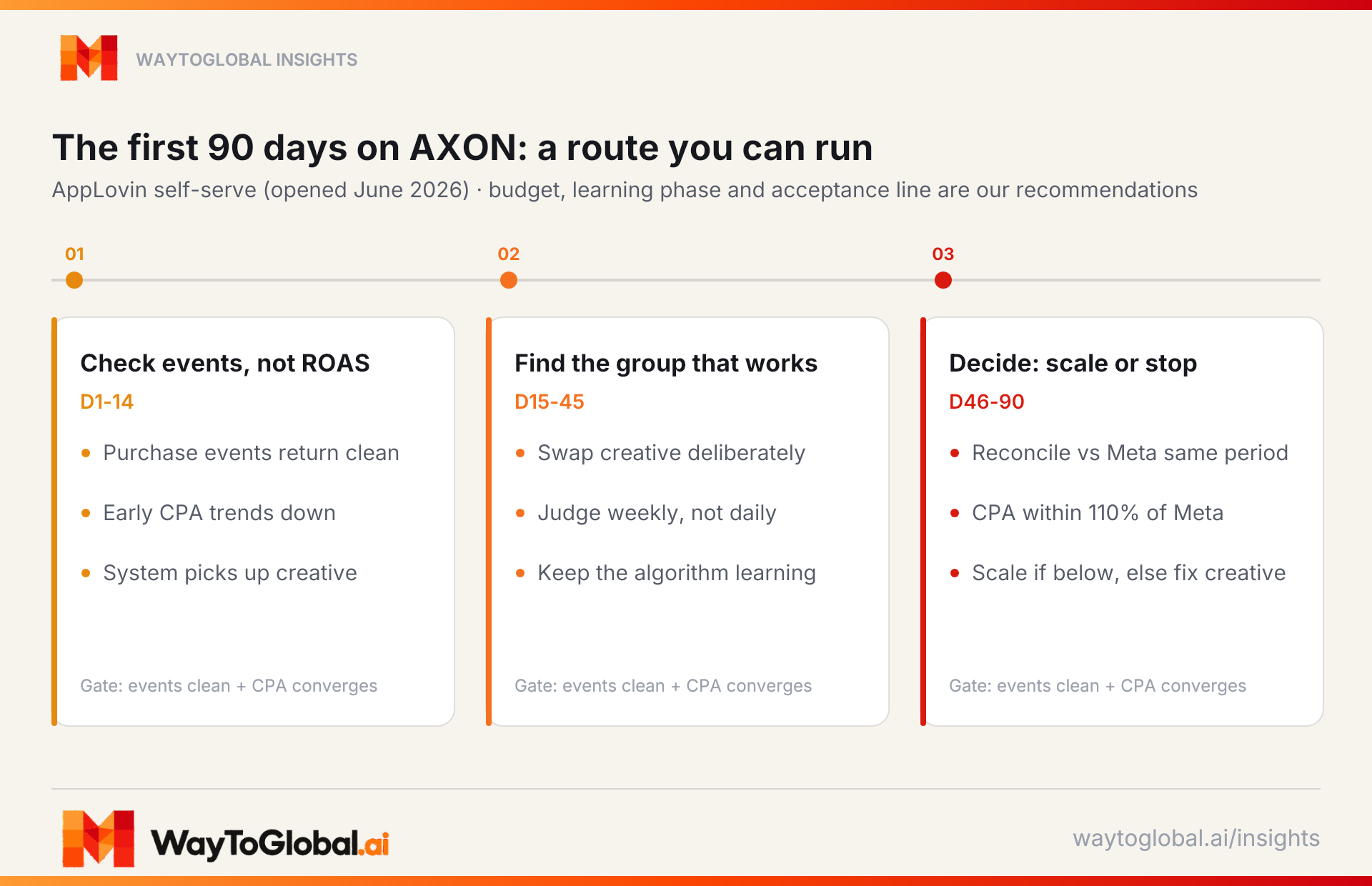
Days 1-14: validate events and convergence only. Open small, run three to five creative groups. Do not look at ROAS in this phase. Look at three things: are purchase events returning normally, is the learning phase converging (early CPA should trend down rather than sideways), and is the system systematically favoring certain groups (if one group is never picked, your creative dimensions are too narrow or something is wrong with events).
Days 15-45: find the group that works. Once the learning phase closes, start replacing creative deliberately — swap the winning group for fresh assets so the algorithm always has something new to learn. From here, judge weekly trends, not single days.
Days 46-90: decide. Reconcile against your own Meta numbers for the same period: is CPA on the new channel within roughly 110% of Meta's CPA over the same window? Below that line, scale gradually. Above it, hold and go back to creative structure and event quality. It is the only acceptance bar worth setting, because a new platform has no history of its own and a horizontal comparison is the most honest ruler you have.
Three ways to waste money
Do not expect fine-grained targeting. Targeting belongs to manual systems; engines like AXON pick the audience themselves. Time spent watching audience packages is time wasted — spend it on breadth of creative instead.
Do not run on broken event return. Learning-phase length scales directly with conversion volume. One broken day of return resets the learning phase.
Do not treat platform numbers as the books. Platform reporting is directional at best. Pretty platform numbers against ugly backend numbers are especially common on new platforms.
When it is the wrong fit
Three cases: when conversion tracking itself is still unreliable (fix the data first); when you have no proven creative to migrate (AXON's automation is built on top of creative — without assets it is just automated cold-starting); and when you need volume in week one (the learning phase runs from two weeks, so if you cannot absorb a slow start, stay out).
Sources: AppLovin official figures (Q1 2026 results: $1.84B revenue, +59% YoY, 84-85% adjusted EBITDA margin; applovin.com blog: Discovery Campaigns and AppLovin Ads opening to advertisers; AppLovin-shared Northbeam measurements: new-customer ROAS +50.1%, new-visitor share +20.9%, advertiser spend 3.4x YoY; industry revenue tracking: ~$1B ecommerce run-rate). Budget levels, learning-phase length and the acceptance line in this piece are our operating recommendations, not official figures. No proprietary campaign data.
Want a second pair of eyes on your AXON launch?
Leave your product category, price point and current channels — we'll come back with a concrete take. And if you want the account opened and the first campaigns run for you, that is exactly what we do.