
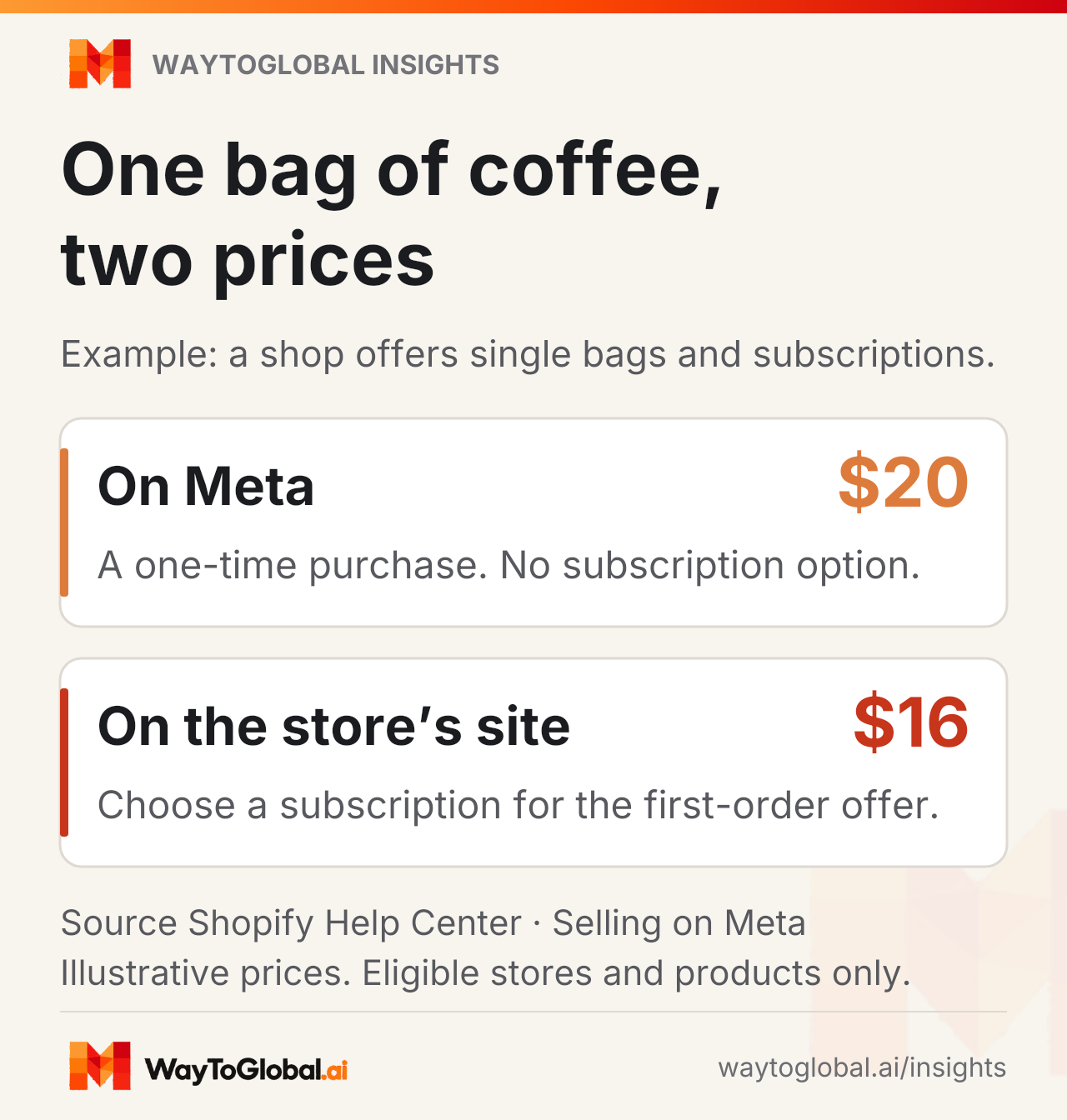
Suppose you run a coffee company. A bag costs $20, or $16 if you subscribe. Your Black Friday ad leads with $16. A customer sees it, sends the product link to Meta’s shopping assistant, Muse, and asks it to order a bag. At checkout, the price is $20. Where did the discount go?
The coffee company is hypothetical. The checkout rule is real. For a Shopify product sold both ways, Meta’s own checkout supports the one-time purchase only. An ordinary discount code can work there. A discount tied to a subscription requires a checkout that lets the shopper start a subscription, such as the merchant’s website. For the roaster, that distinction is the whole point of the promotion. It can afford to take $4 off the first bag because it expects to sell a second.
Most teams already test Friday’s offer on their own phones. Before the campaign goes live, give someone the exact link from the ad and ask them to hand it to a shopping assistant. See how far it gets, which version of the offer it finds and what it would charge. An ad you have already paid for can send a customer down either route.
A store can disappear before the shopper sees a search result
In September, when someone asked Muse to shop on Amazon, the assistant could tell them Amazon had blocked access. In November, e-commerce researcher Juozas Kaziukėnas spotted a quieter change in Muse’s instructions. By default, it would skip Amazon. A GeekWire reporter independently got the same instruction. A shopper who didn’t name a store might get household supplies from Target or Walmart, or electronics from Best Buy, without ever hearing that Amazon had been an option.
It makes sense that Amazon cares where the comparison happens. It earned more than $68 billion in advertising revenue last year. A brand can buy a sponsored spot while the shopper is browsing Amazon’s shelves. That spot is worth less to the brand if the shopper has already settled on an exact model somewhere else. On Amazon’s October earnings call, CEO Andy Jassy said shopping agents were still too small to have much effect on its ad business. He saw a role for Amazon’s own Alexa and for deals with other assistants.
For a smaller retailer, exclusion can happen without anyone making a business decision. In a shopping demonstration described by fraud prevention firm Forter, three beauty retailers’ sites blocked Muse. Forter didn’t identify the stores or say what triggered the blocks. If the assistant never gets far enough to add a product, there’s no abandoned cart for the growth team to recover.
How much business is there already?
On October 21, Meta said more than 10 million people in the US and Canada had set up Muse in its first six weeks. Meta counted everyone who set it up, whether or not they used it to shop. Mark Zuckerberg put the average purchase at over $200, including travel, and said Meta had worked with Stripe in the first week to raise credit limits.
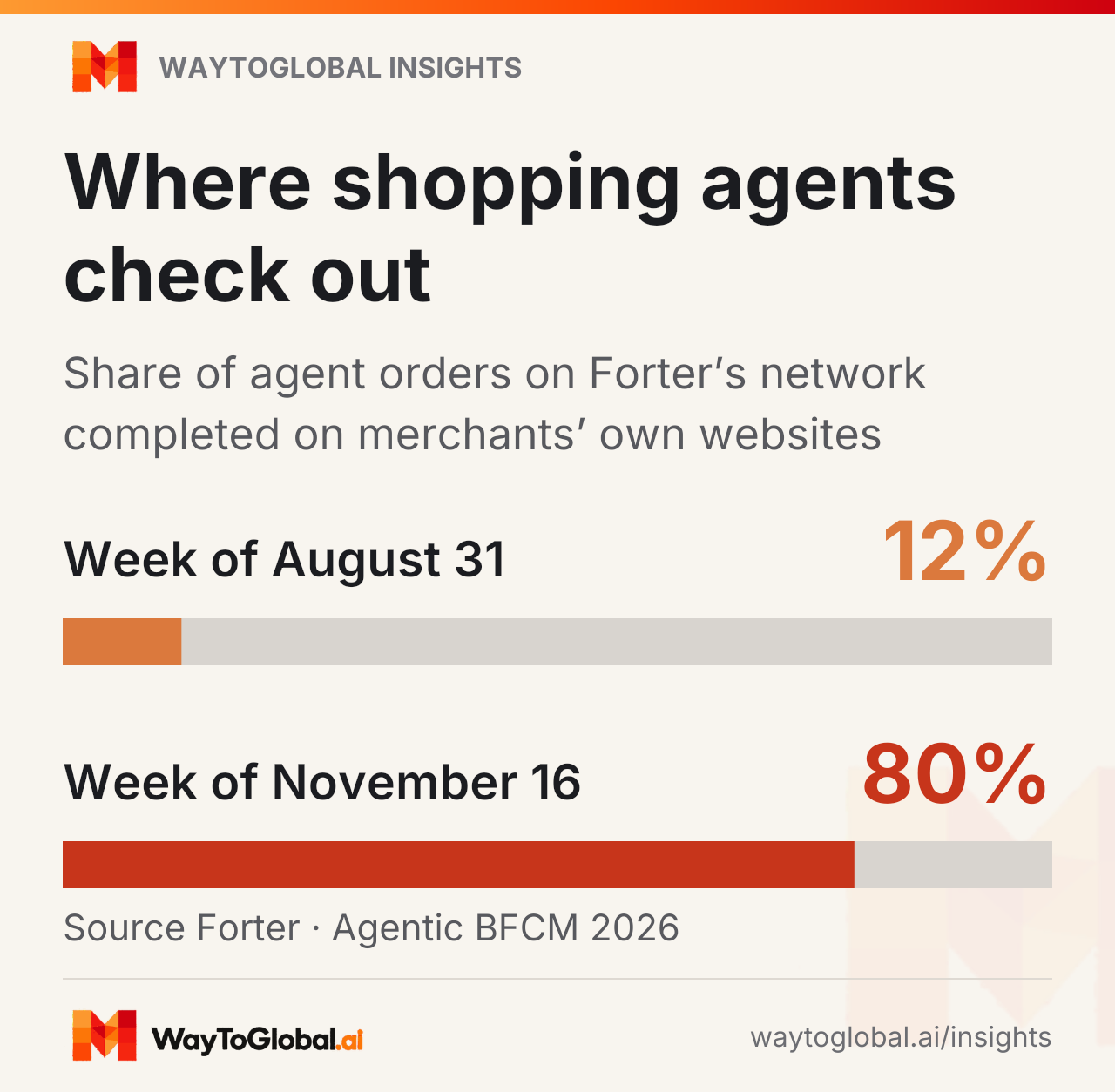
The numbers look different from the merchant’s side. On November 18, Forter put agent purchases at roughly one in every 10,000 orders on its network. Yet 60% of its merchants had received at least one in the previous 30 days. And the path to those orders had changed. In the week of August 31, 12% of the agent orders Forter identified went through a store’s own web pages. By the week of November 16, that share was 80%. Those percentages describe completed agent orders on Forter’s network. They can’t tell you how many attempts were lost along the way. Over November 17–23, Muse accounted for half of the agent orders Forter identified.
That’s a reasonable case for a preflight check, even at a store where a new channel would struggle to justify its own budget. The product page, the offer and the ad spend are already yours.
Check the link in your ad (Chinese-language checker)
What goes on a product page when the customer shops by asking a question?
Nikhiel Genomal, co-founder of clothing brand Cottonique, gave Shopify a good example. Someone with eczema might never think to search for a “hypoallergenic bra.” She can tell an assistant exactly what goes wrong when she wears one, though. Look at the product page for Cottonique’s black drawstring bra. The drawstring is organic cotton. The adjustment rings are plastic. Even the thread gets an explanation. It has a polyester core wrapped in cotton. A customer review adds something the materials list can’t tell you. Tuck in the drawstring or it can show under a fitted top.
Shopify says Cottonique’s sales from AI referrals rose 276% year over year, while its overall sales grew 52%. The starting figures weren’t disclosed. The part a merchant can copy this week is the page itself. Ask the support team what people want to know before they commit to the product in Friday’s ad. If a buyer asks which material touches her skin, “soft and comfortable” gives her assistant very little to compare.
At Wayfair, shoppers often begin one step earlier. The most common request to its Wayfair-branded assistant in ChatGPT was help putting an entire room together. The shopper can return to Wayfair to buy, with saved designs, rewards and orders in one account. Wayfair has separately made its catalog available in Muse. On its November 4 earnings call, the company said visits from AI referrals had more than doubled quarter over quarter to about 1% of traffic. A shopper can get the idea for a room in a chat and place the order herself. That sale illustrates why counting only purchases an agent completes misses part of the business.
Take the offer all the way to checkout
For eligible Shopify merchants, the choice of checkout is yours. Under Sales channels → Agentic, the settings for product discovery and direct checkout are separate. You can make products available to Muse and have the customer come back to your site to pay. For orders placed in Muse with Shop Pay, the customer approves the payment. Your team still handles fulfillment, returns and support. If the offer relies on a subscription or a gift set built with Shopify Bundles, check which checkout can actually sell it.
Can A2A shopping agents tell if the robe comes with the perfume?
A buyer’s agent can ask a retailer’s agent what’s in stock, what it costs to ship and whether the advertised gift comes with it. The two can exchange those questions over Agent2Agent (A2A). Food distributor Gordon Food Service and its supplier Tyson Foods have piloted A2A across their companies for product searches and sales tracking.
Consider this year’s Black Friday offer from Ulta Beauty. Rewards members who spend $75 on qualifying fragrances can choose a robe or a throw while supplies last. Ulta also sells eligible products directly inside Gemini and Google’s AI Mode. A shopper can buy the perfume there, but the gift offer explicitly excludes both checkouts. Ulta still ships the order. The difference is what goes in the box.
Google’s public coffee-maker demo shows how a buyer’s agent could ask a merchant directly about an offer. It sends the request to the seller’s agent, which returns digitally signed carts for the shopper to choose from. The shopper picks one, selects a card and authorizes payment. A mock verification code completes the demo. A2A carries the conversation between the two agents. AP2 supplies a record of the offer and the purchase the shopper approved.
Ulta names UCP as the commerce protocol behind its Google checkout. UCP lets retailers exchange cart details, totals and order confirmations, with A2A as one way to send them. Ulta hasn’t specified which connection it uses. For anyone running a gift-with-purchase ad this week, the question for the commerce team is simpler. When an agent asks what $75 buys, can your store tell it where the customer will actually get the robe?
Two requests to try before Friday
Try two requests with someone who can use Muse. First, give it a budget, a use for the product and a delivery deadline. Leave out the brand name. See which products make the shortlist and what it says about them. Then paste in the exact link from Friday’s ad. Give it the variant, delivery ZIP code and offer, and ask it to stop before payment. The first run shows who you’re competing with. The second gives you a price and a checkout your team can compare with what the ad promised.
If the second run stalls, the point where it stops tells you who can help.
- The product page never opens. Save the URL, time and response. The person who manages your storefront can look for a matching event in the site’s security logs. In Cloudflare, start with Security Events.
- A returning customer gets challenged at sign-in. In Verisoul’s tests, Muse used a cloud-hosted desktop Chrome browser to act on the customer’s behalf. The account can be familiar while the device looks new. Searching the logs for the word “Muse” can miss the visit entirely.
- Payment fails, or an order is canceled. If no order was created, look for payment events in the abandoned checkout. If you have an order number, open its risk assessment and check any Shopify Flow runs that could have canceled it. Forter saw similar bank approval rates for human and agent transactions once they reached the bank. A challenge that stops a shopper on the product page never enters that comparison.
When you reconcile the weekend’s sales, Shopify records orders placed directly in Muse under “Meta AI and Muse.” Analytics on your own site won’t see a payment completed inside Meta. That’s one place to look if the sales report and the website dashboard tell different stories on Monday.
If you have ten minutes before Friday, start with the product URL getting the biggest share of your ad budget. WayToGlobal’s checker requests the public page, reads the crawler access rules the store publishes and looks for product information in the page code. You can see the basic result without signing in. Verify your email for a report with suggested fixes. Sign-in, delivery and checkout still need a separate test with the assistant your customers use.

Check my Black Friday product page (Chinese-language checker)
Sources
- Shopify’s guide to selling through Meta AI and Muse
- Kaziukėnas’s comparison
- GeekWire’s reporting
- Forter’s account of the demonstration
- Meta’s third-quarter earnings call
- Forter’s weekly tracker
- Shopify’s interview with Genomal
- Cottonique’s product page and reviews
- Wayfair’s third-quarter earnings call, page 5
- Shopify on Muse and Shop Pay
- Google Cloud’s account of the supplier pilot
- Ulta’s Black Friday offer terms
- Ulta’s native checkout terms
- Google’s A2A shopping demo
- Ulta’s rollout announcement
- UCP’s A2A checkout specification
- Cloudflare’s guide to Security Events
- Verisoul’s observations
- Shopify payment troubleshooting
- Shopify order risk and automation
- Shopify on orders and attribution